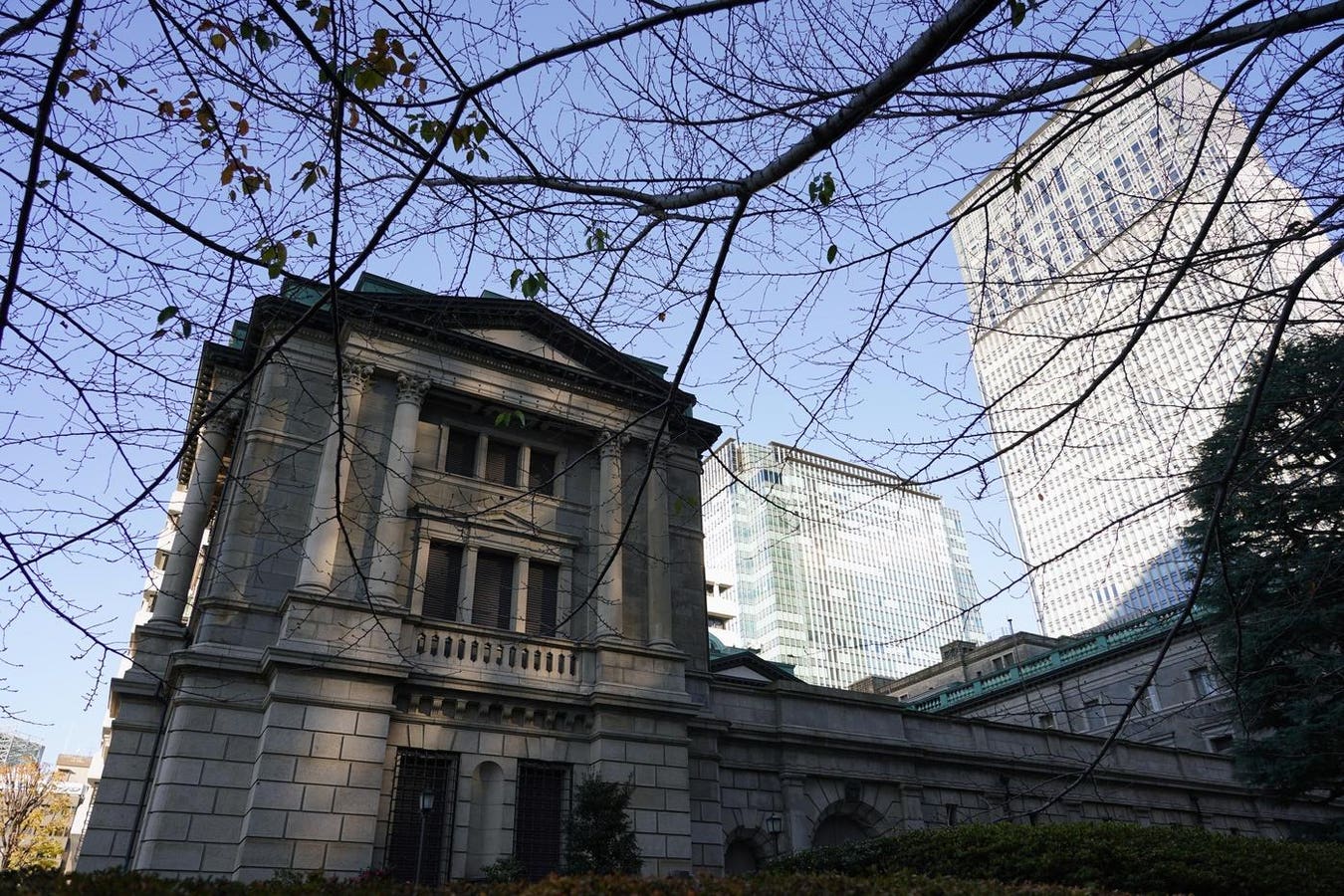
The Bank of Japan (BOJ) headquarters in Tokyo, Japan.
Toru Hanai/Bloomberg
As Jerome Powell faces noisy efforts to end the Federal Reserve’s independence in Washington, the silence from Tokyo is deafening.
In recent weeks, U.S. President Donald Trump’s White House has escalated its attempts to remove and bully Fed Chair Powell. Efforts include threatening indictments over, ostensibly, a renovation project at Fed quarters.
Wisely, Powell called the bluff, dismissing the Justice Department’s focus on a construction project a “pretext” for Trump in his push to control the Fed.
“The threat of criminal charges,” Powell said, “is a consequence of the Federal Reserve setting interest rates based on our best assessment of what will serve the public, rather than following the preferences of the president.”
The drama drew support from abroad. The heads of the European Central Bank, Bank of England, Bank of Canada, Bank of Korea and other monetary authorities rushed to Powell’s defense. In a joint statement, top central bankers, including ECB President Christine Lagarde, said “we stand in full solidarity with” Powell and that the “independence of central banks is a cornerstone of price, financial and economic stability in the interest of the citizens that we serve.”
Former Bank of England official Jonathan Haskel told the New York Times that “it’s in nobody’s interests for there to be worries and instability in the U.S. Other countries hold lots of American assets. Savers in Europe will implicitly be invested in the American stock market. America is in many ways a flagship engine, with the AI revolution going on. Nobody in the world wants to see that at risk.”
But it is at risk, and the threat is unfolding in real time. All of which makes it so disappointing to see the Bank of Japan sitting this one out. As the globe’s most powerful central bank faces an unprecedented assault, we’ve heard crickets from BOJ Governor Kazuo Ueda’s team.
The BOJ claims that wading into a global controversy like Trump versus Powell would be out of character. In the Tokyo context, it’s believed that silence on such matters actually helps to protect the BOJ from political meddling. In theory, perhaps, but what’s afoot in the U.S. is an existential threat to the central banks’ ability to conduct monetary policy properly and responsibly.
“This logic is flawed,” Kumiharu Shigehara, a former chief BOJ economist, wrote in a Japan Times op-ed. “Central bank independence doesn’t mean freedom from explanation. It means delegated discretion — the authority to make policy decisions insulated from day-to-day political pressure. That delegation is sustainable only if the institution explains how it uses its discretion, what assumptions underpin its decisions and where uncertainty lies.”
There are two reasons we need to hear from the BOJ right now. One, because it’s an already arguably less independent than the Fed. Officially, the BOJ became independent in April 1998. But a year later, it cut rates to zero, where they’ve largely stayed since then.
In December, when Team Ueda raised rates to a 30-year high, it was only to 0.75. Not truly independent monetary authorities would slash rates to, or near zero, perpetually. Or implement quantitative easing in perpetuity. Yet this is where Ueda’s BOJ finds itself as newish Prime Minister Sanae Takaichi angles to re-open the stimulus floodgates to juice the economy.
Two, Japan is by far the biggest holder of U.S. Treasury securities, owning around $1.2 trillion. Tokyo should make it clear to Trump that it expects his White House to protect that vast amount of Japanese state assets.
Thanks to this backdrop, Friday’s BOJ meeting was the least suspenseful in ages. Team Ueda stood pat, in part, because it has zero latitude to continue normalizing rates — not with Takaichi making it clear Tokyo is hitting the policy accelerator. And not with Trump’s tariffs hurting both U.S. and Japanese growth prospects.
All this is raising real questions about whether the BOJ can preserve its rate hikes to date. Or, be forced to retreat and lower them.
Takaichi’s Liberal Democratic Party has a long track record of having its way with the central bank. Her mentor, 2012-2020 Prime Minister Shinzo Abe, cajoled the BOJ into cornering the government bond market and becoming the biggest owner of Tokyo stocks. By 2018, the BOJ’s balance sheet eclipsed Japan’s $4.2 trillion economy. That was a first for a Group of Seven economy.
Given these risks, now is not the time for the BOJ to pretend it doesn’t see the Fed struggling to avoid becoming the People’s Bank of China. If Team Ueda thinks U.S. guardrails will save the Fed, then it’s time to think again. And to speak up.