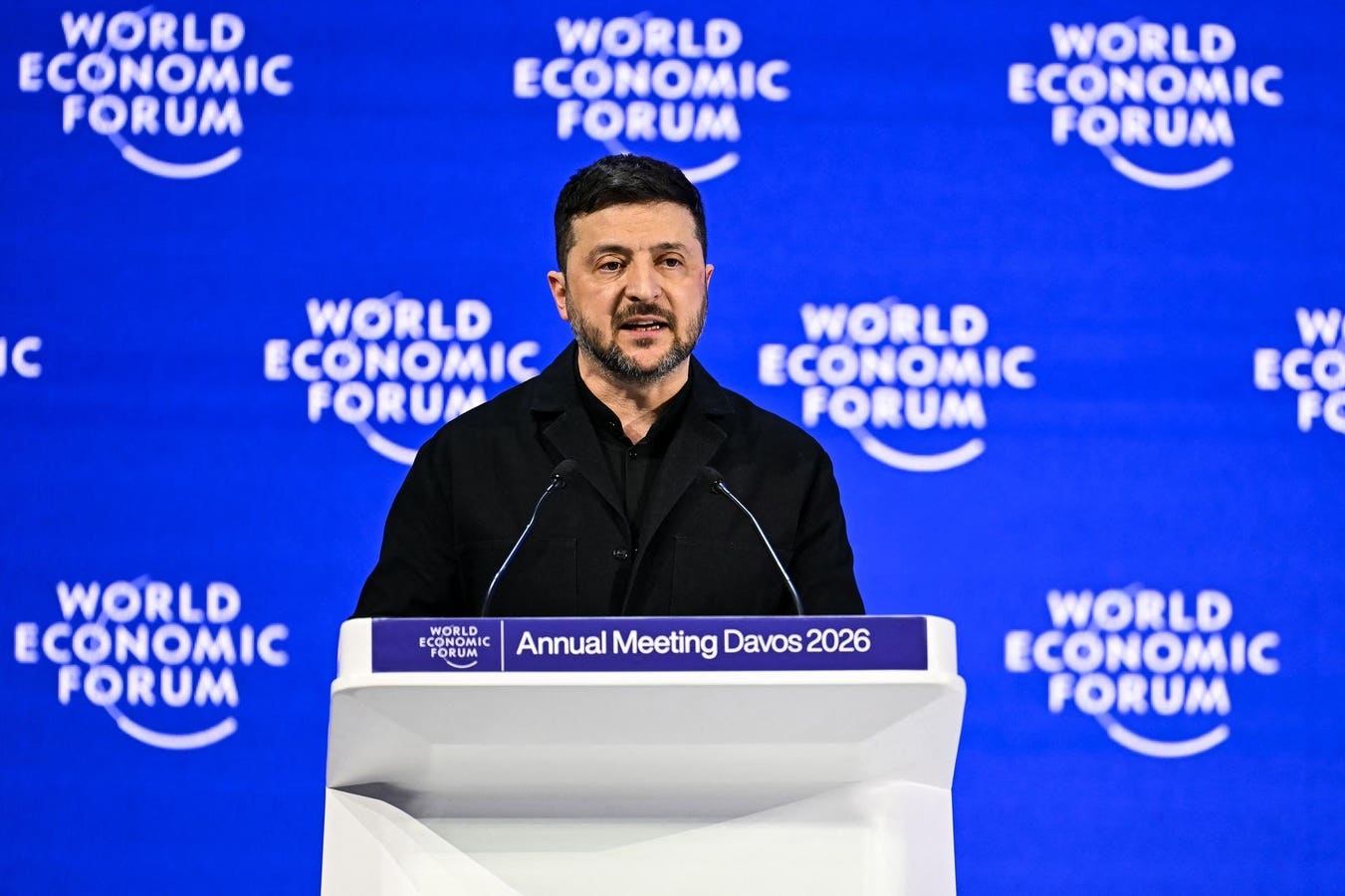
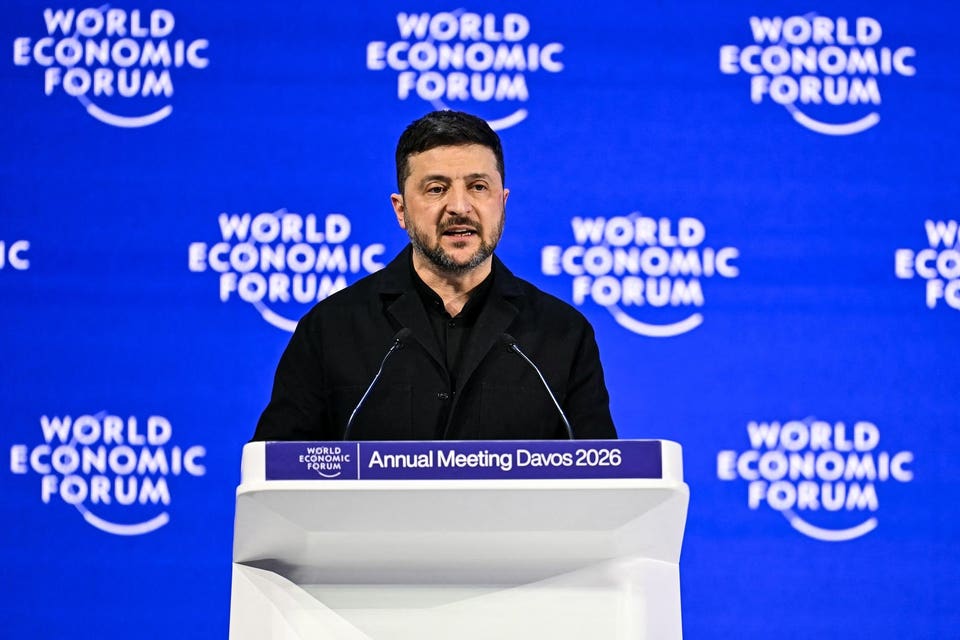
Ukraine’s President Volodymyr Zelensky speaks during the World Economic Forum (WEF) annual meeting in Davos on January 22, 2026. (Photo by Fabrice COFFRINI / AFP via Getty Images)
AFP via Getty Images
Dispatches from Ukraine. Day 1,430
Zelenskyy Rebukes Europe At Davos
January 23, the final day of the World Economic Forum in Davos, Switzerland, brought Ukraine neither breakthroughs nor fresh commitments from allies, only bold statements. The most important moment for Kyiv was a meeting between U.S. President Donald Trump and Ukrainian President Volodymyr Zelenskyy. Both leaders described the hour-long meeting as “constructive.” Afterwards, Trump emphasized that the war must stop; meanwhile, Zelenskyy, whose arrival in Davos remained in doubt until the last moment due to the acute energy crisis in Kyiv — caused by Russia’s bombing the energy and heating infructrtucture on the coldest week of the winter — used the meeting to underline Ukraine’s need for air-defense missiles to shield its battered energy system.
The talks generated no agreements on postwar economic recovery or security arrangements that had been under discussion in recent weeks, as they were clouded by Trump’s aggressive rhetoric about Greenland. Meanwhile, media outlets had expected Ukraine and the U.S. to sign a plan worth possibly billions of dollars, but the agreement was put on hold.
Zelenskyy later delivered a pointed speech in Davos, aimed at Europe. In blunt language, he warned that Europe’s internal divisions were a strategic weakness, accusing European allies of failing to “take the lead in defending freedom.” He called Europe a “fragmented kaleidoscope of small and middle powers” that seemed “lost” as it tried to induce Trump to force Russia to end the war. “Instead of taking the lead in defending freedom worldwide, especially when America’s focus shifts elsewhere, Europe looks lost,” Zelenskyy said.
After his speech, Zelenskyy presented estimates of Russian military losses. According to cited figures, Russian monthly casualties have doubled over the past year, to about 36,000. Zelenskyy attributed the increase in casualties to the effectiveness of Ukrainian drones, a priority of Ukraine’s new defense minister, Mykhailo Fedorov. Russia’s cumulative losses, he claimed, now surpass 1.2 million personnel, roughly a fifth of which have occurred since last June. The Kremlin, however, effectively absorbs these losses through monthly conscription of 40,000-43,000 troops.
Zelenskyy also announced a trilateral meeting involving Ukraine, the U.S., and Russia, the first such meeting in years, to be held in the United Arab Emirates on January 23. Meanwhile, U.S. envoy Steve Witkoff has arrived in Moscow to meet Russian President Vladimir Putin.
Ukraine In Davos
The annual Ukrainian Breakfast in Davos, hosted by the Victor Pinchuk Foundation, centered this year on Ukraine’s EU integration and reconstruction. The January 22 discussion brought together European leaders, NATO Secretary General Mark Rutte, former Google CEO Eric Schmidt, and BlackRock CEO Larry Fink.
A special guest at the Ukrainian Breakfast was Steve Witkoff, US Special Envoy to the Middle East, and the US negotiator on the Ukraine peace process. He shared updates on the progress in peace negotiations: “I think that we have made a lot of progress,” he said, “We spent the whole dinner last night talking about the upward trajectory for the Ukrainian economy and financial system… The President (Trump) talked about a tariff-free zone for Ukraine, that I think will be game-changing, and you’ll see the industry moving into that area,” he added that he’s headed to Moscow later that day to continue the negotiations with Putin and his government.
Steve Witkoff, US Special Envoy to the Middle East, and the US negotiator on the Ukraine peace process at the Ukrainian Breakfast Discussion, an annual private event organized during the World Economic Forum (WEF) by the Victor Pinchuk Foundation and East One.
Nicolas Lobet PRYZM
A recurring theme was how to push Russia toward a peace settlement on terms acceptable to Kyiv. Finnish President Alexander Stubb said Europe and the U.S. might soon converge on a peace plan for Ukraine. In his opinion, however, it was questionable whether Moscow would accept such a plan, and the war would end only if accompanied by further military support for Ukraine.
The debate over using frozen Russian assets to finance Ukraine’s postwar reconstruction, estimated to cost roughly $524 billion, exposed divisions among European countries. Belgian Prime Minister Bart De Wever, a skeptic of direct confiscation and fearful of legal action from the Kremlin, reiterated that any such disposition must comply with international law. Still, he acknowledged that Russian assets should play a role in rebuilding Ukraine once a peace settlement is reached.
Regarding Ukraine’s European track, Ukrainian Deputy Prime Minister Taras Kachka expressed the opinion that Kyiv would be fully integrated into the EU energy market by 2027, even without formal membership. EU Commissioner Marta Kos supported that assessment, noting that Ukraine has completed most of the reforms required for accession. Nonetheless, Dutch Prime Minister Dick Schoof said Ukraine’s path to the EU would take several years.
Speakers also highlighted Ukraine’s role in defense innovation, particularly in drone warfare. Even with generous reconstruction funds, however, Ukraine’s success is not guaranteed. Referring to what he described as well-designed reforms, Larry Fink said that “Ukraine’s future will depend on whether it can establish strong governance … and integrate itself more deeply into the European and global capital markets.”
A January 21 panel, “The Role of the United States in the World,” examined Europe’s security amid shifting U.S. priorities. Former U.S. special envoy for Ukraine Keith Kellogg shared optimism for future negotiations but warned against trading Ukrainian territory for a ceasefire. He argued time favors Ukraine if it can withstand winter, and that Europe, with U.S. support, could deter Moscow.
Russian Attacks
Russia launched a sweeping attack overnight on January 20. Although Ukraine’s Air Force reported intercepting 27 missiles and 315 drones out of 342 projectiles, the mega-strike, which targeted Ukraine’s energy infrastructure, left half of Kyiv without electricity amid bitter cold. Zelenskyy said the attack employed “updated tactics” and included missiles produced this year. The strikes came just days after Ukraine received a new batch of air-defense missiles, which, Zelenskyy said, limited the damage.
In addition, Ukrainian officials reported at least 14 civilians killed and nearly 80 more wounded in Russian strikes in the previous three days in the Kherson, Kharkiv, Zaporizhzhia, Sumy, Donetsk, and Dnipropetrovsk regions.
By Danylo Nosov, Alan Sacks