
Earlier this month the owners of the Pittsburgh Post-Gazette announced they would end publication of the newspaper in May. The announcement followed a protracted labor struggle at the paper that culminated in a recent loss for management at the Supreme Court. What does this mean for the future of environmental reporting in Western Pennsylvania?
The Allegheny Front’s Reid Frazier spoke with two recently retired Post-Gazette reporters who covered the environment for the paper: Don Hopey and David Templeton.
Templeton and Hopey worked on a large investigation called Mapping Mortality, which found higher numbers of death for certain diseases in Southwest Pennsylvania than national rates would predict. They also wrote about a large number of rare cancers in Southwest Pennsylvania, which led to a state investigation into fracking’s public health impact.
Templeton retired in 2020. Hopey retired in 2022.
LISTEN to their conversation
https://www.alleghenyfront.org/wp-content/uploads/2026/01/AF012326_RF_PGenvironment.mp3
REID FRAZIER: I want to go to each of you and ask your reaction to the paper ceasing publication. Dave, we’ll start with you.
DAVID TEMPLETON: I wasn’t surprised. I was kind of expecting that upon my retirement in 2020. [There were] some rumors that they might shut down at that point, but they did persist. I retired just at the point where things started to get really bad with the contract. So I took a buyout and got out of there.
REID FRAZIER: Did you have an emotional reaction?
DAVID TEMPLETON: I was not upset. I felt bad for my fellow reporters who had been there. I was concerned about what the legacy of the Post-Gazette would be and the lack of investigative tools that are necessary for a community as big as Pittsburgh.
REID FRAZIER: Don, what was your reaction?
DON HOPEY: I also wasn’t surprised. The company followed through on the threat that they had publicly made to pull the plug if it lost the court cases. I think it’s a tragedy for the region in terms of coverage, even though it hasn’t really been doing a whole lot of environmental coverage recently.
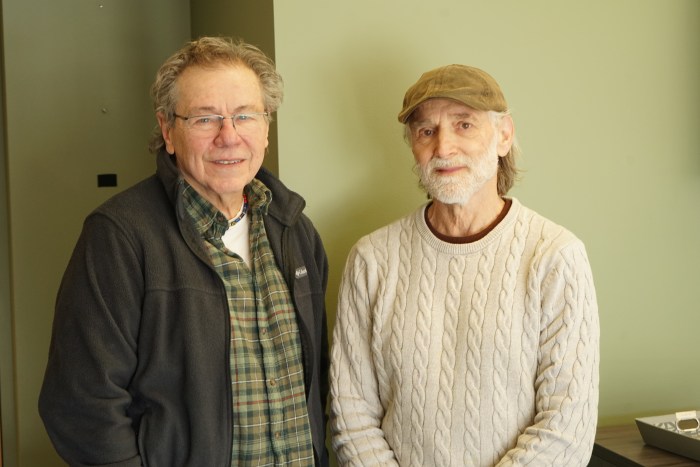 Don Hopey, left, and David Templeton, right, covered environmental news for the Pittsburgh Post-Gazette. Photo: Reid Frazier / The Allegheny Front
REID FRAZIER: So did you guys detect or did you notice how the environmental journalism beat changed over the years? Were there any significant evolutions, did things get better, or worse?
DON HOPEY: There was a time when most of what I was writing was about longwall mining in Washington and Greene counties. Things that I had seen when I worked on the zone edition down in Washington in Greene County for the Pittsburgh Press, I kind of segued very completely into discussions of the Marcellus Shale and stories about Marcellas Shale drilling. So in that way, there was a change in topics, but [it was] again, extractive industries.
REID FRAZIER: Dave, did you detect any evolution of the beat?
DAVID TEMPLETON: Don would know better than I, but I think the continuing issues with extraction industries and the legacy of coal mining in Washington County as people were building and Washington County was growing, (that) became an ever more important issue.
And I think Don was very much aware of that, that more and more people were becoming aware and more activist groups were emerging. They were very helpful. You had to check [what they said] as much as you had to check the industry on details, but they were very active in alerting us reporters about pollution issues and things that they were seeing. So I think it evolved.
Environmental journalism, maybe more so than other forms of journalism, requires someone interested in doing a lot of investigation, a lot of phone calls, record searches, getting into the studies in the archives. This takes a lot of effort. –David Templeton
It started out as something that we reporters were detecting on our own, and then it got to the point where there were a lot of people interested in this and there were a lot of people feeding us information that we had to check out, you know, right or wrong. A lot that led to things that required more investigation.
DON HOPEY: They were interested because things were happening in their backyard. And to them, in terms of their health, in their homes. And that really brought them out of the woodwork and really helped us in terms of our reporting.
REID FRAZIER: After you retired Don and Dave, the P-G no longer had a dedicated environmental journalist. What are your thoughts about the importance of having dedicated environmental journalists where that is their main job and their main area of expertise?
DON HOPEY: I think it’s very important to have that. I don’t see that very much anymore. I think that all the media outlets are facing constrictions because of budgets. I don’t see how that’s going to change. We also, in addition to budget cuts, we see publications like the Post-Gazette going out of business. There’s just fewer of them. Three out of the four newspapers that I’ve worked for in my career no longer exist. The other one has been sold twice since I was there.
[Environmental stories] can be complicated. They can be very scientific. You get to educate yourself, story by story, to the science involved. It can be challenging and you need reporters who are familiar with the science, familiar with subjects. – Don Hopey
DAVID TEMPLETON: I think that environmental journalism, maybe more so than other forms of journalism, requires someone interested in doing a lot of investigation, a lot of phone calls, record searches, getting into the studies in the archives. This takes a lot of effort.
When you don’t have a dedicated newspaper or any other media source that is devoting resources to this, then the public is not hearing the information it needs to hear. For example you see a lot of people supporting fracking statewide. And it does produce some jobs and money for landowners, but they’re not getting the other side, and that information does not come out in the news release generally. It takes a lot of effort to uncover that.
REID FRAZIER: As a follow-up to some of your reporting, Dave and Don, a team of researchers at the University of Pittsburgh found children living near shale gas activities like fracking in Southwest Pennsylvania had a higher risk of developing lymphoma, as well as a strong link between some of the phases of shale-gas development and severe exacerbations, emergency department visits, and hospitalizations for asthma.
DON HOPEY: Yeah, a lot of the stories are not simple stories. They’re not, as Dave said, they’re not the result of a news release. They’re a result of lots of news gathering. They can be complicated. They can be very scientific. You get to educate yourself, story by story, to the science involved. It can be challenging and you need reporters who are familiar with the science, familiar with subjects.
REID FRAZIER: What do you guys think is lost when the paper of record for a given city goes out of business or stops dedicating a reporter to environmental topics?
DON HOPEY: A lot of energy, for lack of a better word, gets lost, I think, in bringing reporters up to speed or reporters coming into an area, parachuting in, and not knowing the terrain, not knowing the geography. There’s also no one to talk to on the staff, no designated person. And getting a reporter up to speed on some of these things is time-consuming and energy-consuming.
DAVID TEMPLETON: It’s just a real detriment to the community and all of those people who are fighting these battles daily and need help and need good information, solid information. There’s a lot of bad information out there about, oh, this happened to me because of that. Well, the reporter is a neutral party that goes to both sides and talks to both sides. Without it, the whole community is lost and the whole community is lacking needed information, both for environmental and health reasons.
Editor’s note: The Allegheny Front reached out to the Post-Gazette and its parent company, Block Communications, Inc., requesting comment about the closure of the newspaper and giving it a chance to address criticism of its treatment of workers and that it “failed” the region by ending the publication, as State Rep. Summer Lee (D-Pittsburgh) has said. The newspaper and Block Communications declined to comment.