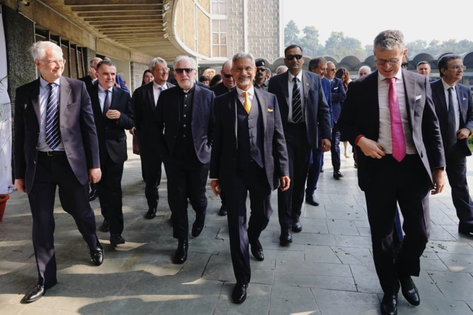
External Affairs Minister S Jaishankar emphasised that stronger India-EU relations will de-risk the world economy by cooperating on resilient supply chains and stabilise the global order through enhanced trade, mobility and security partnerships.
Speaking to ambassadors from European Union member countries on Thursday, Jaishankar described volatility and instability as the new normal in international affairs.
The External Affairs Minister outlined how deeper cooperation would reassure the international community by providing public goods including humanitarian assistance and disaster relief, anti-piracy operations and development projects.
The discussions took place ahead of the 16th India-EU Summit scheduled for 27 January, where European Council President António Costa and European Commission President Ursula von der Leyen will co-chair talks with Prime Minister Narendra Modi.
The two European leaders will serve as chief guests at India’s 77th Republic Day celebrations on 26 January, marking the first time EU leadership has attended the parade in this capacity.
The upcoming summit is expected to deliver significant outcomes including the announcement of a concluded free trade deal and a new security and defence partnership covering maritime security, cyber security and counterterrorism.
India and the EU also plan to conclude agreements on a comprehensive mobility framework to facilitate movement of students, seasonal workers, researchers and highly skilled professionals, alongside a Security of Information Agreement.
EU High Representative Kaja Kallas told the European Parliament that the summit would adopt a new comprehensive strategic agenda for 2030, setting the course for deeper engagement across trade, security, technology and mobility.
The proposed Security and Defence Partnership will facilitate deeper cooperation between the two sides, with potential for Indian firms to participate in the EU’s $200 billion SAFE programme designed to speed up defence readiness.
An India-EU Business Forum is expected to be organised on the sidelines of the summit, with both sides viewing the engagement as crucial for navigating an increasingly fragmented global landscape shaped by ongoing conflicts and economic disruptions.