“It just so happens that people who value freedom the most are often deprived of it,” ran the opening line of Belarusian human rights activist Ales Bialiatski’s Nobel Peace Prize acceptance speech, which, in an irony lost to nobody, had to be read out by his wife during the ceremony as Bialiatski himself was languishing in a Belarusian penal colony.
Just weeks later, Bialiatski was sentenced to 10 years behind bars on obviously fabricated charges of smuggling and illegally financing anti-government rallies. Though the other Nobel laureates with whom he shared the 2022 peace prize — Yan Rachinsky of Russian human rights organisation Memorial and Oleksandra Matviichuk of Ukraine’s Centre for Civil Liberties — had been able to attend the ceremony, his absence in Oslo spoke volumes.
Bialiatski founded human rights group Viasna — the Belarusian word for spring — in 1996, following the brutal state response to a series of anti-government demonstrations that subsequently became known as the “Minsk Spring”. Though at that time Alexander Lukashenko had only been in power for two years, Bialiatski was already well aware of the president’s dictatorial leanings.
Last month, as the dictatorship of Alexander Lukashenko continued to barter the release of its thousands of political prisoners for any form of sanctions relief from the United States, Bialiatski was one of 123 inmates who was suddenly released and dumped on the border of neighbouring Lithuania or Ukraine after the Trump administration agreed to lift its restrictions on Belarusian potash.
His two spells in Belarus’s notorious network of prison camps and penal colonies where “people are subject to ghastly tortures and unimaginable suffering” only seem to have redoubled Bialiatski’s fierce determination to see freedom triumph in his homeland, however. Novaya Gazeta Europe caught up with him in Oslo one month after his release.
NGE: Upon your release, you were taken to Lithuania along with a few other amnestied political prisoners who either had foreign or dual citizenship, while 100 other Belarusian political prisoners were deported to Ukraine. Can you describe that experience?
AB: I was transported just like everyone else. Nobody knew where we were going or who was in the group. We were taken individually, and I was blindfolded. I was able to tell when we were approaching Minsk as we were driving along the ring road. Even blindfolded, I had a rough idea of where we were and understood that we were being driven towards Lithuania. I had no notion at all, however, that a large group of other prisoners was being released simultaneously.
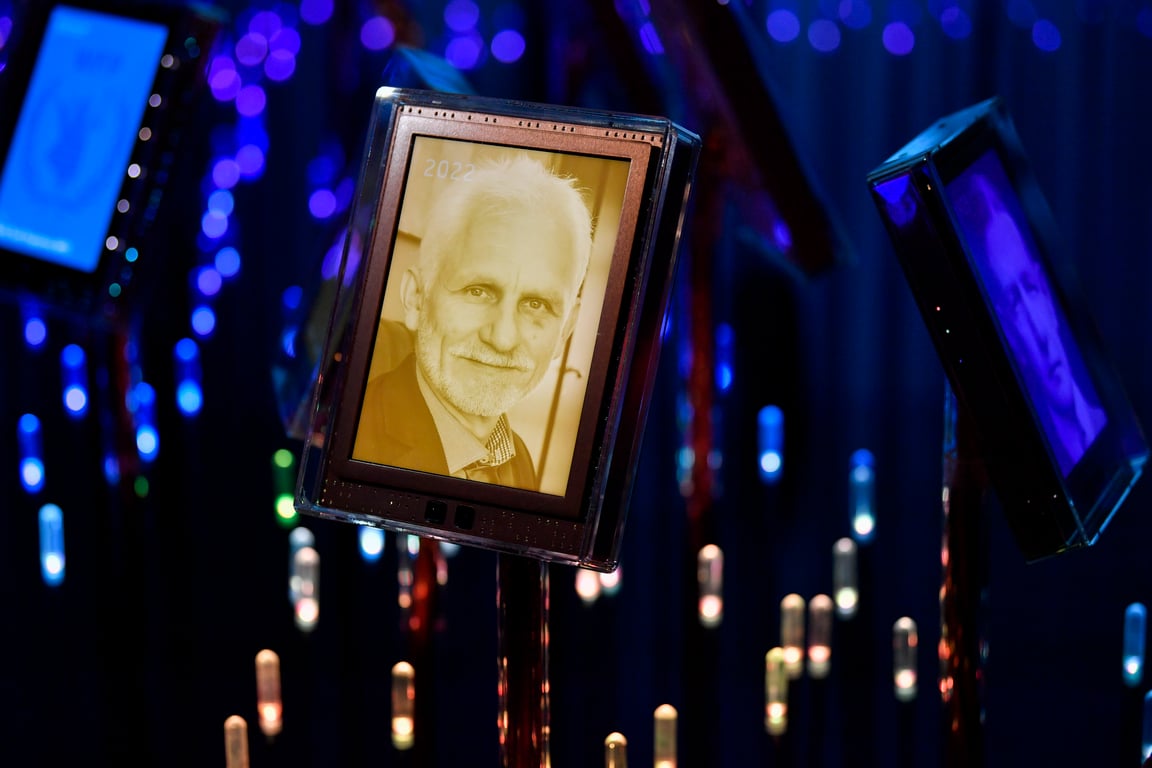
A portrait Bialiatski on display in the garden at the Norwegian Nobel Institute in Oslo, Norway, 7 October 2022. Photo: EPA / RODRIGO FREITAS
Nobody told us where we were being taken. We weren’t given any documents granting us pardons, amnesties, or otherwise explaining our release. Fortunately, our group, which was taken to Lithuania, was allowed to keep our passports. But those deported to Ukraine were in many cases simply handed a slip of paper with a stamp on it, including my colleague from the human rights centre Viasna, Uladzimir Labkovich. As I still have my Belarusian passport, I could theoretically board a train in Lithuania bound for Minsk. But that experiment would no doubt end in another arrest.
NGE: When Belarusian political prisoners are released, they all say that the actual number of political prisoners in Belarus is far higher than the figures given by human rights activists.
AB: That is indeed the case. In my colony there were 10 political prisoners “on the list”, but at least another six people who were not known as political prisoners despite having been jailed for political reasons.
Whereas pressure on political prisoners was initially exerted individually, it has now become an all-embracing phenomenon.
NGE: When you were imprisoned for the first time, only a handful of political prisoners were tortured, usually on orders from Lukashenko himself. But now torture is commonplace. Can you compare your two prison terms?
AB: Nothing is done without orders being issued, it’s just that these days, as a rule, they’re not coming from up high, but from the regional offices of the Interior Ministry’s Department of Penal Enforcement. It’s a simple process: an officer from the regional administration comes to the prison for an inspection, and half of our political prisoners are immediately sent to solitary confinement. When someone from Minsk arrives, the other half goes to solitary confinement for some minor infraction of the rules. Political prisoners will arbitrarily have a year or two added to their sentences, all on orders from above, as nobody shows any initiative on the ground — all they do is carry the orders, with varying degrees of zealotry.
Some officials build their careers on their treatment of political prisoners. It’s usually the department heads who call the shots on the ground. Of course, sometimes the prison warden colony or his deputy is involved. As a rule, there are two or three such officers in each prison who, in turn, are in direct contact with the powers that be and the intelligence services.
In general, the prison guards themselves tend to have a neutral attitude towards political prisoners, and sometimes even secretly sympathise with them. The repressive system we see today was first introduced in the 2010s, but was carefully developed and further refined in the 2020s. Whereas pressure on political prisoners was initially exerted individually, it has now become an all-embracing phenomenon.
NGE: Were you not tempted to refuse to go into exile in Lithuania as political prisoner Mikalai Statkevich did?
AB: At the border, we were transferred into a minibus with some Americans. So theoretically, I could have jumped out onto the neutral strip at that point. But in order to do what Statkevich did, you need his character and determination.
NGE: You’ve been a political prisoner twice over. Your two arrests came 10 years apart, first in 2011, then again in 2021. So you celebrated two major birthdays — 50 and 60 — behind bars.
AB: A stroke of luck on that front, you might say. I can’t bear milestones, birthday wishes, speeches, get-togethers. I even managed to avoid the Nobel Prize ceremony. I was in prison, so Natalia had to sit through it.
NGE: And how did you find out that you had won the Nobel?
AB: I found out right away. Back then, in October 2022, we were taken to see the case material every day before it was passed on to the court. And in the corridor, one of my fellow accused said: “Ales, it looks like you’ve won the Nobel Prize.” I brushed it off and said: “Yeah, whatever.” But then a lawyer came in and confirmed that was the case.
To say I was surprised would be more than just an understatement. Shortly before they announced the winners, I’d read in Nezavisimaya Gazeta that Sviatlana Tsikhanouskaya was one of the bookies’ favourites to win, and I thought, “That’s good. They haven’t forgotten Belarus.” But I didn’t think she had a chance, given that we were at war, and Belarus was in the spotlight far less than it had been two years earlier. And I certainly didn’t put myself in the picture.
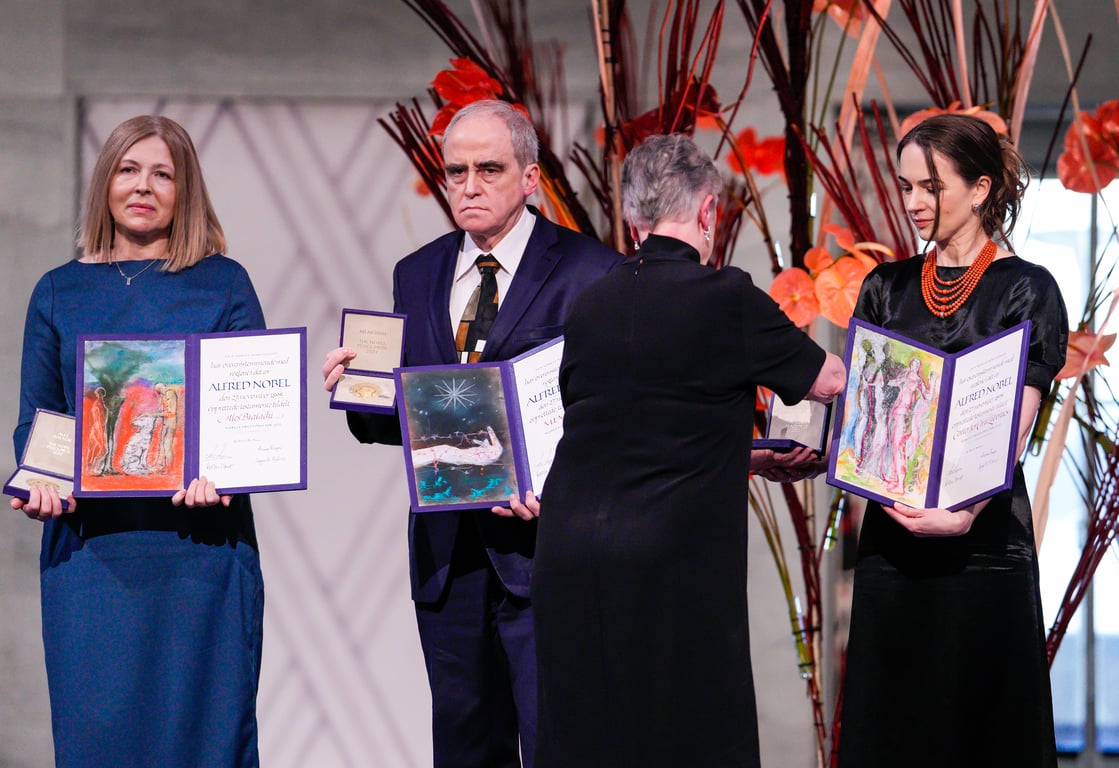
Natallia Pintsyuk (L), accepts the Nobel Peace Prize for 2022 on behalf of her husband, alongside fellow laureates Jan Rachinsky and Oleksandra Matviichuk, in Oslo, Norway, 10 December 2022. Photo: EPA / Javad Parsa
There was a certain symbolism in the Nobel Committee awarding the peace prize to human rights activists from Russia, Ukraine and Belarus. A tragedy tied up in war, the suppression of democracy, and mass repression. I think the Nobel Committee decision was sending a signal to the authorities in Russia and Belarus to end the mayhem and stop this horror. I’m just a symbol here. The award was given to Belarusian civil society for the heroic struggle it has now waged for decades — a struggle for justice, free elections, democracy and human rights.
NGE: How bad was your treatment in prison?
AB: The most difficult thing was being kept in isolation. I had some experience of that during my first sentence, but even then I still received over 30,000 letters during the three years I was in prison. During the second sentence, which lasted for over four-and-a-half years, I received just 50, and only one — from my wife — over the whole of last year. None of my letters to her were ever delivered. Here in Oslo, I was told that 2,000 postcards had been sent to me by supporters, but I didn’t receive a single one.
NGE: What were you allowed to take with you when you were released?
AB: Only personal belongings. I asked to keep the letters as they had already passed prison censorship, but even those few dozen letters I received were confiscated. There was one very notable difference between the two terms I served, though — no political prisoners died during my first sentence, everyone came out alive. Since 2020, however, people have started to die in custody.
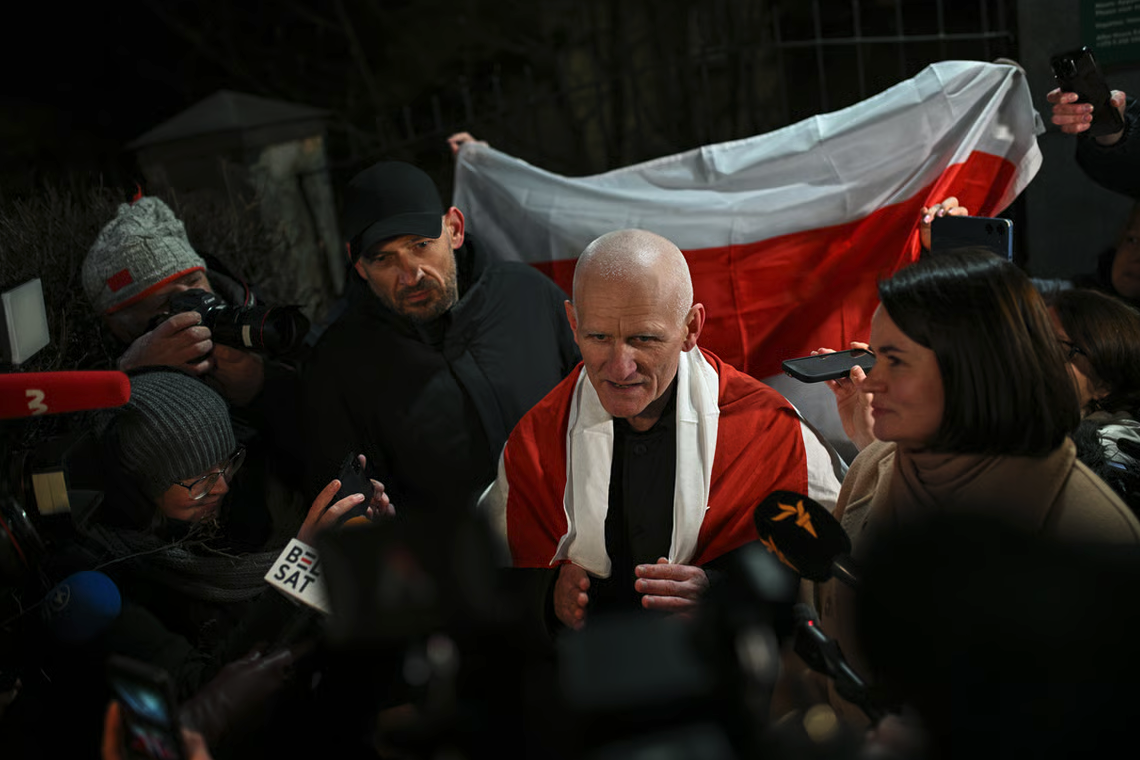
Ales Bialiatski speaks to reporters in Vilnius, Lithuania following his release from prison, 13 December 2025. Photo: Valdemar Doveiko / EPA
NGE: Were you ever placed in a segregation unit?
AB: I spent 38 days in solitary confinement and another six months in a six-square-metre cell where I was allowed to take 25 minutes of exercise each day. Compared to other political prisoners who spend years in solitary confinement or punishment cells, I had it relatively easy. If it weren’t for the Nobel Prize, I would probably have spent much more time there.
NGE: So the Nobel Prize did offer you some protection?
AB: Of course, it gave me certain safety guarantees. From the moment the prize was announced, it was clear that my imprisonment was being carried out under the personal supervision of Lukashenko himself, something I was repeatedly able to confirm from his speeches. As a commodity that could be exchanged for something, I enjoyed some level of protection from administrative arbitrariness. It also earned me the respect of other inmates, and by that I don’t only mean from my fellow political prisoners. Anybody with even a modest education who was familiar with the Nobel Prize treated me with respect, which likewise increased my level of protection. However, many other inmates simply had no idea that the Nobel even existed.
NGE: Did other prisoners ever come to you asking for help? After all, you’re a Nobel laureate.
AB: I’m a human rights activist, not a lawyer. Whenever I did get those requests, I’d always shrug and say: “Sorry, guys, I can’t help you there.” But as it really wasn’t safe for my fellow inmates to approach me, there were few requests.
NGE: Half a million Belarusians have now fled political repression, many of whom have expired passports or no documents at all. Some have even had their asylum applications rejected for serving in the Belarusian army. Do they represent a new category of human rights cases?
AB: This was all a huge surprise to me. In prison, I knew what was happening to political prisoners, as I was inside myself. But I had no idea what was happening on the outside with refugees and mass migration — I had no idea how many people had left. … I will be here in Europe doing everything I can to ensure Belarusian political émigrés receive support at the governmental level. I will also raise these issues with international organisations. … Before 2020, Belarusians fleeing persecution and applying for asylum would typically receive it within months. Now, the process takes years. Countries bordering the totalitarian regimes of Belarus and Russia operate under heightened security, especially given the endless provocations and talk of war breaking out in Europe. Naturally, this has had a direct impact on Belarusian refugees.