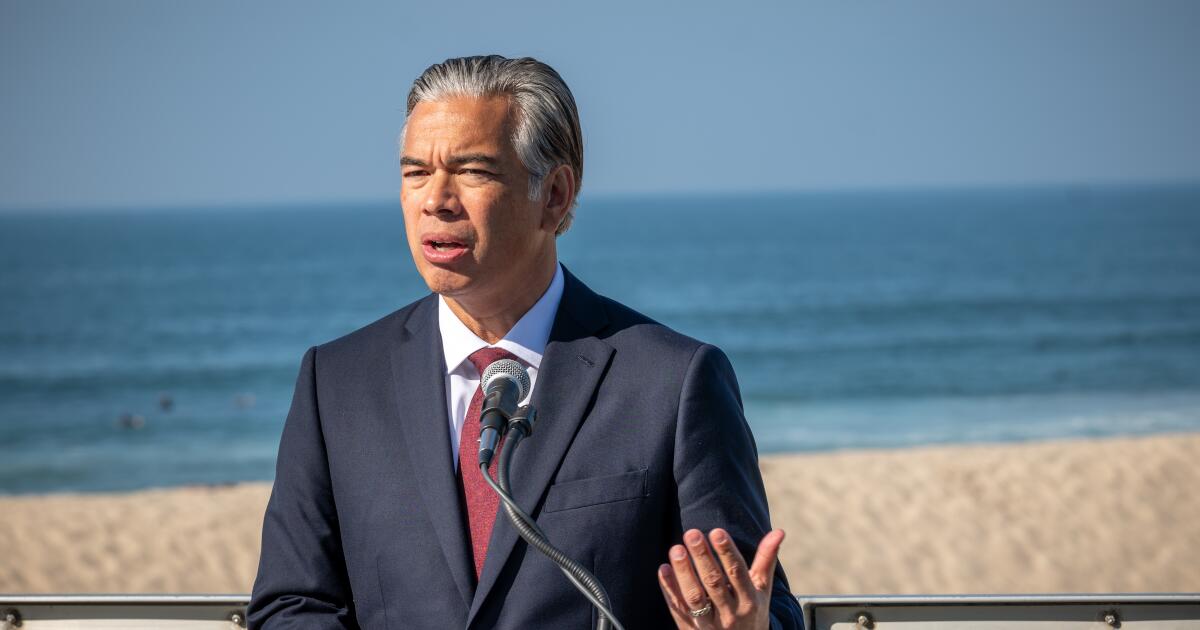
For more than a year, a Texas oil firm has clashed with California officials over controversial plans to restart offshore oil operations along the Santa Barbara County coast.
Now, California’s feud with Sable Offshore Corp. has escalated further, and involves the Trump administration.
On Friday, California Atty. Gen. Rob Bonta announced that he had filed suit against the federal government, alleging that the Pipeline and Hazardous Materials Safety Administration had usurped the jurisdiction and regulatory authority of Sable’s oil pipelines in an “unlawful power grab.”
“California has seen first-hand the devastating environmental and public health impacts of coastal oil spills — yet the Trump Administration will stop at nothing to evade state regulation which protects against these very disasters,” Bonta said in a statement Friday. “California will not stand idly by as the President endangers California’s beautiful coastline and our public health to increase profits for his fossil fuel industry friends.”
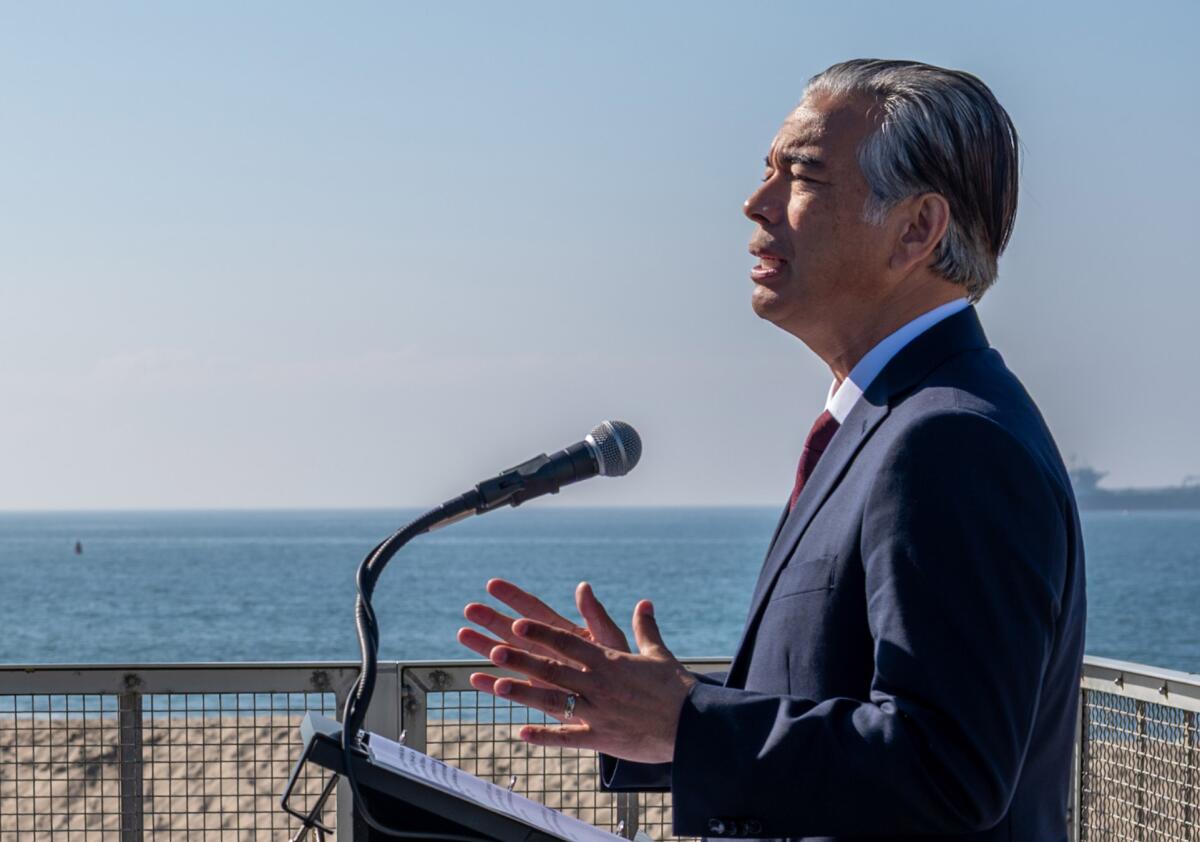
Atty. Gen. Rob Bonta speaks at a news conference at Dockweiler State Beach to announce a lawsuit alleging PHMSA illegally usurped oversight of a controversial pipeline system that runs from federal offshore oil platforms into California.
(David Butow/For the Times)
The attorney general’s petition, filed in the U.S. 9th Circuit Court of Appeals, challenges PHMSA’s attempt to federalize oversight of two onshore pipelines and its recent approval of Sable’s plan to restart the lines. Along with the Office of the State Fire Marshal, the agency that had been working to review Sable’s restart plan, the attorney general argued that PHMSA’s decisions violate the Administrative Procedure Act and asked the court to overturn them.
A spokesperson for the federal pipeline agency, which falls under the U.S. Department of Transportation, disputed California’s challenge, pointing out that the pipelines were “regulated for decades, under both Republican and Democratic administrations, as an interstate pipeline.”
The lines were “redesignated as intrastate in 2016 when … taken out of service,” a statement from the PHMSA spokesperson said. “Based on the facts presented by Sable in their letter to us last November, PHMSA agreed with the operator that returning the pipeline to our jurisdiction was appropriate.”
Restarting the pipelines “will bring much needed American energy to a state with the highest gas prices in the country,” the statement said. “We look forward to a swift resolution in this case to provide the operator with regulatory certainty and Californians with affordable American energy.”
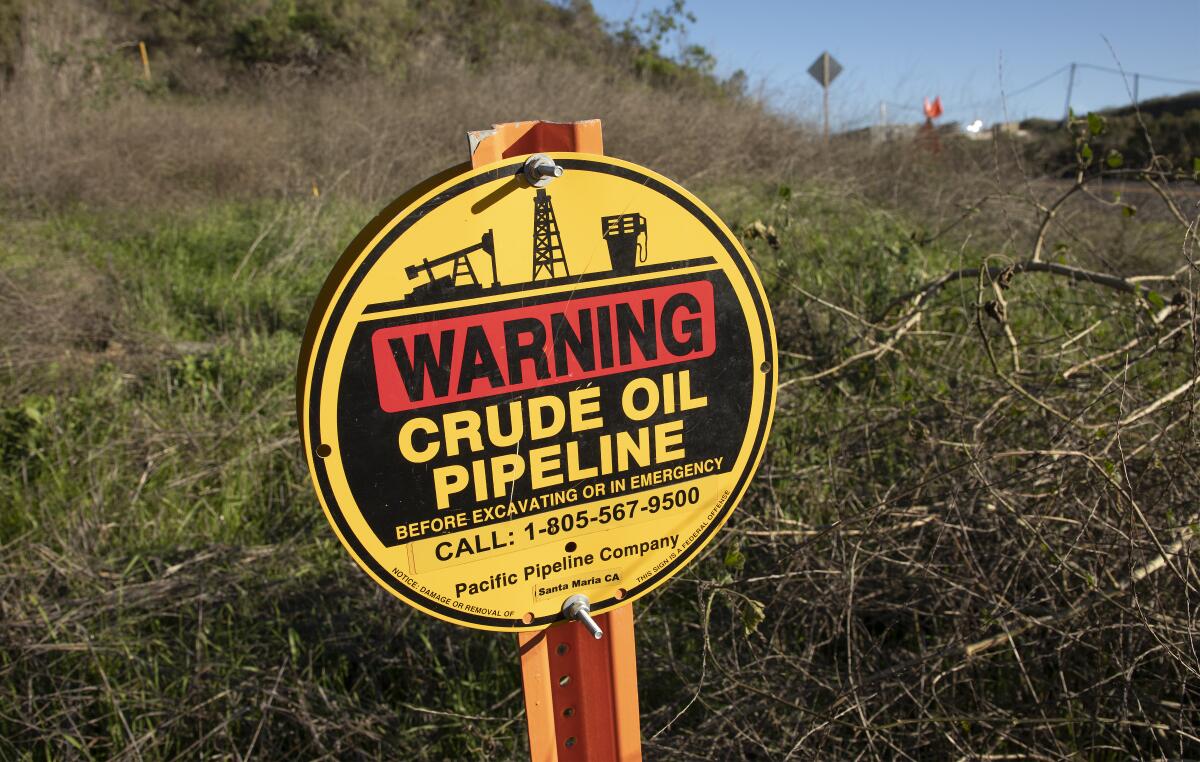
Signs warn of an oil pipeline owned by Sable Offshore Corp.
(Al Seib/For The Times)
Representatives for Sable did not respond to a request for comment on the case.
Approvals for these pipelines have become a major sticking point in the Houston-based company’s plan to revive three drilling rigs in federal waters off Santa Barbara County’s coast.
The pipelines are part of a network of offshore and onshore lines. The two lines in question are located onshore and run through Santa Barbara and Kern counties. A corroded section of one of them burst in 2015 near Refugio State Beach, causing one of the biggest oil spills in the state’s history.
The former owner shuttered operation after that spill, but Sable announced in 2024 that it planned to restart oil production — a move that sparked fear and concern among locals, environmental activists and state and local regulators.
The Trump administration didn’t immediately get involved, but it did signal its support for the project last year, as part of its goal to increase U.S.-made oil.
But in December, PHMSA officials reclassified the onshore pipelines as “interstate” pipelines, citing their link to offshore rigs along the Outer Continental Shelf in federal waters.
Soon after that, the federal agency approved the pipelines for a restart, shocking many who had been working for more than a year to ensure Sable’s compliance with state and local laws.
Bonta on Friday called both those findings from PHMSA incorrect and illegal, saying the federal agency had “no right to usurp California regulatory authority, pointing out that the pipelines “originate and terminate within California.” That is how they were described and mapped in the federal consent decree reached after the 2015 spill.
“The law is clear. These pipelines are in California’s jurisdiction,” Bonta said Friday morning at Dockweiler State Beach. Bonta said the beach was just one of many stretches of California coastline that President Trump and the federal Pipeline and Hazardous Materials Safety Administration are putting at risk.”
“The federal administration has no right to usurp California’s regulatory authority,” he said. “We are taking them to court to draw a line in the sand and to protect our coast, beaches and communities from potentially hazardous pipelines.”
While Bonta was clear that his office’s latest lawsuit doesn’t directly address whether the the pipelines should, or can safely, restart, he said the current approvals from PHMSA mean the company might do so “in short order.”
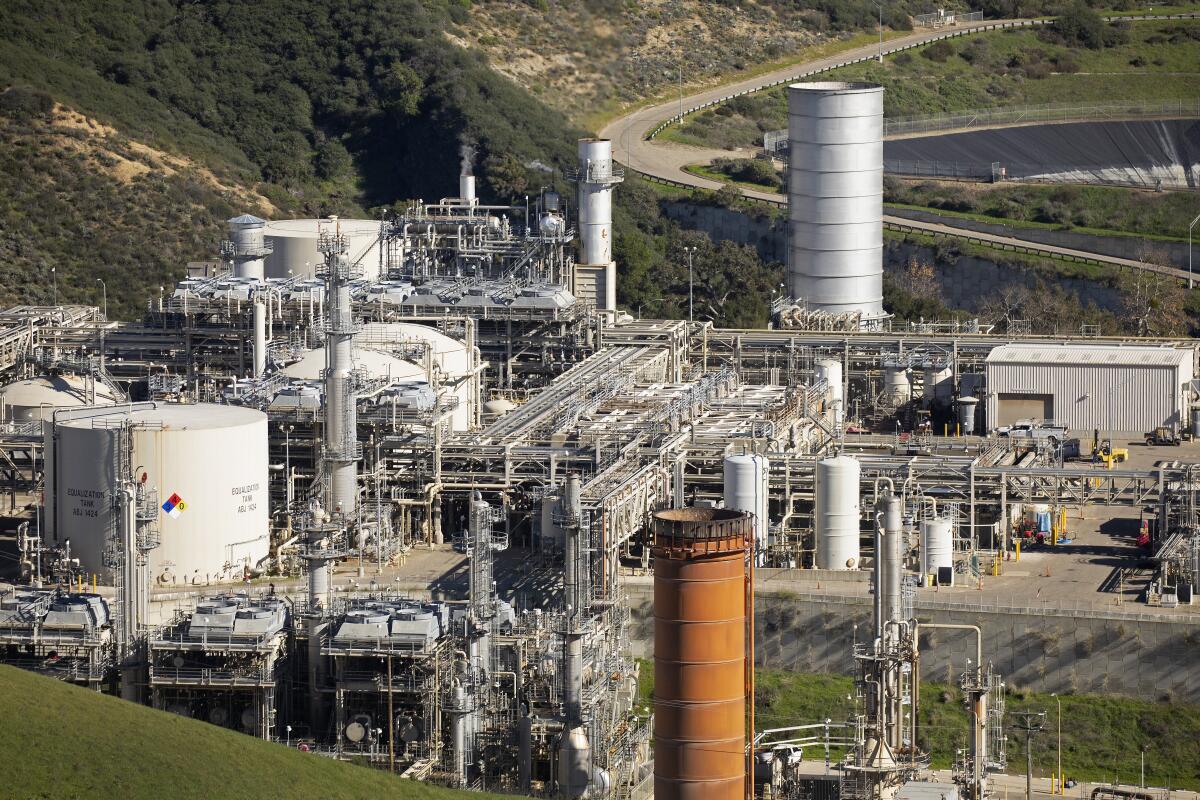
Sable Offshore Corp.’s Las Flores Canyon Plant operates in Goleta.
(Al Seib/For The Times)
But despite the green light from federal officials, Sable representatives told a Santa Barbara County judge this month that it hasn’t yet started transporting oil through the two pipelines in question.
That step, which is key to restarting the offshore oil production, has remained stalled because Sable has repeatedly clashed with state and local officials.
Last year, the California Coastal Commission found that Sable had failed to adhere to the state’s Coastal Act despite repeated warnings and fined the company $18 million. In September, the Santa Barbara County district attorney’s office filed criminal charges against the company, accusing it of knowingly violating state environmental laws while working on repairs to oil pipelines that have sat idle since a major spill in 2015.
The company also remains entangled in several ongoing lawsuits, including one brought by the Central Coast Water Board — represented by Bonta’s office — that alleges the company repeatedly failed to follow state laws and regulations intended to protect water resources, repeatedly putting “profits over environmental protections.”
The company has repeatedly denied that it has broken any laws and insists that it has followed all necessary regulations.