Three months ago Kim Bailey considered her life humdrum. ‘I was working full-time as a manager in the public sector.
‘I’d walk my dogs in the forest. I’d been married for ten years. I didn’t go out much,’ says the modest mother-of-four by way of illustrating just how unremarkable her routine in the pretty East Sussex town of Crowborough was. ‘I was boring – very boring,’ she insists.
Walking the streets with banners? Certainly not. Rebutting the words of seasoned politicians at public meetings? Not so much. Appearing on breakfast television? Nope. ‘I’d never been on a protest before, I’d never done anything like this in my life.’
Kim, 44, is sitting in the Blue Anchor, a pub that’s become the backdrop to events that have unfolded since October, when the Home Office announced plans to turn the town’s military training camp (primarily a centre for Army cadets) into a temporary home for up to 600 adult male asylum seekers.
Ever since that announcement, Kim’s life has been anything but boring. When we met on Thursday, she’d spent most of the day under an umbrella at the entrance to the camp, talking about why the good folk of Crowborough – a market town with a branch of Waitrose in its tidy centre and Ashdown Forest (of Winnie-the-Pooh fame) at its fringe – are so alarmed by what’s going on.
Every Sunday hundreds, sometimes thousands, of townsfolk have poured on to the streets to protest a decision which they say ‘rides roughshod’ not just over the town, but over planning law.
Matters came to a dramatic head in the early hours of Thursday, when the first group of 27 migrants were transported into the camp by coach with a police escort, at 3.28am – not, one might argue, an hour that conveys transparency.
There were more comings and goings in the early hours yesterday, suggesting the numbers have swollen further. ‘We won’t be providing a running commentary on numbers,’ declared a Home Office spokesman.
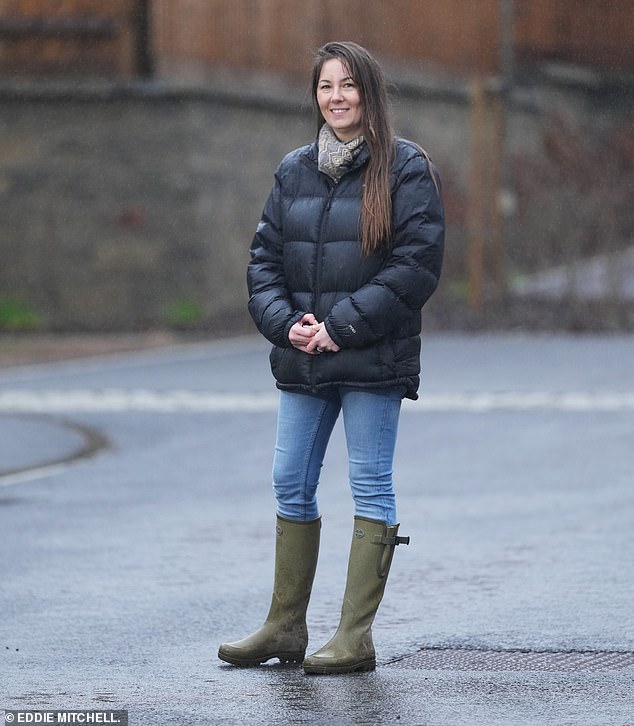
Three months ago, Kim Bailey (pictured) considered her life humdrum

Over one thousand protestors against the asylum seekers camp at Crowborough in Sussex marched for the 9th Sunday in a row on January 4 2026
Kim had been expecting the arrivals ever since food and refrigeration trucks rolled through the entrance – a mile or so from Crowborough’s centre in the forested fringes where affluent commuters have their large detached homes – late last week.
It’s all made for a very busy time for Kim, who still can’t quite pinpoint what made her put her hand up at a public meeting, hastily convened by a local Reform candidate, and volunteer to take on the role of chairwoman of what needed to be a community – not political – campaign.
‘I can’t tell you why,’ she says with a chuckle. ‘I just felt my hand going up and this little bird on my shoulder going, ‘Put your hand down, you are not qualified to do this’.’
Clearly, she didn’t listen to the bird, which is why Kim had to book leave this week from the senior managerial position she has occupied for the past decade, to liaise with lawyers and help spearhead the group’s campaign.
Even now, as she dries off from the rain, she is juggling a flurry of phone calls and messages in her capacity as chairwoman of Crowborough Shield, the campaign group hastily assembled in the wake of that October bombshell.
The group’s self-avowed purpose is to protect ‘the interests, wellbeing and long-term future of Crowborough and its surrounding communities’. Although perhaps most pressingly it is now seeking a judicial review against the decision to convert the camp amid widespread concern, not just about the impact of the imminent arrival of an even larger and undocumented group of male migrants, but how such a decision came to be made in the first place.
As a figurehead – she has a co-chair, father-of-two Alex de Warrenne – Kim could not be more eloquent and passionate. ‘Essentially, I’m standing up for what is right for this town,’ she says. ‘This isn’t about 600 asylum seekers. This is about the whole thing.
‘This is about unsuitable accommodation for people that are supposed to be vulnerable and at risk. This is about a community that is having a central government decision imposed on them without any say, without any safety measures, without any safeguarding assessments, nothing.
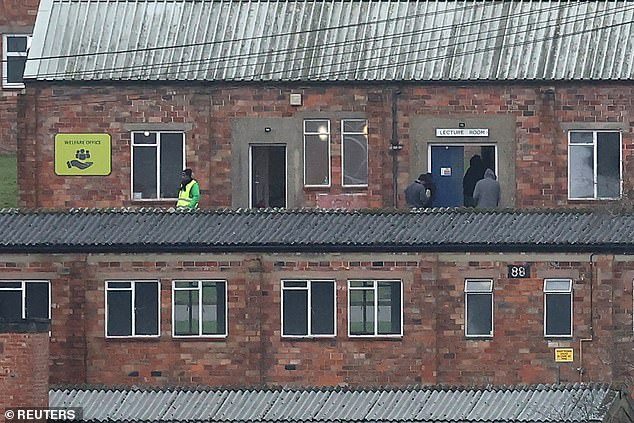
People enter a building at Crowborough army training camp, repurposed by the UK government as an accommodation centre for asylum seekers, in Crowborough, southern Britain, on Friday

Hundreds of people waving flags and banners gather outside Crowborough Army Camp to protest the Home Office’s plans to house 600 male migrants in a former army barracks in West Sussex, United Kingdom on January 18, 2026
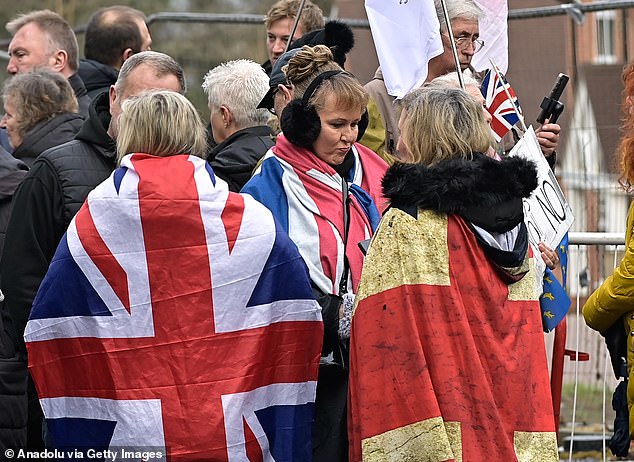
Every Sunday hundreds, sometimes thousands, of townsfolk have poured on to the streets to protest a decision which they say ‘rides roughshod’ not just over the town, but over planning law
‘We vote for representation, not rule and that’s what’s happening here. Central government saying: ‘This is what we’re doing, don’t stand in our way.’ That’s what they’re saying to us. It’s taking away the voice of an entire community.’
She speaks from the heart but it’s not just passion that’s gone into the campaign, her own financial security is on the line, too.
As directors of Crowborough Shield, it is Kim and Alex with whom the buck stops, should their legal efforts fail.
A crowdfunder launched by the group to challenge the Government in the courts has raised £93,000 but there is – to their dismay – no cap on costs and the Home Office, says Kim, is already seeking £35,000 in costs, raising the risk that if the bill soars, their own homes will be at risk. Inevitably, her mind does wander down the alleys of ‘what if’.
But she trusts that even if the Government fails her, it won’t come to that. She doesn’t come across as a woman weighed down by anxiety; she’s upbeat and focused even after a long day spent in the rain. She feels it, of course she does, ‘but it’s not enough to deter us,’ she says.
Kim is warm and friendly, the perfect voice and face of a public campaign; she’s also not easily intimidated, which is perhaps down to a childhood spent in foster homes from the age of nine to 16, at which point she began to live independently, putting herself through college.
‘I used to challenge social services all the time. Social workers hated me,’ she says. ‘At school, I’d always stand up for the children being bullied. I would always be the one that would face off the bullies. I’m like a dog with a bone when something’s not right, when people are being exploited, treated unfairly. I find it very difficult to put it down.’
There was the time during Covid when she went into battle with British Airways over flights booked and paid for that weren’t refunded. She took them to arbitration, got her money back, then templated her letter and shared it for others to use online.
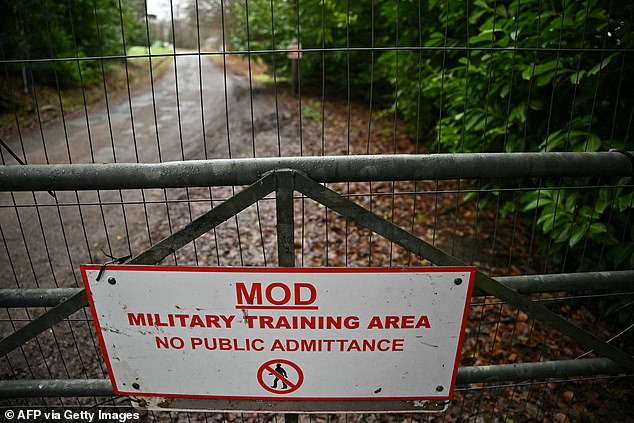
Signage warning unauthorised people to stay out is pictured at a gate outside the Crowborough Training Camp in Crowborough, south-east England on December 11, 2025

In Crowborough, one of the most striking features of which – apart from its location in an area of outstanding beauty – is its political diversity
As she talks, it becomes clear the Home Office has got quite a fight on its hands. ‘I grew up without parents. I put myself through school, college, university. I worked three jobs, I’m raising two children on my own [she has two stepchildren as well as her own].
‘I bought my first house and then to have the Government stand there and say, ‘If you carry on, we’re going to take it all?’
‘If there’s one thing to fight for, it’s that, isn’t it? The family home.’
That home is here, in Crowborough, one of the most striking features of which – apart from its location in an area of outstanding beauty – is its political diversity. Wealden District Council is run by a Liberal Democrat/Green/Labour alliance and Kim and Alex stress how diverse their group is.
Kim recoils from the notion of Nimbyism and attests she ‘hates politics’, even if she has been approached by more than one political representative during the past three months, wanting to tap into her inimitable talents.
She is careful talking about her career, but says: ‘I feel very strongly about having a voice for people who feel they don’t have one and in my job I’ve done a lot of that. I’ve advocated for the deaf community. I learned sign language so that I could communicate with deaf communities. I have worked with migrant communities over access to services.’
She points to Crowborough’s long history of opening its doors to those in need. ‘The community has helped Afghan families as part of the Afghan refugee programme when we brought over the interpreters who supported the soldiers. It also opened its arms to Ukrainian refugees.

People attend a protest against asylum seekers being housed at an army training camp in Crowborough, Britain, November 23, 2025

undreds of people waving flags and banners gather outside Crowborough Army Camp to protest the Home Office’s plans to house migrants there
‘But it’s very different to have 250 families compared with 600 single undocumented men from unknown origins, unknown criminal backgrounds, on the edge of town with nothing to do.’
The experience, she says, of what has happened elsewhere – in Epping, for instance, where an asylum seeker was jailed for sexually assaulting a 14-year-old girl and a woman while living in an asylum hotel – raises concern.
‘It definitely brings fear to our community,’ she says. ‘Whether it’s genuine or perceived, it’s still a real fear that needs to be managed carefully and sensitively.
‘The Home Office are not engaging, the district council haven’t engaged – no mitigations, no reassurance has been provided. The Government has announced it’s not safe for the cadets to parade on site with the asylum seekers there under the guard of military personnel, but it’s perfectly safe for schoolchildren to stand ten metres outside that camp at a bus stop in the dark. How do you justify that? Of course parents are going to worry.’
Lest anyone think Kim is soapboxing, one need only look at the photographs of those Sunday protests, of young and old pouring into Crowborough.
Those living near the 37-acre site have always enjoyed this leafy spot, which is being converted post-haste after the Home Office used ‘Q-class rights’ to bypass normal planning permissions, a process that allows the use of a site to be changed without a full planning application or full environmental impact assessment.
Phill Straker, 69, lives next to the main entrance to the camp. His wife is a beekeeper and spends lots of time at the back of their property.
‘She could be in the polytunnel or the greenhouse on her own and be approached,’ he says. ‘It might be completely harmless, but of course you’re going to feel intimidated. Even if it were 500 young English guys, unemployed, with nothing to do… it only takes one bad apple.’
He has two grandchildren, aged eight and ten, who spend two days a week at their home.

Crowds gather outside Crowborough training camp with flags and banners ahead of the peaceful protest on December 14, 2025

Crowds march through Crowborough during the peaceful protest on December 14, 2025
‘The garden has always been a fantastic playground. But you can’t really leave them to play as you would have done,’ he adds. Such is their concern, the Strakers have installed four security cameras.
Others have gone further. Mark Hodson, who runs Crowborough Security Systems, has never been busier throughout his 35 years in business. ‘Before the camp our work was spread out within a 45-minute radius of Crowborough,’ he says.
‘Since mid-November nearly every job has been in Crowborough itself. People are spending thousands on cameras and alarms for their properties and, in some cases, panic buttons. But I’m not rubbing my hands with glee at all the extra work, as I live in Crowborough myself. People are extremely worried and angry with the Government.’
Karen Creed, 62, remembers how different it was when Afghan families evacuated during the withdrawal from Kabul in 2021 were housed at the camp before being resettled elsewhere.
‘There was a reason for them being here,’ she says. ‘We got to know that they weren’t illegal immigrants. But the fact that now it is all men in a facility like that gives it a completely different dynamic and we don’t know the background of any of them.’
It’s this that is driving Kim Bailey on. Three months ago she was picking her way through divorce proceedings, her youngest daughter had just left for university and her house was on the market. Kim wanted to move to Spain.
Selling up might be tricky now. ‘The house had been on the market for about six weeks and we’d had nine viewings… then the announcement was made at the end of October and everything stopped, not a single inquiry, so I took it off the market.’
For Kim, at least, there is a silver lining. Now she wouldn’t want to leave, having forged new connections in a town in which for the first ten years of her residence (she moved from Brighton) she knew only a handful of people.
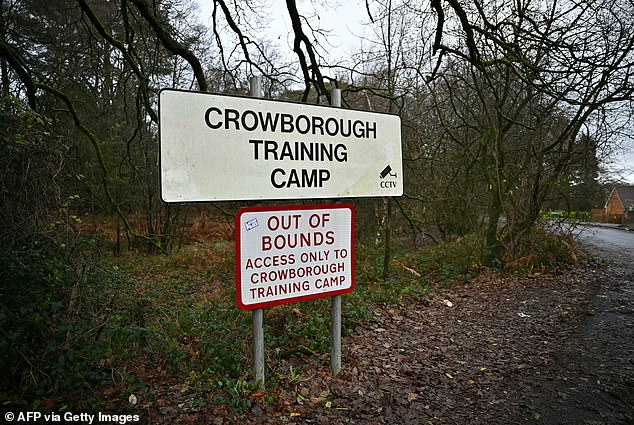
Signage for the Crowborough Training Camp

A British Union Jack national flag and the English flag of St. George attached to a lamp post beside an entrance to Crowborough army training camp
‘This situation has changed the lives of a lot of people,’ she says. ‘I’ve made some lifelong friends.’
Kim has been talking to lawyers, as Crowborough Shield contemplates if it can apply for an injunction to prevent further migrants being moved to the camp.
And she is ready. ‘I’m used to challenges. I think even as a woman who has a career, she spends her whole life fighting. You’re always up against strong competition. One of the things I’ve always done is fight for people’s rights, advocate for people that don’t have a voice.
‘Migrant communities, ethnic minorities, disabilities. I spent years being an advocate and a voice for those people because it’s the right thing to do.
‘And there’s no difference here. It’s the right thing to do.’
Additional reporting by Kristina Wemyss