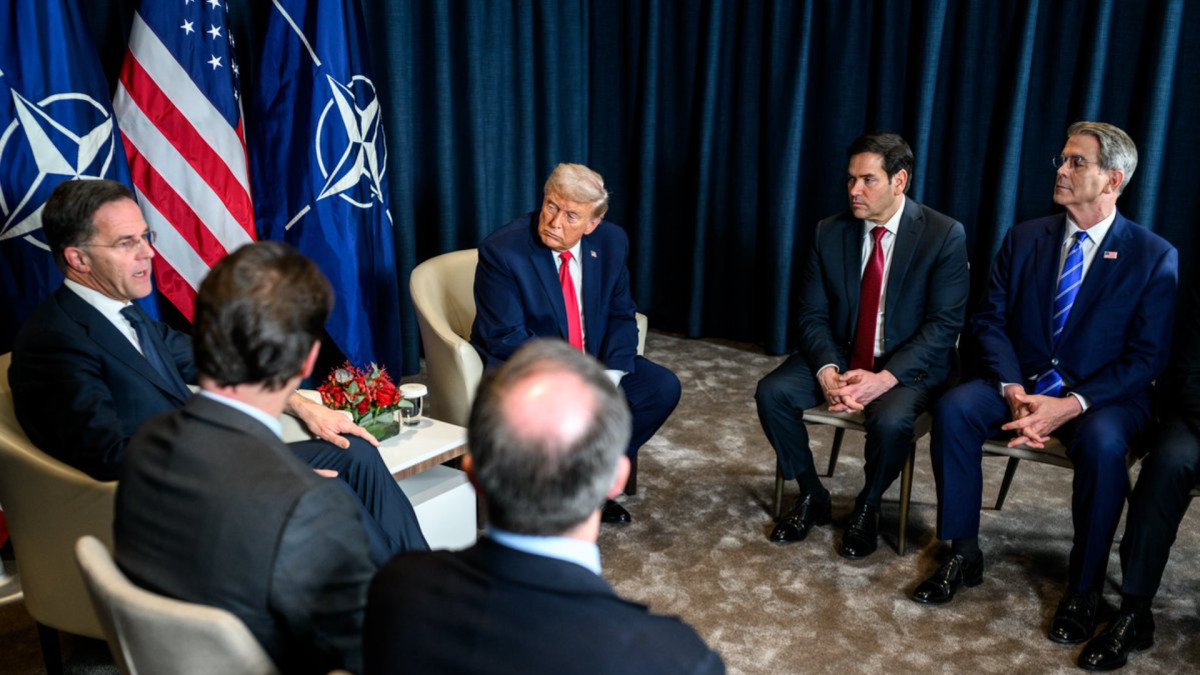
World leaders may be gathering this week in Davos, but surely their minds are elsewhere: Greenland. Since President Trump returned to office one year ago, Greenland has been back on his radar, much like during his first term. But things have escalated. Through a variety of messages and statements over the course of the past year, he has made clear his belief that Greenland becoming U.S. property is necessary for the country’s national security.
Less than a month into 2026, rhetoric has ratcheted up. Both the Danish and Greenlandic foreign ministers recently met in Washington, D.C., with U.S. Vice President J.D. Vance and U.S. Secretary of State Marco Rubio, in a conversation that reportedly did not put an end to Trump’s desire to purchase Greenland nor to Denmark and Greenland’s refusal to entertain this idea.
“In Europe there was a general sense that they had learned how to manage Trump by conceding on trade, increasing defense spending, and being deferential”Leonard Schuette – International Security Program fellow at the Belfer Center for Science and International Affairs”I think most European politicians did not take threats against Greenland very seriously at the beginning. After all, Trump had also signaled interest in Greenland during his first term. And there was a general sense in Europe that they had figured out how to manage Trump by conceding on trade, increasing defense spending, and being deferential”, Leonard Schuette, Ph.D., International Security Program fellow at the Belfer Center for Science and International Affairs (Harvard Kennedy School), told Agenda Pública. “But the combination of the National Security Strategy (NSS) and the kidnapping of Maduro showed that Trump’s threats needed to be taken much more seriously”, Schuette added.
“European decision makers are extremely worried about Greenland. They face a dilemma: they know that they must support Denmark, a key NATO ally and an important EU country. But they also don’t want to jeopardize negotiations over Ukraine by alienating Trump”, Schuette added. Schuette previously served as a senior researcher at the Munich Security Conference.
At the moment, military forces from various European countries are engaged in training exercises in Greenland, as Denmark and other European countries make clear that if the United States were to attempt to take Greenland by force, it would be the end of the North Atlantic Treaty Organization (NATO). “If Trump takes Greenland, he will lose Europe, because NATO would be driven to a new purpose: defending Europe and Canada against their former ally, the U.S.”, U.S. ambassador (ret.) Eric Nelson told Agenda Pública. “Russia and China would be relatively more powerful than ever vis-à-vis a U.S. without European allies”, he added.
“U.S. security concerns can be fully met under the existing treaty with Denmark”Eric Nelson – Former ambassador and associate director at the George C. Marshall European Center for Security StudiesAccording to Nelson, who served as U.S. Ambassador-in-Residence and Associate Director at the George C. Marshall European Center for Security Studies, “U.S. security concerns can be fully met now under the existing treaty with Denmark”. As for how the United States could actively bolster Arctic security, Nelson said: “A serious commitment to U.S. security in the Arctic would mean investing in an Arctic fleet of icebreaker military vessels, an area in which NATO today relies heavily on Nordic capabilities”.
Nelson added that Denmark and other European leaders could take note of Zelensky’s negotiations with Trump, arguing that “President Zelensky’s experience facing highly adverse negotiating terms from the U.S. shows that continuing negotiations to find an acceptable win for Trump to pocket may be a better alternative than threatening the U.S. with graver consequences”.
Ultimately, according to Schuette, “at the end of the day it has to be clear: if the U.S. moves to control Greenland against the will of Denmark, by military or other means, it would bury the U.S. credibility as a security guarantor in Europe – and thus NATO. From a European perspective, that has to be prevented at all cost”. As for Nelson, he believes that the final dollar amount of a potential U.S. purchase of Greenland could be so high that it “may compel the few Republican senators needed to refuse to fund this venture”.
Looking ahead, Schuette concluded: “Venezuela could well only be the beginning; nothing is off the table”.