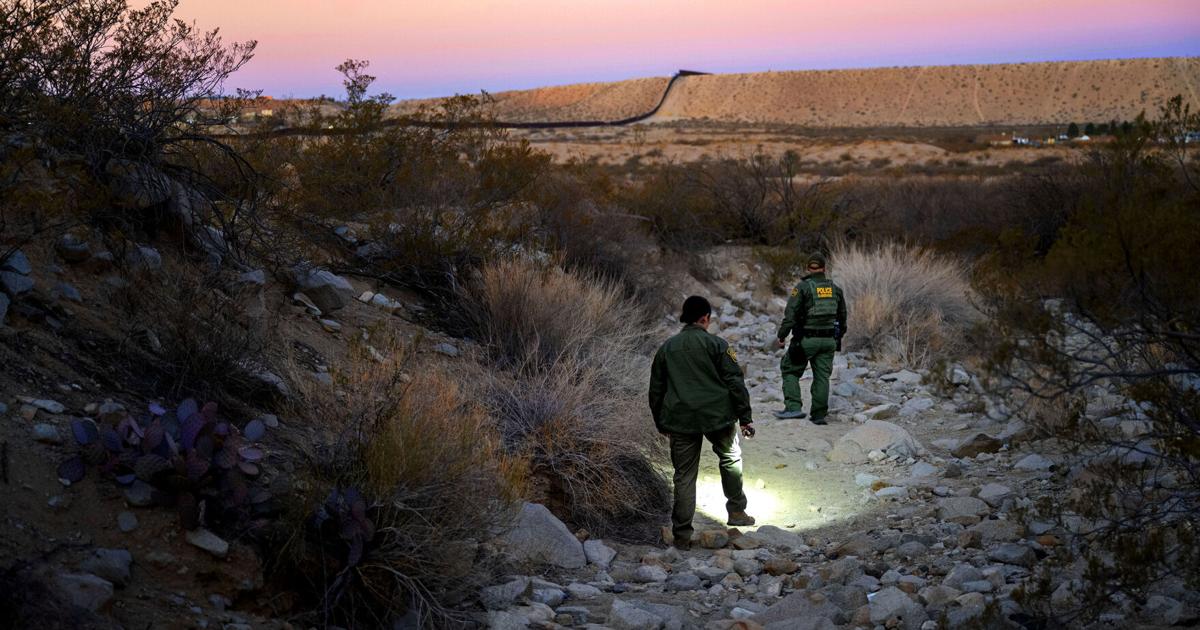
SANTA TERESA — The lower jawbone of an unknown person seems to lie in the very same spot it did a year ago, though the desert sun has bleached it.
A handful of other sites of scattered human remains lie within a mile, few as pristine as the jawbone. A few hundred feet away, leg bones and a piece of spinal column have been picked at and moved away from the ribbons that once flew over them.
At another spot, “some of the bones are gone now,” said James Holeman, 60, a Marine veteran and leader of Battalion Search and Rescue, which has spent years scouring the New Mexico landscape west of El Paso for sites of the dead, marking them with ribbons and reporting them to authorities who are then tasked with recovering them.
But some remain unrecovered after more than a year, and Holeman and partner Abbey Carpenter, 68, are losing faith they ever will be collected.
“It kind of puts us in a spot,” Holeman said on a recent visit. “Like — do we call it in again? How many times do we have to call it in? There hasn’t been dialogue or any scrap of support.”
Many of the human remains likely belong to migrants who crossed the border around 2023 to evade U.S. Border Patrol by charting paths through the harsh terrain of the New Mexican desert, where a massive concentration of remains lies among the mesquite bushes west of El Paso, Sunland Park and Ciudad Juárez. Many are presumed to have died from exposure in the conditions — an assumption that’s impossible to confirm without an investigation. Holeman said his group has located about 89 sites in New Mexico and Arizona over the past two years. About 39 of those were in Doña Ana County.
The group’s volunteer searchers have marked five sets of remains that have sat on the sand unrecovered for nearly 18 months since being reported. They have also returned to “audit” 15 sites where skeletal remains were previously recorded — and found human remains or personal effects still present at each location. Some of those 15 sites Holeman’s group reported themselves, while others were marked on government agencies’ maps as cleaned-up sites.
“We went to 15 and all 15 sites had bones left behind,” Holeman said, noting one spot had a wallet, cellphone and identification card. Those personal items can make all the difference when the New Mexico Office of the Medical Investigator, which is tasked with recovery of remains, sets out to reunify them with families of the deceased.
“ I don’t think there’s any families out there that are like, ‘Oh, just send us a few bones.’ They want everything,” Holeman said.
One year later
Almost a year has passed since The New Mexican’s “Dead in the Desert” series, a monthslong investigation into sites of migrant remains along New Mexico’s southern border — sites reported by volunteer searchers who described hostility from authorities tasked with responding.
Since then, the border has changed. Crossings by migrants have plummeted, and nearly 110,000 acres along the border have been transferred to the U.S. Army, filling the state’s southern landscape with roving U.S. Army forces and vehicles.
Military operations on the border are one part of a larger offensive on both illegal and legal immigration from the Trump administration. Trump’s approach in recent months has included sharp amplification in the tactics and volume of U.S. Immigration and Customs Enforcement raids nationwide, arrests at courthouses during immigrant check-ins and efforts to revoke the protections of refugees, asylum seekers and immigrants previously shielded by the Deferred Action for Childhood Arrivals program.
But for Holeman’s group, some change has been for the better, he said: Authorities have begun doing a better job of recovering remains.
But there is a catch: Holeman doesn’t think authorities’ numbers of remains recovered add up.

U.S. Custom and Border Protection agents Orlando Marrero-Rubio and Nicole Galvan search an area along the border wall in Sunland Park in January 2025.
Michael G. Seamans/The New Mexican
There are the five sites Holeman said have sat unrecovered since at least September 2024, when his group first flagged and reported them. And there are the 15 other sites on the list of spots officials knew about but where human bones still lie, exposed to the elements.
Despite the uneven terrain, low visibility over mesquite bushes and sweltering heat in the summer, many sites lie in desert clearings only a few miles from the border wall, and just a few minutes’ drive from a Love’s Travel Stop.
Chris Ramirez, spokesperson for the New Mexico Office of the Medical Investigator, wrote in an email that recovery is often a tough task.
“The field investigator and transport team do their very best,” Ramirez wrote. “However, this geography of New Mexico is extremely rugged, sandy, filled with wildlife, and is often extremely difficult to access.”
Disputed numbers
The number of recoveries of the bodies of “probable migrants” has seen a steep drop in the last year, from 149 in 2024 to 13 in 2025, according to data provided by the University of New Mexico Office of the Medical Investigator.
Monthly distribution of recoveries of probable migrants/migrants, as reported by the state Office of the Medical Investigator
Courtesy of the New Mexico Office of the Medical Investigator
Not a single probable migrant death was reported from July through December, according to the report.
Ramirez declined to offer an on-the-record explanation for the drop in recovered remains or answer other additional inquiries, instead opting to send The New Mexican a statement nearly identical to the one he sent in December 2024, noting the agency “works diligently to collect all known pieces of human remains, both for a complete and thorough medical examination, and out of respect for the decedent and their family.”
Year-by-year migrant recoveries recorded by the state Office of the Medical Investigator.
Courtesy of the New Mexico Office of the Medical Investigator
The U.S. Department of Homeland Security reported in October that fiscal year 2025 had the lowest number of apprehensions by U.S. Border Patrol since 1970 at 237,565. The agency claimed that total was 87% lower than the average of the four prior fiscal years.
Holeman agreed policy changes have reduced crossings, but argued the federal government has also reduced the presence of Border Patrol agents tracking migrants through the desert — and with it the odds authorities stumble upon remains to report.
Ramirez did not answer an inquiry into the volume of reports that come from Border Patrol, and whether that number dropped in 2025.
Holeman disputed the Office of the Medical Investigator’s assertion that no remains were recovered from July through December, saying his searchers reported seven sites during that period and many of those remains in fact were recovered. One of those reported sites was covered by outlet National Catholic Reporter after Holeman’s group and a dozen Jesuit priests and seminaries stumbled upon a site of skeletal remains, sweatpants and hair extensions.
“We have seven just ourselves,” Holeman said. “Why are they undercounting these? We reported them, and they’re gone — so where the hell did they go?”
Bones left behind
The jawbone site, referred to by Holeman as “fence line girl” for its position under a barbed wire fence, is among five unrecovered sites stemming from a string of reports in September 2024.
Holeman blamed in part a policy that was in place for several months requiring those reporting remains to stay on the phone with sheriff’s deputies until local authorities and the Office of the Medical Investigator arrived.
James Holeman of Battalion Search and Rescue documents a site where human remains were found during a search near Santa Teresa in February 2025.
Michael G. Seamans/The New Mexican
The policy was eventually dropped by the Doña Ana County Sheriff’s Office after Holeman and those from other search groups reported waiting hours for authorities. But it’s an example to him of arbitrary roadblocks placed by the sheriff’s office and the Office of the Medical Investigator.
Another is a policy Holeman thinks breaks state law — that he must first contact the sheriff’s office, which must then deploy Office of the Medical Investigator officials, rather than going directly to the state agency. In an email he provided to The New Mexican, Greg Brachle, Office of the Medical Investigator field investigations supervisor, told Holeman to go through the sheriff’s office first, adding “this is not just a practice, its our agency policy and is set up to follow the State of New Mexico Statutes and Administrative Codes.”
Holeman pointed to a section in state statute which would suggest the contrary, that “anyone who becomes aware of the death shall report it immediately to law enforcement authorities or the office of the state or district medical investigator.”
“As per state statutes,” Ramirez wrote, “law enforcement agencies have the legal responsibility to call NM OMI to the scene of a death investigation.”
The 15 additional sites Battalion revisited, Holeman said, come largely from authorities’ own data — a public map known as the El Paso Sector Migrant Death Database. The database compiles information from a mix of agencies, including U.S. Customs and Border Protection, the New Mexico Office of the Medical Investigator and El Paso County agencies.
The group returned to the sites — mostly in Doña Ana County, though others are further west toward Deming and Animas — and said they found human remains or personal effects at all 15 locations, re-reporting each site to authorities as they found them.
“Some were collected but badly,” Holeman said. “They do a better job now. They won’t say it has anything to do with us, but they do a better job now.”
‘Kind of caught’
In their desperation to see the remains picked up, Holeman and Carpenter have begun to consider picking them up themselves — despite fears local authorities would prosecute them for tampering with a crime scene. The organization’s relationship with Doña Ana County Sheriff Kim Stewart is fraught.
“We’re kind of caught,” Holeman said. “Let’s say we collected them and we took him to the sheriff’s office. She’d bust us so fast.”
“She wants anything and everything for us to slip up,” Holeman said of Stewart, who contended to The New Mexican more than a year ago that Holeman’s group had contaminated sites of remains, had not been cooperative with her office and even planted remains.
The contentious relationship has barely changed over the past year between searchers and Stewart, who was not available for an interview in time for publication but wrote in an email this week that Battalion Search and Rescue is “not credible in several ways,” adding their claims are “all over the map” and have devolved into “personal attacks.”
“It’s really not worth my oxygen given its largely fabricated narrative,” Stewart wrote.
Jurisdiction hot potato
Alongside their work searching the desert, Holeman and Carpenter have sought answers through meetings and inquiries to the local county commissioners, the Office of the State Auditor and the Governor’s Office, Holeman said. None of those meetings made Holeman feel there would be greater accountability for agencies responsible for the remains.
“Everyone’s like, ‘Go to the FBI; go to the AG,’ ” he said. “We’ve done all that — and nothing.”
Concerns about the sheriff’s office’s inaction “fall outside the statutory authority of the OSA,” a representative of the New Mexico Office of the State Auditor wrote in an email to Holeman he provided to The New Mexican, suggesting he reach out to the New Mexico Department of Justice.
Holeman did just that, but said he was later told it was outside of the scope of that state agency’s investigations too.
“The loss of life along our border is a tragedy, and every set of remains deserves dignity and care,” Lauren Thorp, a spokesperson for the governor, wrote in an email this week. “Governor Lujan Grisham appreciates the work of volunteers and takes their concerns seriously. She has engaged with those searching for remains and will continue to work with them and her partners to ensure procedures protect every site and honor every person.”
Carpenter recalled the meeting with a representative from the Governor’s Office as being friendly. But, Holeman said, “he basically said ‘Good luck.’ “
In response to a records request, the Office of the Medical Investigator provided a report on the postmortem examination of Ada Guadalupe López Montoya, a 33-year-old woman from El Salvador whose identification card was found near bones and other belongings.
The March report details the November recovery of a partial skeleton “tentatively identified” as López Montoya, whose bones were recovered alongside belongings like pants and a sock “covered [by] sandy debris,” according to the report.
“No other remains were found,” it stated, after a search of 200-400 meters, including a visual recreation of her partial skeleton, missing nearly the entire ribcage and many extremity bones.
Holeman said investigators should have looked harder.
“We found many rib bones out there,” Holeman said, listing off a slate of bones that he said remain at the López Montoya site under the “ faded pink ribbons that we tied.”
The search
Every month, Holeman said, Battalion finds another site of migrant remains from New Mexico to Arizona. Their searches have grown more sophisticated since they began in 2023. What started as roundabout walks has since become carefully plotted grid searches creating mosaics on their pathfinding app, Gaia.
Paths of searches from Battalion Search and Rescue, collected on GPS app Gaia
Courtesy of James Holeman
Part of that sophistication, Holeman said, is turning away would-be volunteers they can’t accommodate. The process has to be led by experienced navigators like he and Carpenter, he said.
On a 7-mile search last week, Holeman hiked alongside two regulars who accompany them monthly — and who view the searches as an extension of their own work.
“It fills out the story,” said Heidi Cerneka, an immigration attorney in El Paso with Las Americas Immigrant Advocacy Center. “ Because I work with people that came through the desert, I feel like this is the human part. The court is the legal part.”
Heidi Serena walks along the trail that migrants appear to use to enter the United States in the desert in Santa Teresa along the Mexico border on Saturday, December 7, 2024. The squares of foam are used by people to hide their tracks in the sand.
Michael G. Seamans/Staff Photogr
Religious adherents venture out into these desert sites every month on the Saturday following the search to attend a mass held for the dead, delivered by Jaroslaw “Father Jarek” Wysoczański, a Polish-born friar of the Franciscans Conventual of the Province of Our Lady of Consolation.
“This is a cemetery,” said Wysoczański. “This is sacred ground.”
He began working in the desert when, while overseeing the Holy Family Refugee Center in El Paso, he recalled how the recent drop in arrivals prompted him to venture into the desert.
“I thanked God, ‘You give me a lot of immigrants — we are receiving every day 50 people,’ And now nothing,” he said.
Wysoczański, who is now living in the U.S. on a religious visa, said he was drawn to the U.S.-Mexico border through his own experience as an immigrant living on the border of Poland and Germany, only a few hours from the Berlin Wall before it was toppled.
On his very first search, Wysoczański found “the bones of a lady,” he said — a sight that led him to pray for her on the spot. He couldn’t sleep that night. His thoughts raced with the the silence and invisibility of her death in the desert, he said, and the impact such a death has on families.
“ They don’t know where they passed away,” he said. “They don’t know their last words.”