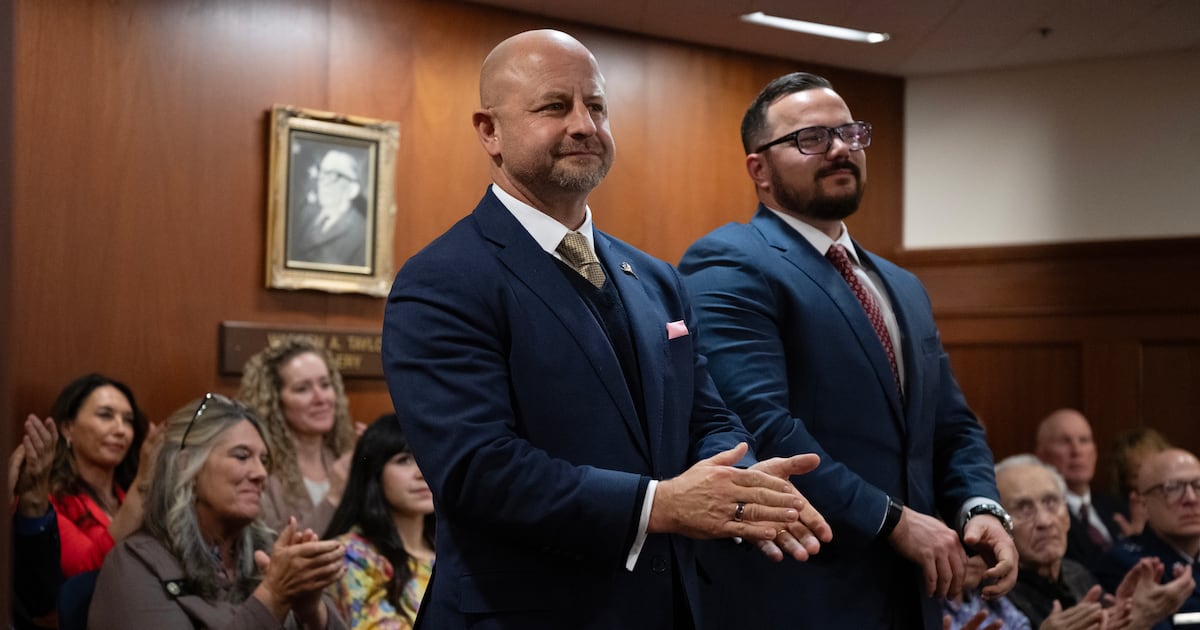
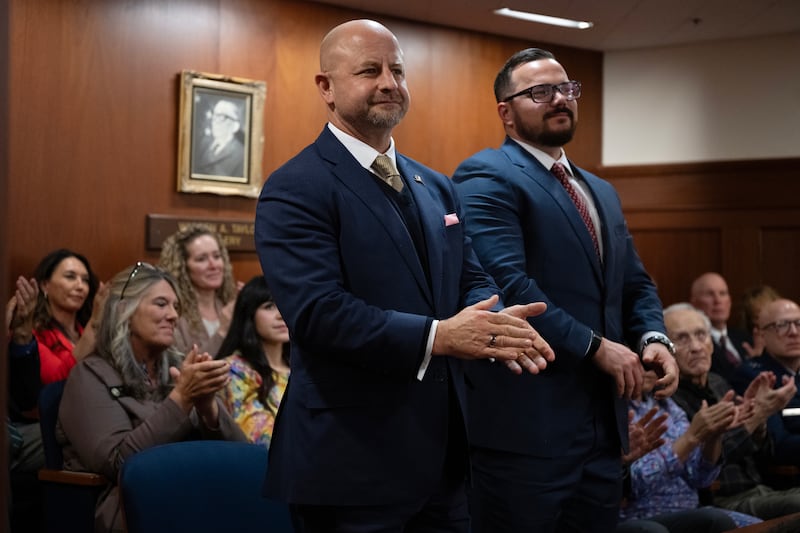
 Glenfarne Group’s CEO Brendan Duval and Glenfarne Alaska LNG president Adam Prestidge are recognized during Dunleavy’s State of the State address in Juneau on Thursday. (Marc Lester / ADN)
The developer of the giant Alaska LNG project said it has completed several preliminary agreements to advance the project, with pipeline manufacturers and builders, as well as gas suppliers and buyers.
Brendan Duval, chief executive of Glenfarne, told reporters in a virtual meeting Thursday that the agreements will set the stage for potential investors and lenders to enter the project.
After the company’s announcement, Gov. Mike Dunleavy praised the project in his State of the State speech, calling it “closer to reality than ever.”
But key state lawmakers cautioned that the Glenfarne agreements aren’t binding. They said major steps still remain for the project to become reality.
Duval said the new deals include preliminary agreements with ExxonMobil and Hilcorp to provide the North Slope gas for the project.
The deals also include letters of intent to supply gas to Enstar, the Southcentral gas company, for 30 years, and to supply gas to the proposed Donlin gold project in Southwest Alaska, he said.
Tim Fitzpatrick, a Glenfarne spokesperson, said the company will not release the new agreements.
Glenfarne has not reached a final investment decision in the Alaska LNG project, though it’s “imminent,” Duval said.
Such a decision gives the project a full green light for development. It was originally expected late last year.
The company expects to start placing pipe in the ground as early as December, he said.
The project calls for up to 800 miles of pipeline from the North Slope that is designed to initially deliver gas to Alaskans, at an estimated cost of $11 billion. That should be up and running in 2029 and account for about 10% of the project’s pipeline capacity, he said.
The next phase of the project calls for large deliveries of LNG, or liquefied natural gas, to Asian countries. That involves the construction of a gas liquefaction plant and shipping terminal in Nikiski, and a gas treatment plant on the North Slope.
The total cost of both phases has long been estimated at $44 billion.
Duval said Thursday that the cost estimate has been updated. The amount will not be publicly released, he told reporters.
Potential investors in the project’s facilities will have the information they need to make a decision, he said.
That could include the state, currently a 25% owner in the project’s development. The state could also own up to 25% of any of the facilities, if Alaska leaders choose to do so.
Mixed reaction from Alaska leaders
Similar projects to tap into the North Slope’s vast quantities of natural gas have failed for decades.
But Dunleavy struck an optimistic tone in his Thursday speech.
“This will be the single most transformative project in Alaska since the trans-Alaska pipeline,” he said.
He praised the progress on the project, and recognized Duval and Glenfarne as the sort of risk-takers who helped build Alaska.
“It was built by people with vision,” Dunleavy said. “Alaska wasn’t built by can’t-doers and naysayers.”
He called the new gas sales precedent agreements with ExxonMobil and Hilcorp a “huge milestone.”
Dunleavy said the project will keep energy prices low, help displace diesel fuel, create new industries, and provide job opportunities to keep young Alaskans in the state.
“We have so much wind at our backs,” he said.
“Industries of all kinds are eager to harness this abundant and affordable resource for decades to come, not the least of which are our Southcentral power and heating utilities facing a looming shortage,” he said. “This project is also a national security priority for the president, a priority for our military bases, and for our allies in Asia.”
President Donald Trump has made the Alaska LNG project a bargaining chip in his global trade war, saying gas sales to Asian countries could dramatically lower the nation’s trade deficit.
Glenfarne has signed preliminary commercial agreements for the full project with gas buyers in Japan, Korea, Taiwan and Thailand.
The preliminary deals could lead to final agreements.
But Alaska lawmakers stressed after the governor’s speech that there are currently no binding gas sales or purchase agreements for the project, and no agreements for its financing.
“So they’re talking a lot about the project, and it feels like there’s progress,” said Sen. Bill Wielechowski, a Democrat and vice chair of Senate Resources.
“But do they have any firm commitments on any of those things? Not that I’m aware of,” he said.
Sen. Bert Stedman, a Republican and co-chair of Senate Finance, said the project has a ways to go.
“You know you have a project when you have take-or-pay contracts and you have access to capital and people are willing to step in and lend the money and put in the equity position,” Stedman said.
“I think we’re making progress, but we’re not there yet,” he said.
Questions about possible state deals, investment
Duval and Glenfarne representatives updated lawmakers on the project in Juneau on Thursday.
In their half-hour-long meeting with reporters, they focused most of their attention on the project’s first phase.
Duval declined to answer questions about any potential, long-term tax or royalty deals that the Alaska Legislature may need to provide to support the project.
Duval said the company will address that question in an upcoming meeting with reporters, likely in the coming weeks.
Dunleavy has said he plans to ask lawmakers for a 90% reduction in the state’s oil and gas property tax to support the project throughout its life, said to be 30 years or more.
Senate leaders said they have many questions on how the project will impact revenue to the state, including the potential for investments in Alaska LNG that could lead to tax write-offs for oil and gas producers.
“We need to look at our current laws, and do they work for this new project,” said Senate President Cathy Giessel, a Republican.
Rep. Zack Fields, a Democrat and vice chair of the Legislative Budget and Audit Committee, said the Legislature will need to see detailed financial information from Glenfarne if it’s going to consider making any investment in the form of equity or reduced state revenues.
“But if they’re going out there and they’re doing a project that is privately financed with private buyers, I wish them success,” he said.
Brad Keithley, a longtime industry observer and former oil and gas attorney, said he doesn’t understand how the state can be asked to consider reducing taxes without knowing what the cost of the project will be, along with other details.
“The question is, tell us what the cost is, tell us what the rates are, tell us what the financing plan is, and then we can evaluate whether we need to give up a piece of the state’s revenue,” he said.
Larry Persily, an oil and gas analyst and former Alaska deputy commissioner of revenue, said Glenfarne has reached a greater level of detail in selecting contractors. But there are still many questions, he said.
“I still didn’t see anything in yesterday’s press release that gave me any confidence they’re close to a final investment decision or that they conceivably would begin construction before the end of the year, as they said they would,” he said. “It seems like we’re building the largest, most expensive gas project in North American history by press release.”
Duval said any potential investors will “have every bit of information and every bit of transparency necessary to make a major investment decision like that at the appropriate time.”
Potential pipe builders, suppliers
Alaska LNG isn’t the only LNG project in the works for Glenfarne.
The company currently has no operational LNG export facility.
But it’s working on smaller projects, including Magnolia LNG in Louisiana and Texas LNG.
Duval said Glenfarne is now working to bring together investors and lenders for the Alaska LNG project, known as equity and debt syndication.
“Having all of these agreements in place allow us to create the financial profile of the project,” he said.
The project is now “investable and financeable,” he said.
Duval said that apart from the effort to line up investors and lenders, Glenfarne currently has “sufficient arrangements” to proceed with the placement of the pipe, he said.
That will keep the project on schedule, Duval said.
Duval said that “manufacturing that pipe and getting it on the water and sent” to Alaska should take place around summer, he said.
A second final investment decision, this one for the full project, is expected a year after the “fully financed” final investment decision for the first phase, he said.
Duval said a final investment decision can take longer for an independent developer like Glenfarne that must pull together investors and lenders, than for a large oil and gas company that “can just pull the funding straight off their balance sheet,” he said.
Duval said the gas supply precedent agreements with ExxonMobil and Hilcorp include the price terms for gas and the length of those contracts.
“And for us that is a that is a huge step towards getting this project up and running,” he said.
He said it’s common for a project like Alaska LNG to establish preliminary agreements that include those terms, which can later be finalized.
“To move through into what we call long-form contracts … you may end up spending a million dollars on legal costs getting them fully put in place, so you have to start with the the key terms,” he said.
“I see it as very unlikely that any of our partners would back out from the terms they’ve agreed in these agreements because we’ve actually selected basically the best companies in the world and domestically to be our partners here, and this is a project of national and international attention,” he said.
“Conditional awards,” which could lead to definitive agreements, were also signed with several pipeline suppliers and builders, Glenfarne representatives said.
They include Greece-based Corinth Pipeworks to manufacture some of the 42-inch pipe.
Different contractors would build the pipeline in roughly 200-mile sections, Glenfarne said. One group of potential builders consists of Texas-based Associated Pipe Line Contractors, and Alaska-based companies Doyon and Cruz Construction.
Glenfarne also recently announced a strategic partnership with container ship owner Danaos, designed to facilitate the construction of LNG tankers and make a $50 million investment in the Alaska LNG in the project.
Duval said the project would employ 10,000 people at its peak, and Glenfarne will be looking to hire Alaska workers and contractors as much as possible.