In a committee room in the Legislative Yuan, Taiwan’s parliament, lawmakers were posing with packs of pet food and toy dogs draped in orange high-vis vests. This was the launch of the Animal Companion Disaster Preparedness and Evacuation Handbook, a guide to preparing pets for disasters and evacuation.
Much of the information applied to natural disasters such as earthquakes or typhoons but for Watchout, a civil-society group that helped to publish the guide, its primary purpose is to encourage pet owners to prepare for an invasion from mainland China.
“If a war might happen, you can do something to be prepared for that, you can do something during that war, you can do something after the war occurs. Then you won’t be feeling helpless,” said Watchout’s chief operating officer Hung Kuo-Chen.
“We’re just telling people what you can do in advance. You can prepare an emergency bag for food and water and find different way to shelter, and to communicate even without the internet.”
For Hung, Taiwan is already under attack from Beijing through cognitive warfare, so that the island’s morale will be eroded through disinformation long before any military campaign begins. Watchout warns Taiwanese citizens that even if they are not serving in the military, they are on the front line.
“Every time you turn on your phone, you are on Facebook, you are on Twitter, YouTube, or even turn on your television, actually, it’s another front line you’re facing. You have to be aware of that. This might be some attack. You have to know how to track different information, like where it’s from, what is its purpose, and is it valid?” he said.
“If one by one, we’ve been persuaded that maybe it’s not that important to defend our country, to defend our democracy, or this place, Taiwan as a country is not that important, it’s not worth it for us to defend ourselves, then by one by one, the whole willingness to defend ourselves, the whole resilience of society will decrease. Then it will be easier for our enemy, for China to invade or to conquer us.”
[ UK approves China plan for its largest embassy in Europe despite espionage fearsOpens in new window ]
The restaurants, bars and cafes of Taipei are bustling, the stock market is booming and the economy is buoyant, driven by high-tech manufacturers including TSMC, the world’s biggest producer of advanced semiconductors. The company’s profits grew by 35 per cent year-on-year in the last three months of 2025, with most of its revenue coming from the most high-end chips used in AI and 5G telecommunications.
But there is an air of unease in Taiwan, as the island feels threatened by Beijing and fears abandonment by the United States under Donald Trump. Meanwhile, Taiwan’s president William Lai and the legislature are locked in a standoff that has seen lawmakers start impeachment proceedings against him.

Ngalim Tiunn, a member of the Legislative Yuan, at the launch of the Animal Companion Disaster Preparedness and Evacuation Handbook. Photograph: Facebook
Last month saw the latest in a succession of increasingly audacious Chinese military exercises around the island that started in 2022 when former US House speaker Nancy Pelosi visited Taiwan. Until then, there was an understanding that forces from Beijing and Taipei each kept to their own side of median line of the Taiwan Strait that separates the island from the mainland.
Since 2022, Chinese military aircraft, naval vessels and coast guard ships have routinely crossed the median line and the People’s Liberation Army (PLA) has maintained a regular presence of naval vessels around Taiwan on an almost daily basis. PLA aircraft carriers now regularly cross over to the eastern side of Taiwan to conduct exercises in the western Pacific.
“During these exercises, the Chinese Communist Party has indeed focused on large-scale scenarios related to an armed invasion of Taiwan, selecting specific situations to conduct on-site drills for its troops. Commonly observed scenarios include joint blockades and so-called joint firepower strikes,” said Chieh Chung, a research fellow at Taiwan’s Institute for National Defence and Security Research.
“During the exercise at the end of December, the focus was notably distinct from other targeted drills. It emphasised so-called anti-access strategies, aimed at preventing foreign military forces – primarily from the United States and Japan – from intervening in the event of an armed invasion of Taiwan.”
Taiwan is at the centre of the first island chain, a Cold War term used by the US to refer to a string of islands and archipelagos stretching from Japan down to the Philippines. If Beijing were to take control of Taiwan, it could limit Washington’s freedom to operate in the western Pacific and reduce its capacity to defend allies in the region.
Ceded by China to Japan in 1895 under one of the unequal treaties that marked Beijing’s “century of humiliation”, the island remained under Japanese occupation until 1945, when it became part of the Republic of China under its nationalist leader Chiang Kai-shek.
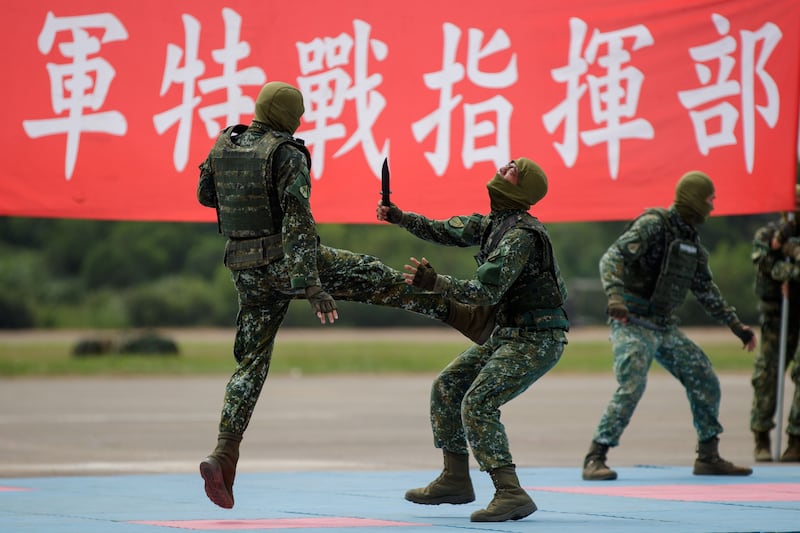
Taiwanese soldiers demonstrate close-combat skills during an anti-invasion drill in 2023
When Chiang lost China’s civil war to Mao Zedong’s communists in 1949, he fled to Taiwan with his supporters, establishing a military dictatorship there and continuing to claim that his was the legitimate government of all of China. Mao asserted that his People’s Republic of China (PRC) included all of the national territory including Taiwan, a claim that has been renewed by all his successors in Beijing.
Washington backed Taiwan’s claim until 1979 when it established diplomatic relations with Beijing and agreed to cut diplomatic ties with Taipei. Other countries including Ireland followed suit, Taiwan was driven out of the United Nations and the island now enjoys full diplomatic relations with only 12 states.
In 1992, a few years after Taiwan became a democracy, Beijing and Taipei reached an informal consensus under which both sides agreed that there was one China but they disagreed about what that meant. Although the terms of the consensus are disputed, it has allowed Beijing to accept Taiwan’s self-governing status for the time being as long as the island does not declare formal independence.
Xi Jinping has intensified China’s official rhetoric on Taiwan since he took office in 2012, declaring that resolving its future could not be left to the next generation. He says he wants unification by consent but will not rule out the use of force if Taipei declares independence, and a US intelligence report claimed that he told the PLA to develop the capability to take over the island by 2027.
Most people in Taiwan worry that Trump will abandon Taiwan. Or even that Trump will entrap Taiwan
— Yi-ching Hsiao
“If a military invasion of Taiwan is to succeed, it must first create an overwhelmingly favourable situation around Taiwan before a US intervention can have an impact. Or it must simultaneously attack Taiwan and be able to repel US military intervention. Frankly, neither of these is easy to accomplish,” Chieh said.
“I personally believe that the likelihood of China using military force against Taiwan in 2027 is not as high as some external speculation suggests – unless a severe political situation arises in the Taiwan Strait or between the two sides of the strait that Beijing finds completely intolerable. In my view, the period of higher military risk is more likely around 2032 to 2035.”
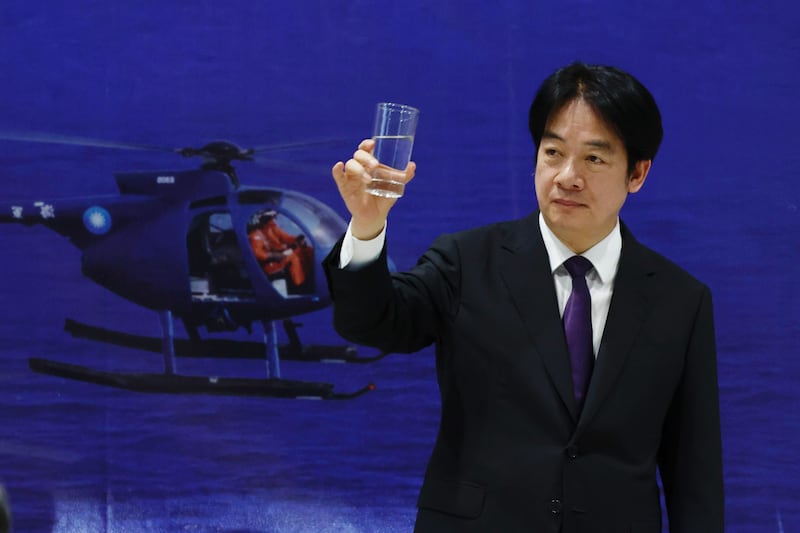
Taiwanese president William Lai in Kaohsiung, Taiwan, in 2025. Photograph: Ritchie B Tongo/EPA
A number of Beijing’s recent military exercises around Taiwan followed what it saw as provocative statements by Lai, who became president in 2024. He has not explicitly called for Taiwanese independence but he has described Beijing as a “hostile, foreign force” and he promotes Taiwan’s distinct identity over the Chinese cultural identity it shares with the mainland.
Lai won the presidency in a three-way contest with 40 per cent of the vote and his Democratic Progressive Party (DPP) lost its majority in the legislature. The opposition Kuomintang (KMT) which favours closer ties to Beijing and the smaller Taiwan People’s Party (TPP) together have a narrow majority.
Lai hoped to regain his party’s edge in the legislature with recall petitions against dozens of opposition lawmakers last year but every one of the recall votes failed to unseat the incumbent. The KMT and the TPP have refused to pass some of the executive’s key proposals, notably a massive defence spending bill.
Last November, the legislature passed a number of amendments to a budget bill which would have transferred more tax revenues from the central government to local authorities. Lai’s administration refused to enact the amendments, the first time since Taiwan became a democracy almost 40 years ago that the executive has declined to promulgate a law passed by the legislature.
“It’s the constitutional custom and in the past, all presidents signed all the laws. It was difficult to imagine that a president or the head of executive yuan could reject a law passed by the legislature. In my opinion, yes, this should be an obligation. But I have to admit that this obligation is not written in the constitution,” said Yang Kuei-chih, whose Plain Law Movement tries to improve public understanding of the law.
“The problem is our constitution has no solution to this conflict between the ruling party and the opposition. Because the legislature is dominated by the opposition but the executive is dominated by the DPP. Both of them consider themselves the real representatives of the people. No one wants to step back and it becomes this big problem.”
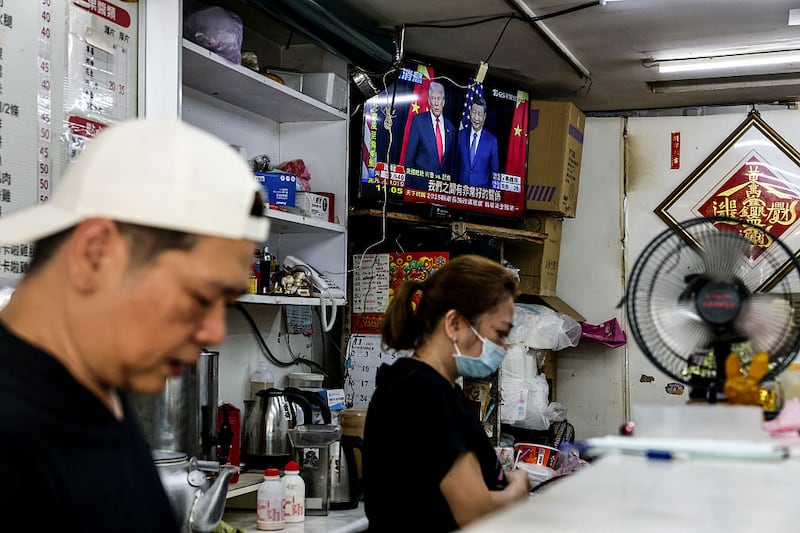
Footage of the meeting of US president Donald Trump and China’s president Xi Jinping in South Korea. Photograph: I-HWA CHENG/Getty Images
The US and Taiwan agreed a trade deal last week that will see Taiwanese exports subject to a 15 per cent tariff, the same as that imposed on the European Union. Taiwan has agreed to offer loan guarantees to TSMC to open more semiconductor factories in the US, a move that could undermine the island’s so-called “silicon shield”.
[ US sets 25% tariff on some chip sales as part of Nvidia dealOpens in new window ]
This refers to the fact that Taiwan manufactures most of the world’s most advanced semiconductors and that disrupting that production could have a catastrophic impact on the world economy. This is perceived as a brake on Chinese military action against the island but the more production is moved overseas, the less effective the silicon shield will become.
Trump’s eagerness for a trade deal with Xi and his indifference to democracy have increased anxiety in Taiwan that he could sacrifice the island’s interests.
“Most people in Taiwan worry that Trump will abandon Taiwan. Or even that Trump will entrap Taiwan. Because the Taiwanese people worry that Trump wants to change his relationship with Xi Jinping and that he will sell out Taiwan,” said Yi-ching Hsiao, director of the Election Study Centre at Taipei’s National Chengchi University.
Washington this month approved a massive, $11 billion package of weapons sales to Taiwan, including 82 sets of HIMARS rocket systems, along with 420 short-range ballistic missiles. With a range of 300km, these missiles are capable of crossing the Taiwan Strait to launch attacks on the southeastern coastal areas of mainland China.
[ Future of US in the Asia-Pacific is under close considerationOpens in new window ]
“If you look at China, China’s strength, it’s the coastal area. That’s the economic centre. That’s the war zone. That’s where everything gets bombed. China’s economy will go back 30 years,” said Tony Hu, a Taiwan-born former United States air force officer and Pentagon official.
“In the Taiwan Strait you can see as far as you want, there’s no place to hide. Oh, man, it’s too beautiful. I mean, for a war fighter, you never get that. Like, the enemy’s right there in front of you, shoot. You, on the other hand, have mountains and hills to hide behind. He’s got nothing. It’s just so perfect, a perfect kill zone.”
Xi has overseen a dramatic expansion and modernisation of China’s military, which now has a bigger navy than the US and the largest arsenal of ground-based conventional and dual-use missiles in the world. But the country has not fought a war since the 1970s and Hu believes that without combat experience, China’s well-equipped military is less formidable than it appears.
“That’s not a war-fighting capability. You’ve got to combine it with people, tactics, strategy. Right now, the Chinese rocket force has a commanding general who is a navy guy. Does he know when to employ those missiles and rockets?” he said.
Should we respond to a political problem with military force? Should we ignore all other means to maintain the peace and stability?
— Prof Alexander Huang
Every military expert agrees that an amphibious invasion of Taiwan would be a difficult and dangerous military operation. But Beijing can put great pressure on the island through so-called grey zone operations which may fall short of the threshold for acts of war.
“I think they’ve shown Taiwan over time, since August 2022, that China is capable and determined, if necessary, to use force to strangle Taiwan, to intimidate Taiwan, to coerce Taiwan without a full invasion,” said Alexander Huang, a professor at the Institute of Strategic Studies at Tamkang University and an adviser to the opposition KMT.
“China does have the capability to fully encircle Taiwan if they are determined to. Secondly, the Chinese prefer to exhaust our spirit, exhaust our aircraft and navy ships, rather than attacking them. Number three is that China has designed and planned their military coercion of Taiwan within the perimeter, so as not to trigger an international response. So, Taiwan feels the pain, but there is no need or no time for an international response.”
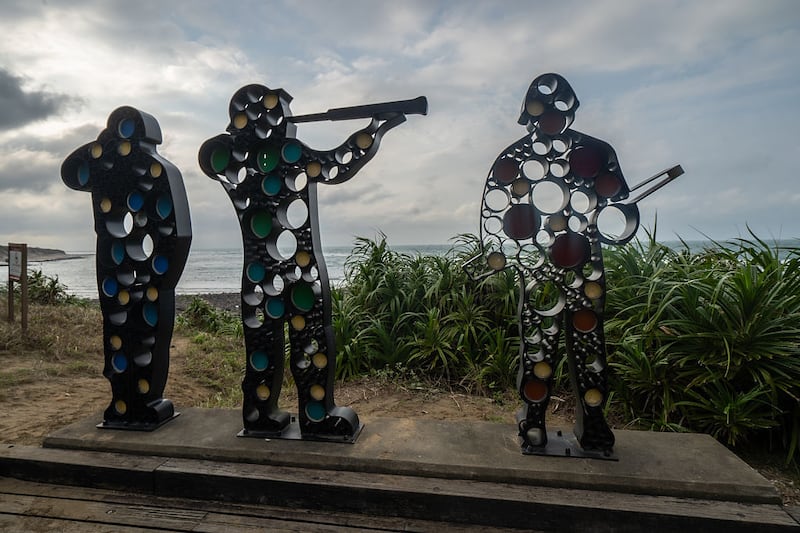
The Three Soldiers, a public art installation by a local Taiwanese artist, commemorates generations of troops once stationed along Taiwan’s rugged northeastern coastline overlooking the East China Sea. Photograph: Giles Clarke/Getty Images
The legislature has voted down Lai’s defence spending bill on the grounds that it is too much too fast but Huang says that if the KMT wins the presidency in 2028, it will continue to buy weapons systems from the US. But he believes that under the DPP, Taiwan has placed too much emphasis on the military dimension to relations with Beijing.
“The relationship across the Taiwan Strait is not only military-to-military in nature. It’s basically 77 years of political differences that have not been resolved. Should we respond to a political problem with military force? Should we ignore all other means to maintain the peace and stability? That’s the big question that Taiwan needs to answer, and the various foreign advisers should think about it,” he said.
“People were lazy or naive to think as long as there is no formal, full declaration of Taiwan independence, then everything will be fine. China does not believe that. Because they witnessed DPP politicians, particularly William Lai, trying to pull Taiwan away not only from Chinese influence, but even Chinese culture and history.”
Huang believes that a KMT government would reassure Beijing that there would be no promotion of Taiwan independence or an independent Taiwanese identity. He says that Lai has made Taiwan less safe not so much because he has provoked Beijing but because he divided the island’s people with his confrontational approach to the opposition.
“He divided Taiwan to the level that we have got this constitutional crisis. It was unnecessary. If he continues with his personality of no compromise or forcing the majority to vote for every budget bill, we will continue to see this gridlock in our parliament,” he said.
“This is during the time when there is huge challenge from the reciprocal tariffs and a huge challenge from the PLA exercises. Making compromises is the basic instinct of any politician, but it seems to me that William doesn’t like it.”