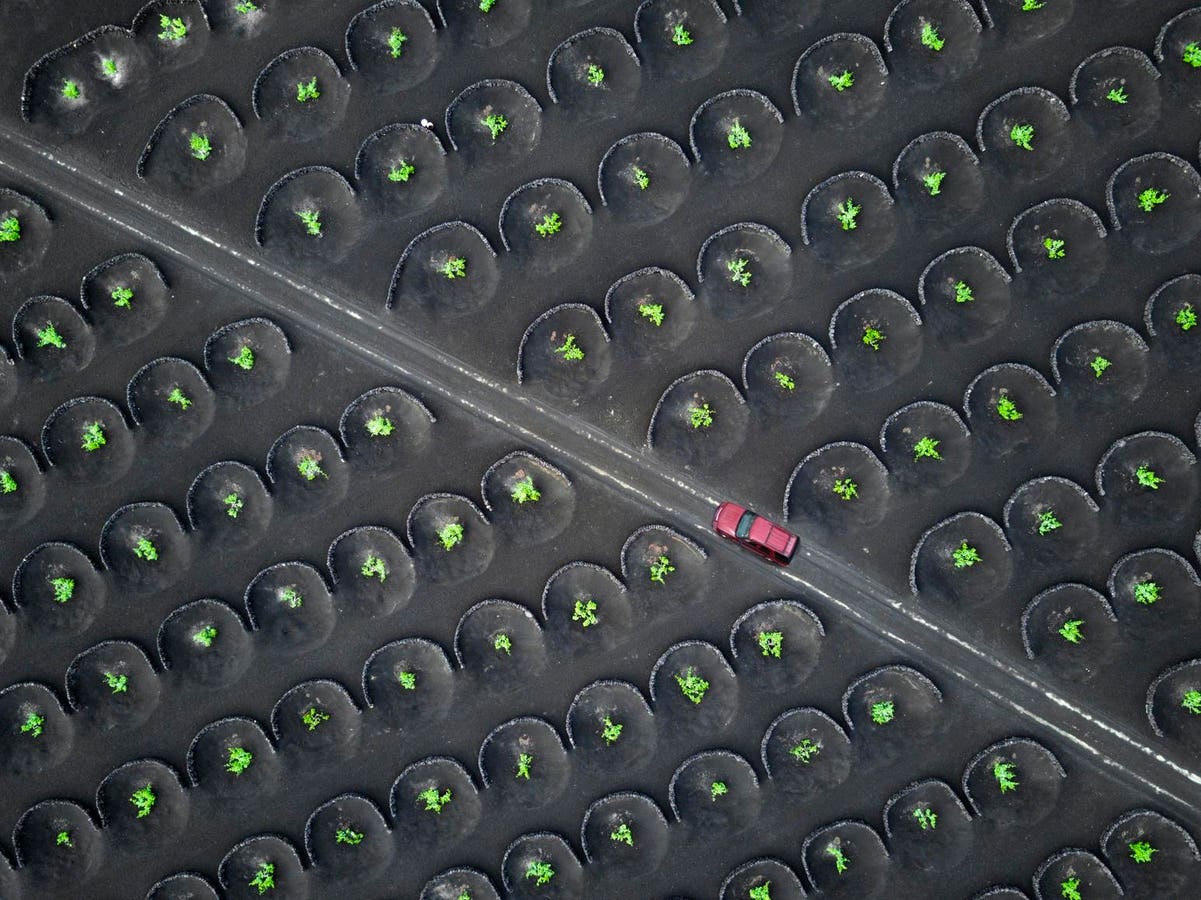
Aerial view of la geria Vineyards in Lanzarote, Spain
getty
If you stand in a vineyard in the Canary Islands, the landscape does not resemble most wine regions.
There are no trellised rows. Instead, black volcanic gravel covers the ground and shallow craters dot the terrain. In the center of each one, a single vine grows low to the earth, protected by a curved wall of lava stones.
This system is one of the most distinctive approaches to viticulture in the world.
A wine region shaped by volcanoes
Traditional vineyard and winemaking plantation techniques in extreme volcanic landscape in La Geria, Lanzarote, Canary islands, Spain
getty
The Canary Islands sit about 60 miles west of Morocco in the Atlantic Ocean. The eight main islands were formed by eruptions, landslides and erosion over thousands of years. Their soils range from light volcanic sand to dense basalt rock, often layered with ash from relatively recent eruptions.
That geology directly influences how wine is grown here.
Despite a subtropical climate, rainfall is limited, freshwater resources are scarce and Atlantic trade winds regularly sweep across the islands carrying salt and humidity. By conventional standards, much of this terrain would be considered difficult for agriculture.
ForbesThe Future Of Oak: How Rioja’s Barrel Tradition Is EvolvingBy Emily Price
Wine has been made here since the 15th century.
After Spanish colonization, Malvasía wines from the Canary Islands became widely known in Europe in the 16th and 17th centuries. These wines were shipped to other continents and consumed in royal courts. Over time, demand declined as preferences shifted toward French and Portuguese wines, and the industry contracted to small-scale local production.
One historic producer that remains is El Grifo in Lanzarote, founded in 1775.
A current example from this producer is El Grifo Malvasía Volcánica Seco (Lanzarote). The wine is dry, with notes of lime peel, green apple and sea spray, supported by firm acidity and a saline finish.
Appellations across the islands
Lanzarote Island, Canary Islands, Spain
getty
Wine is produced on seven of the eight main islands under a network of protected designations. Tenerife alone has five. A broader Islas Canarias designation allows wines from anywhere in the archipelago to carry a shared identity.
The islands differ significantly. The eastern islands are lower in elevation, geologically older and much drier. The western islands are steeper, higher and shaped by varied microclimates created by altitude and cooling trade winds.
Tenerife, dominated by Mount Teide, contains some of Europe’s highest vineyards and a wide range of wine styles.
Rainfall in places like Lanzarote can be minimal. Traditional irrigation was not part of the system.
Instead, vines rely on humidity from ocean air. The porous volcanic ash, known as picón, traps condensation from morning dew and slowly channels moisture toward the roots.
This contributes to the bright acidity found in many wines from the islands.
Los Bermejos Malvasía Volcánica from the region shows citrus, tropical fruit and a stony, salty backbone that reflects these growing conditions.
The crater vineyards of Lanzarote
After eruptions in the 18th century buried farmland under ash, growers adapted by digging large pits called hoyos. Each vine is planted at the bottom of its own crater and protected by a curved wall of lava stones.
These craters help retain moisture, reduce wind exposure and create a warmer microclimate as dark stones absorb and release heat. Trellises are not used and all work is done by hand.
On Tenerife, the cordón trenzado system trains vines into long, braided strands that run horizontally across the ground. This method improves sun exposure and airflow in steep terrain.
Ungrafted vines and indigenous grapes
A vertical closeup shot of dark grapes growing on the branches of a vine in Tenerife in Spain
getty
The Canary Islands were never affected by phylloxera. Vines grow on their original roots and some are more than a century old.
More than 20 indigenous grape varieties are recognized here, along with many additional genetic variations. Malvasía Volcánica, Listán Blanco and Listán Negro are widely planted. Other grapes include Baboso, Vijariego, Negramoll, Albillo Criollo, Gual and Verijadiego.
Volcanic soil does not contribute a specific flavor. It affects how vines grow. These soils are low in nutrients, drain quickly but retain small reserves of moisture, and warm rapidly in sunlight before releasing heat at night.
This results in low vigor, small berries, concentrated fruit and preserved acidity.
Efforts in recent years have focused on recovering ancient grape varieties and highlighting the distinctive conditions of the islands. The wines have gained recognition in international competitions and among sommeliers and critics.
These vineyards are labor-intensive and difficult to farm. Sustaining this tradition depends on continued local commitment and growing global interest in wines that clearly reflect their place of origin.