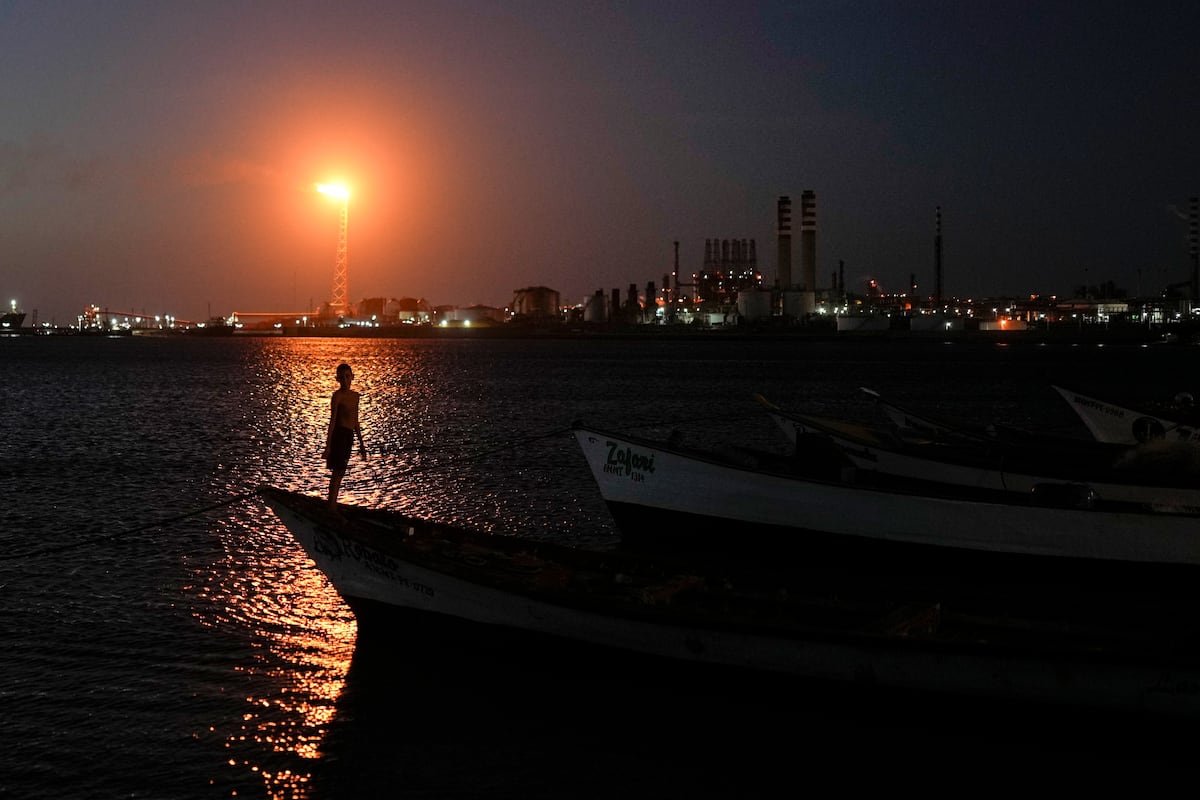
The future of the economy in a Venezuela without Nicolás Maduro depends on legal reforms that the Chavista government is quickly initiating. Debate on reforms to the hydrocarbons law began Thursday at the National Assembly, a first step towards allowing foreign capital to take part in the exploitation and commercialization of Venezuelan oil, under the watch of the United States. It marks the beginning of a new period of détente, leveraged by the oil business, which Washington negotiated with the Venezuelan government following its military attack and capture of Maduro and his wife, Cilia Flores, on January 3.
Primary proposed modifications to the law focus on opening the doors to the oil sector’s privatization and the reduction of governmental control, after years during which the Chavista regime sought to centralize the economy. Until now, joint ventures — in which the Venezuelan government held a majority stake — were the only way for foreign investment to enter the country’s oil industry. Now, the reform looks to allow private companies domiciled in the country — within the framework of contracts signed with the government — to participate in the primary sector.
The debate came to a National Assembly with a minority bloc of opposition leaders, and the plan was approved in the first of two discussions. After a quick reading of the articles, the Libertad bench, led by opposition leader Henrique Capriles, abstained. Earlier, before the session began, Representative Stalin González stated in a message on his social media accounts that his parliamentary group had not received the proposed amendment to the law. “They talk about coexistence, but their exclusionary and discriminatory practices remain intact,” he wrote on Instagram.
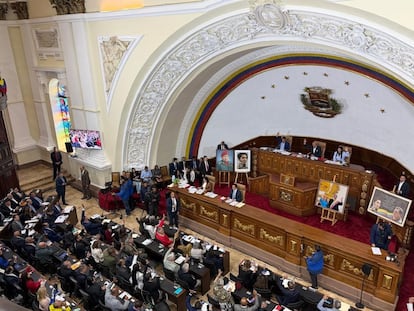 Voting at Venezuela’s National Assembly on Thursday.ASAMBLEA NACIONAL DE VENEZUELA E
Earlier in the week, opposition lawmakers called for a broad discussion of the legal reform at a press conference. “We would like to know the scope of the new energy agreements and what changes are being sought in the law. Let’s not be afraid of debating oil issues in this country,” said Capriles.
Among the modifications is one related to the 30% share currently due to the Venezuelan government for extractions from deposits. That rate can be lowered to 20% if it is determined that a mature or extra-heavy oil deposit, such as those in the Orinoco Belt, is not economically exploitable with the higher rate of concession. The reform proposed by the executive branch reduces that percentage to 15% in the case of joint ventures, though it would remain at 20% for private companies.
The direct sale of crude oil to companies is also currently allowed, but an article has been added to the proposed legislation stating that disputes and doubts regarding that regulation can be resolved in local courts and through independent mediation and arbitration. Beyond the exploitation period, ownership of oil fields would remain with the Venezuelan government.
Access to Venezuelan oil is the primary demand of Donald Trump’s administration, and Chavismo is responding swiftly. Agreements between Caracas and Washington have already been finalized, with a first sale of crude oil for $500 million, of which Venezuela has received $300 million.
In a meeting between Trump and U.S. oil companies a few days ago, representatives of various firms showed interest in investing in Venezuela, but also demanded legal and political security. In the era of Hugo Chávez (1999-2013), the expropriation of Exxon Mobile and Conoco Phillips’s assets — which was followed by lengthy litigation that is still ongoing — deterred foreign investment. During Maduro’s administration, assets of U.S. companies in other sectors were also confiscated.
Venezuela’s interim president Delcy Rodríguez has announced that her goal is to incorporate figures from the private sector, as provided for in the anti-blockade law. That instrument has allowed for negotiations under confidential agreements with private capital close to the government for the recovery of companies and sectors that Chavismo nationalized and bankrupted in previous years.
Two other regulations discussed on Thursday were approved quickly. They relate to socioeconomic rights and the streamlining of procedures. The latter gives the Venezuelan president the power to suspend, reduce, or repeal any type of procedure, law, or resolution that contravenes the “acceleration and optimization” of administrative procedures.
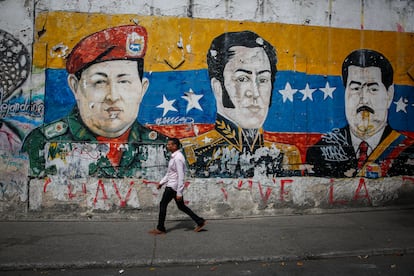 A mural depicting Hugo Chávez, Simón Bolívar and Nicolás Maduro on January 30, 2019 in Caracas, Venezuela. Marco Bello (Getty Images)Military changes
For his part, Defense Minister Vladimir Padrino López announced changes among the highest officers of the Armed Forces, after the armed incursion of the U.S. Army on January 3 that incurred 79 military casualties, killed four civilians, and left military installations and homes destroyed.
“From here, before the Venezuelan people, following the precise instructions of the acting president Delcy Rodríguez, we are carrying out throughout Venezuela the new appointments that have been decided for the command structure of the Bolivarian National Armed Forces, which have no other purpose than to ensure the continuity of the force’s operational units,” he said, before a formation of cadets.
The changes have been made official, for the time being, for the heads of the comprehensive defense zones of 14 states and regions of the country. The announcement was made from Fuerte Tiuna, one of the facilities most affected by the attacks, and where Maduro and his wife were captured. Padrino said that the president is a “prisoner of war” and that both Maduro and Flores “are free of all charges” brought against them in a New York court.
“It has been 465 hours, 19 days since this military fort, this very space where we are now, was attacked by the world’s leading lethal nuclear power,” Padrino said. The minister added that Venezuela was used by the United States as a “laboratory” to carry out a “systematic bombing, assisted by the highest level of artificial intelligence ever tested.”
Sign up for our weekly newsletter to get more English-language news coverage from EL PAÍS USA Edition