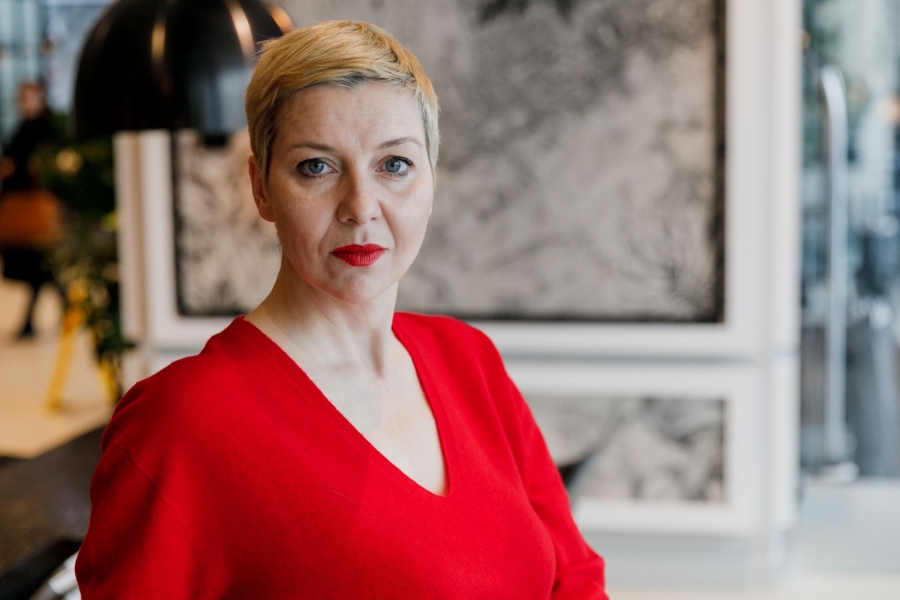
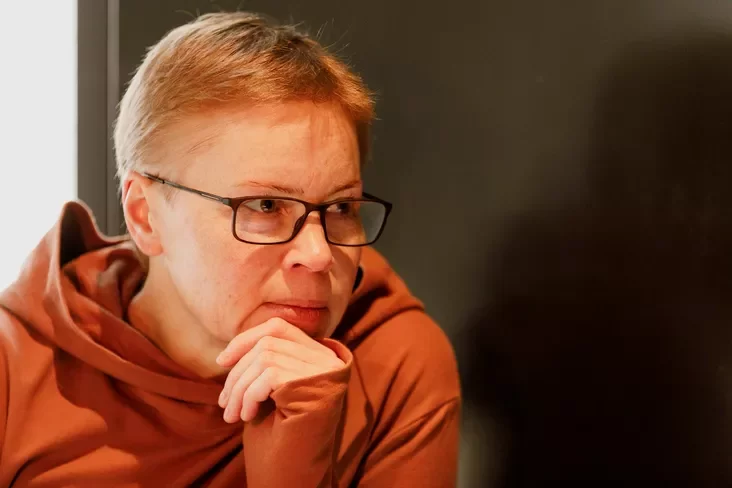
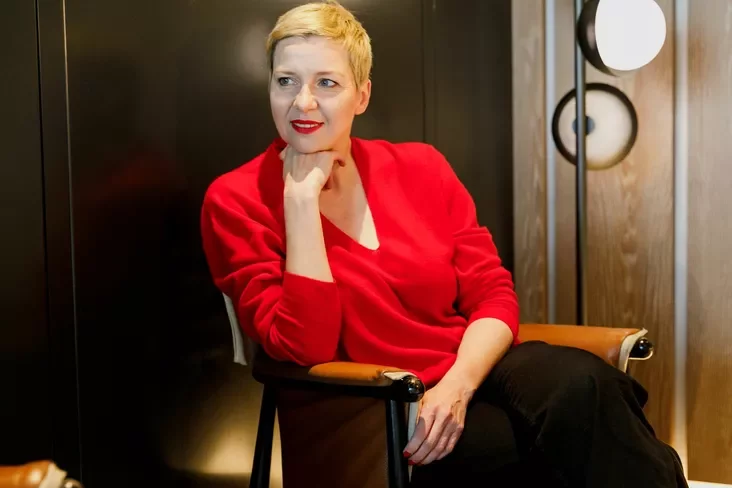
But now, it seems, everything has come together. A month after her release, Kalesnikava is blonde again. But her signature trait is not the color of her hair or red lipstick, but (using her terminology) an incredible smile with which she brightens her surroundings: like-minded people and opponents, cellmates — pleasant and not so much, staff of the pre-trial detention center and the penal colony, simply strangers. We practically didn’t cross paths in the pre-trial detention center, although we were in neighboring cells, but Masha was carefully hidden from other inmates of Valadarka. However, we often saw each other in the penal colony, and for three weeks we even spent time in the same unit. And during all this time, I never saw Masha gloomy or with a dim gaze. On December 13, 2025, we were taken out of PC-4 and out of Belarus. We are recording the interview in Warsaw.
The text was published on the Telegram channel of Tut.by chief editor Maryna Zolatava.
— Masha, hello. What do you want to talk about more — prison or freedom?
— About everything.
Sanctions and human lives: “People are more important”
— Then let’s talk about a very specific thing, one that concerns both you and me. Katya Bahvalava, Iryna Melcher, my wonderful Liudmila Chekina, Irachka Zlobina… Many, many women, women of retirement age, women who sent us parcels to the pre-trial detention center and received sentences of 3-4 years for it. They are now in the penal colony. Do you have any ideas, any plan – what to do to get them released?
— We are now moving into the realm of politics…
— I don’t know, you can call it whatever you want, it’s a question on the surface, not even a question, it’s pain. I personally can’t calmly accept this, knowing that now the girls in the penal colony are clearing snow…
— Minus 20, yes, can you imagine?
— Those quilted jackets, which after the first or second wash are no longer quilted jackets at all.
— Wet shoes… By the way, I check the weather forecast every day; I even have Homiel set in my settings. It’s always cold everywhere, plus there’s snow, and I catch myself thinking about the girls several times throughout the day… And I, like many others, am also looking for opportunities to help people get released. From my side, I can only say that my sister Tanya [Khomich] has been involved in advocacy and the issue of political prisoners since 2021, and the strategy she chose is obviously successful, given that we are talking here now. This means communication with politicians, communication with people who make decisions. In our case, [Donald] Trump, his administration, and the Belarusian authorities played a role. And perhaps European politics should also look in this direction and somehow change its rhetoric. If it works with America, why wouldn’t it work with the EU? We are closer to the European Union. Germany is closer to Belarus and needs Belarus, and Belarus needs Europe. Why not? If pure pragmatism works, and people can be free, why not take advantage of it? Because sanctions, okay, sanctions… But people are more important. The conditional desire not to lift restrictions or the desire for some dialogue — these cannot be compared with human lives, and we are now specifically talking about people’s lives, isolation, and the pressure under which almost 9 million Belarusians continue to live.
— I wanted to clarify: what are you already doing now and what steps are you ready to take to get the women released?
— I convey my vision. I only have one tool – myself; I don’t have media or any access to other tools. The people I meet, I explain to them why, for example, it is important for the European Union to also enter this track of dialogue – starting a conversation with authorities they do not consider legitimate. I explain why this is important and necessary. And if America does it, why can’t the EU?
Павялічыць
On the “only right decision” for Lukashenka: “If you are a strong person, you show mercy”
— And why can’t you directly appeal to the Belarusian authorities and tell them that it is in their interest to release the women? And not just the women — all political prisoners?
— I’m not sure they will hear me.
— It directly depends on them. Lukashenka can release people, right? After all, it’s not done by order of Trump or EU officials; only Lukashenka can do it. Can you explain to the Belarusian authorities — if this is the case, of course — that releasing political prisoners is in their interest? Do you have suitable words and arguments for this?
— How can obvious things be explained? I don’t know how to explain why the sun shines and it gets hot.
— In the Year of Women, releasing women is…
— That would be a super PR move, absolutely. The same as if I had been left in the country instead of being expelled to Germany, that would also have been a super PR move. But for some reason, such things are outside the authorities’ field of vision, I don’t understand why.
But, perhaps — I’ve heard this idea — they are afraid to appear weak, and if they release people, they supposedly show weakness. In reality, it’s actually the opposite: if you are a strong person, you show mercy, you are capable of making such ambiguous decisions. We understand that such decisions might be unpopular among his inner circle or the security forces, but in the long term, they are actually the only right ones. This fear of appearing good and weak, though kindness is strength, it seems to me, is also obvious. Being evil is very simple: you just cut everyone down, took a hammer, hammered all the nails around you, and everything is great. But it seems to me that this would be a demonstration of both strength and wisdom, because there would not be a single person who would criticize it, and all of us, and I would be the very first, would thank him for it. As I have, in fact, already done.
I am not ashamed of my words: I am truly grateful that people were released, and I am grateful for every single person, and I am ready to talk about it, and it absolutely doesn’t matter if I’m pelted with tomatoes, because there is nothing more important than human life. And those of us who have gone through this meat grinder, we have the moral right to say whatever we want and to express gratitude for such actions. We have this right, and I will use it.
Release: “I did not expect it to affect me too”
— Let’s go back to the events of a month ago… December 12th, we came to work, before lunch Masha disappears somewhere. Rumors spread through the factory: she’s already been released… Then it starts: no, Masha has been taken from the factory so many times, and each time she returned… I come from work to the unit, I see a ticker in the news: Belarusian-American negotiations are taking place in the Palace of Independence, and I realize that “Masha was released” might not be so far from the truth. But then Masha is led to dinner, Masha is led from dinner… How was your day? What were your expectations, anxieties, were there any alarm bells?
— I knew that a meeting had taken place, and I very much hoped that people would be released, and this time more than usual. I didn’t expect it to affect me too. Early on Saturday morning, even before the check, I found out that 20 women had been released. Because at night, apparently, someone saw some movements of people. I just walked around almost shouting with joy that it had happened. I went to work very happy, I was very happy sewing until at some point an officer came up to me and said: “Maria Aliaksandrauna, it’s over.” I said: “What do you mean, it’s over? I’m still sewing.” And he said: “Maria Aliaksandrauna, this time it’s really over.”
Павялічыць
New world: “If you don’t take a side, they start to hate you”
— How was this month?
— Very fast. Many joyful events. Dad, sister, cousin with family, relatives in general, many friends… I’m really looking forward to meeting everyone. I’m not as active on social media as before. What worries me a bit is how they’ve changed.
— Any other upheavals, visual ones? Perhaps you noticed any changes?
— Yes, I even came up with a term for it. It sounds good in German, in Russian — a terrible surprise. I was already terribly surprised or badly surprised. A surprise bordering on fascination, because of how society has changed. I’m not talking about Belarusians now, but in general. Six years ago, it was impossible to imagine people allowing themselves to openly spread hatred in any public space, in the media, or in conversations with each other. Now hatred has not just become a language of communication. Now, if you don’t take a position on one of the sides, they automatically start to hate you.
— “He who is not with us is against us”…
— I think this is very scary, because if we believe that we, the European community, are building democracy and that we are committed to the values of democracy, but if we are not ready to listen to another person when they express an opinion with which we disagree, then democracy ends there, you can put a period and call it something else. And this is what struck me the most, and what I cannot agree with.
Plans for the future: “Return to normalcy”
— I know that thousands of people (and I among them) want to know the answer to the following question. A month has passed. What are you going to do next?
— There are three directions in which I want to develop. The first is culture and art, because I am still a person from that environment. I’ve really missed what I used to do.
The second direction is, of course, politics, the socio-political direction. Now I will more precisely formulate our position on political prisoners and the situation in Belarus as a whole — and I will broadcast it. I am invited to a number of meetings and events. For example, to the Munich Security Conference, where I will have the opportunity to express my position and our vision for solutions.
And third. I am very interested in continuing to engage in creative business. And, perhaps, I will find a form in which all these three directions will be somehow connected.
— Okay, let’s talk in more detail about the socio-political direction. How would you formulate your position?
— The situation in Belarus is very difficult. But from any difficult situation, there is always some way out. I have a vision of what it could be. To formulate it in two words, it’s “a return to normalcy.” I really like this phrase.
A return to normalcy is not a quick process or one that happens in a single day. It is a gradual reduction of pressure on society and business, bringing the country out of isolation. It involves stopping arrests, suspending repressive laws, allowing people to freely read news, travel, conduct business, and develop civil initiatives, to calmly return to the country, and obtain documents abroad. This requires clear and predictable rules — both for the return of people and for the work of independent media and civil society.
I think everyone is interested in this. People who remained in the country, people who were forced to leave the country. We all want to return home, to our relatives, to our friends, to visit graves — I, for example, to my mother’s grave. And we want Belarus, as we imagine it, to exist. Now it seems unrealistic. But in history, nothing has ever lasted forever. And the situation that has developed in our country will one day end. And why not start now to form the atmosphere and groundwork for further political transformation to happen less painfully or with minimal upheaval?
Is such a return to normalcy possible under the current government? Previously, under Lukashenka, many of these things existed. Whether it’s possible now is a difficult question. But Western partners can talk about this, and the authorities within the country can also understand the importance of this process.
Павялічыць
— In your opinion, are the current Belarusian authorities interested in such a return to normalcy at all?
— It seems to me they even broadcast this: the restoration of normal relations with neighbors, with Europe. These are not my fantasies; this is what I hear periodically. Opening borders, restoring ties, the return of people, the return of business. I am sure that it is important and necessary for the Belarusian authorities for business to return, for active Belarusians who know how to work to return… The other thing is that our understanding of “normalcy” is certainly a bit different. If it were the same, there would not have been five years of repression and ideological indoctrination.
— But the return of active people — I’m trying to put myself in the shoes of the current authorities now — could be perceived as a threat. Because for the authorities, the most important thing is still to preserve and strengthen their power…
— Of course, such risks exist for the authorities. But let’s be honest: today, the situation in the country is largely under control, and this should also be realized within the system. Perhaps there is an understanding that constant tension in society cannot be a strategy for decades to come, and that it needs to be gradually reduced, making the country more open.
Yes, it is always a challenge to meet with people who have a different point of view, who can ask uncomfortable questions. It is difficult. But, perhaps, this is where strength is manifested — if you can allow yourself such a dialogue, you can take a step towards normalization.
I am not currently considering the war with Ukraine, although, of course, it strongly influences everything happening in Belarus. But when it comes specifically to our country and Belarusians, it’s about the most basic, simple things: opening borders, the return of people, normal transit, normal physical movement.
Such normalization would allow not only to reduce internal tension but also to gradually start restoring economic ties with Europe. International organizations, projects, cooperation formats would begin to return — things without which a modern country simply cannot develop normally.
On dialogue: “For the Belarusian authorities, I am more of an opportunity than a threat”
— You often use the pronoun “we.” Who is “we”?
— These are the people who were once in Viktor Babariko’s headquarters.
— Does that mean you and Viktor Babariko are continuing your activities together?
— Yes, you could say that. We are currently trying to formulate it for ourselves, because it’s impossible to just get out of prison like that and immediately present some program the next day. Each of us has our own strengths and weaknesses.
— And the ultimate goal of your team’s activities?
— A return to normalcy.
— Do you or Viktor Dmitrievich have any political ambitions today: to come to power in Belarus, to occupy any key positions?
— I certainly don’t. It never interested me. I am still a person to the core from art and culture; I value my personal freedom above all else. I believe that people who engage in state building, who work in power, to some extent do not belong to themselves. Personally, for me now, it is very important to belong only to myself and to be responsible for my own life.
— And does Viktor Dmitrievich want to be the president of Belarus?
— He should answer that question himself.
Павялічыць
— It’s clear that you have already met Sviatlana Tsikhanouskaya, and you have some idea about Belarusian political activities in exile. What do you think about it in general?
— First of all, I was very happy to see her. I understand what a great burden she has taken upon herself, and she is honorably walking this difficult path. Not many people could have lasted this long. I think that for many Belarusians, she is very important as a symbol of resistance. In some things, perhaps, we may differ with her, but all of that means nothing to me. I have a very good human relationship with her. I understand that she has her own direction, her own vision for her activities. We have ours.
There’s an expression: there’s room for everyone on stage. It seems to me that this applies to politics, to the current situation in Belarus and in the world in general. Everyone has their own vision, their own tools, but we have some main goal. And if everyone, from their side, makes some positive efforts to return to normalcy, then that’s not bad.
— I got the impression that Sviatlana Tsikhanouskaya’s strategy is to strengthen sanctions against Belarus. Do you agree with that?
— I do not agree with such an approach; my first interview in the FT recently came out, where I laid out my vision. Sanctions are imposed so that they can eventually be lifted, and if sanctions hit ordinary people and businesses, there is nothing good in that. I present this position not with the aim of criticizing anyone. Least of all do I want a “divide and conquer” situation. Least of all do I want to exacerbate our “differing views.”
— Recently, I’ve seen several proposals and reflections on the topic that it would be good to establish some dialogue with the Belarusian authorities. Are you ready for such a dialogue?
— Absolutely.
— And where would you start it? “Let’s talk about…”
— Let’s release people. And on a global scale: we have one Belarus, we have nothing to divide. The future of the country depends on us and on you. And if there is even one chance that such a dialogue can take place and that it can lead to some positive consequences, I believe it is worth pursuing. I understand that this sounds very strange coming from a person who has been through hell, I understand that this is a very unpopular opinion, but I believe that the lives of people (not only those in prison, but also ordinary Belarusians who are also in a prison, without being in a penal colony) are worth talking about, even with Lukashenka.
— You said you would like to return to Belarus. When do you think that might happen?
— I want it to happen tomorrow. But it will probably happen when they stop feeling any threat from me. By the way, I don’t really understand why they feel threatened by me, because for the Belarusian authorities, I am more of an opportunity than a threat. Because I can actually talk, I understand that in some situations, compromises can be made. If there is a common goal, it doesn’t scare me.
That same day: “Managed to leave the car through the window and go towards Belarus”
— Let’s go back. Do you remember what happened on September 7, 2020?
— Yes, I remember very well.
— So you woke up on the morning of September seventh, twenty-twenty, and…
— I got ready and went to the post office; on the way, I met, by the way, Zmitser Lukashuk, who walked with me for some distance. And then some strange men escorted me into a minibus. I managed to throw my phone onto the roadway, but they later retrieved it. And throughout the day, various conversations took place, which were supposed to convince me to leave the country. From the very beginning, I conveyed my desire to stay in Belarus. Even during these many hours of conversations with different people, I still did not give up my desire. The moment I was forcibly put into a car with Ivan, I saw three passports there. I found mine, tore it up, and threw it out the window. And it was clear to me that without a passport, in theory, no country should accept me. And, apparently, this became clear to those who were trying to expel me. We drove a little further, and I asked to stop the car. The doors were locked from the outside, but I managed to get out of the car through the window and walk towards Belarus. There, people I knew put me into a minibus and sent me to the Mazyr border detachment, where I spent the whole day, and at night I was already transferred to pre-trial detention center No. 1.
— On September seventh, you were interrogated at the KGB, correct?
— At GUBOPiK and the KGB.
— And who were these people? Do you know them?
— I know, but I won’t name them.
— How did they talk to you: politely, rudely, what specifically did they tell you?
— At the KGB, they spoke to me politely; at GUBOPiK, the roles were distributed between good cop and bad cop — depending on the situation. There were moments when they spoke to me quite sharply, to which I, as always in such cases, reacted simply: I refused to talk. But overall, the conversation was more or less calm.
— What happened after the arrest? You were brought to Minsk…
— To the Investigative Committee. There, they presented me with a decision about my placement in pre-trial detention center No. 1. All of this happened late at night; I found myself in Valadarka around one in the morning. In the morning I woke up… although it’s impossible to call it sleep. By that point, I had barely slept for two days and physically felt very unwell. And I could barely eat anything. I understood that my relatives were very worried, and I constantly asked for them to be informed of my whereabouts and for me to be connected with a lawyer. She was only able to reach me after noon on September 9th. They found out I was in the pre-trial detention center when the investigator called my dad and said that the apartment I rented would be searched. Then a lawyer immediately arrived, and on the same day, they were able to give me things and food. That, of course, was very cool.
About the stolen time: “The most terrible thing is when you realize you can’t hug your grandmother or grandfather one last time”
— In the cell itself (I think it was the 82nd), no one knew who I was, but overall, the attitude was absolutely correct. They told me that a few hours before my “arrival,” they were all gathered from different cells. I “traveled” through several other cells — both in Zhodzina and Valadarka — and everywhere the convicted persons behaved very correctly towards me. Overall, I didn’t experience great stress specifically from where I was. I, of course, understood that it was horror, some kind of Middle Ages.
— Yes, I remember cell 82, I was there too. In the pre-trial detention center, in Valadarka and Zhodzina, was your communication with relatives and loved ones normal?
— At first, they even brought me mountains of letters that arrived for me, although not all of them reached me either. Somewhere from mid-November 2020, their number sharply decreased. And from spring 2021, there was a period when I received almost no letters from my dad, from my sister, and almost no one at all for six months. But I had the opportunity to communicate with lawyers. There were difficulties there — for example, with time: sometimes meetings were too short, sometimes there supposedly weren’t any offices available. But overall, once a week, and sometimes even twice a week, I had the opportunity to talk with lawyers. I am, of course, very grateful to all of them for this time, because I received a lot of invaluable experience from them, which I later needed when defenders were no longer allowed in.
— Do you consider these five and a half years lost time?
— No, for myself personally — no. But the greatest suffering these five years brought was the inability to communicate with loved ones. During this time, I, like many others, lost relatives. And the most terrible thing is when you realize you cannot say goodbye, hug your grandmother or grandfather one last time, say some warm words, or hold their hand. All physical and, to a lesser extent, psychological problems (I had almost none of them) — are nothing compared to the realization of this loss.
Ulcer and operation: “They saved my life”
— Much was written and said — both in the pre-trial detention center and later in the penal colony — about your health problems. Tell us what happened to you and how seriously it affected you?
— To be honest, I don’t really like bringing up this topic, because for me it’s already in the past. When you talk about it, you return to that situation again, and I have already overcome it and moved on.
— I had an operation in Homiel after I was in the punishment cell (ShIZA). They saved my life — the surgeons, the doctors who operated on me. Then I started thinking: for some time I wasn’t given help, but at a certain moment, the decision was made to provide that help… This means that some person or some people in the colony’s administration took responsibility for calling an ambulance and taking me to the hospital. And I realized that I am personally grateful to these people or this person. My whole family is also grateful, because if it weren’t for that specific decision, then, of course, I wouldn’t be sitting here next to you now — I simply wouldn’t exist. And this realization that the people on whom my life depended could have not called an ambulance, but nevertheless, despite everything, decided to save me, in some way, perhaps even fundamentally changed my worldview or attitude towards these people.
— But still, leading up to the operation itself, when the situation was probably critical, did you complain to the penal colony administration about health problems?
— In the ShIZA itself, yes, but before that I didn’t have such obvious problems. But something went wrong in the ShIZA; the conditions somehow affected my physical state. For example, when you can’t sleep for a long time, apparently something happens in the body. And so I developed a disease that I had never had before — an ulcer. At 42, I didn’t even imagine where the stomach was. Yes, I reported that I felt unwell.
— Did they not react to your signals at all? Why did it still reach such a state that an operation was needed?
— I think it’s about my reaction in general. Overall, I behaved very calmly in prison and in the punishment cell as well. The doctors later told me: if you had screamed from pain, they would have immediately believed that you were unwell. But I was in so much pain that I couldn’t scream. At the moment it all started, I just cried. Perhaps they simply didn’t believe it was that serious.
But overall, I thought a lot about it. There is such a global difference in the attitude towards people in our country and in Europe — from the perspective of the state system. In Europe, no matter what, the person is at the center of everything. There’s an expression: “Sometimes it’s better to err on the side of caution.” And I often saw myself how this works in Germany: if you can say “yes” and “no,” they say “yes.” Even if you might be lied to or manipulated. That is, it’s easier for Europeans to make a decision even to their own detriment. And in our country — on the contrary: it is believed that if you help people, you are weak. And that is a threat. It’s a matter of trust in the environment, in each other. There is such a difference, and I feel it very well.
— Do you feel good now? Have you recovered, are you healthy?
— Better now, I’m in the process of recovery. I have plans for more intensive recovery and returning to my active sports rhythm. And if it works out, you and I will run the marathon in Berlin together. Maybe I’ll run at least five or ten kilometers. I’m very optimistic. I’m already doing some workouts as much as possible; I really enjoy it — it’s something I’ve missed for many years.
One and a half years of isolation: “They tried to convince me that no one was writing to you, everyone had forgotten you”
— You were taken to the hospital from the punishment cell (ShIZA). And how did it happen that you were in the penal colony, and in the punishment cell, and in the PKT (Prison-Type Unit)? Why was all this happening to you?
— Well, purely technically, it happened because there were supposedly some violations for which I was punished. But it’s clear that these violations did not occur in most cases.
— Can you recall why you first ended up in the punishment cell?
— Because there was some violation, supposedly related to impolite treatment of staff. I don’t remember exactly now.
— Yet I saw and heard how you spoke with the administration. Communication was always extremely correct. It amazed me how you could communicate with the colony staff at such a level. Do I understand correctly that you ended up in the PKT after being in the punishment cell several times?
— No, not exactly. First there was the punishment cell (ShIZA). It was supposed to be long: some new punishments had already appeared there, and it was supposed to last not ten days, but 20-30. But since I ended up in the hospital, and then spent a month in the medical unit, I was transferred to the general unit. And there, some new violations supposedly occurred, but they no longer sent me to the ShIZA — they probably understood that it was too dangerous. Therefore, in March [2023], I was sent to the PKT, and only in autumn 2024 did I return to the general unit. After that, I was in the ShIZA only twice: once for three days, the second time for ten.
— You already mentioned some difficult moments. I’m trying to compare it to myself. I worried about loved ones. But I, one might say, was a lucky person, because I regularly received letters, called relatives, and parcels arrived for me. You had none of that! I understand that you couldn’t just silently endure it; obviously, you asked the administration questions…
— Yes, I asked, of course. But, as a rule, after that, I was sent to the PKT or the ShIZA for three days. Parcels, transfers, money orders — these were not as important to me as information about my dad. When parcels or transfers arrive, you understand: if dad can send them, it means he’s okay. But when it stops, you don’t understand the reason: either something happened to him, or everything is simply blocked here.
— I have this trait: when I reflect, I don’t choose the worst option. I hardly doubted that it was just some artificial measure of isolation. Despite the fact that, of course, they tried to convince me: supposedly, no one writes to you, everyone has forgotten you. But I didn’t pay any attention to that at all. And, probably, that’s why it was relatively easy for me to bear the very fact of the absence of letters. But the absence of information is more difficult. Something can always happen… Sometimes, of course, it was very hard to think about it.
— I’ll put it this way: it was very important for me to preserve myself both in ShIZA and in PKT, because I promised my dad to come out alive. And I was confident that both my father and my sister would likewise take care of themselves so that the moment of our meeting would eventually come. And later this was confirmed: when I had the opportunity to meet my dad, I realized that I had thought absolutely correctly.
Responsibility to political prisoners: “If the deal process itself depends on my behavior, I cannot hinder it”
— Do I understand correctly that during your entire time in the penal colony, you only had one visit with your father?
— No, in 2022 there was one short meeting, even before the ShIZA. In 2023, immediately after the operation, there was an instant meeting — in the colony’s medical unit. And footage was published to confirm that I was alive, and this was very important for my dad, and for me, and, probably, for all our friends. How these decisions were made, I don’t know.
Then, two years later, I also met with my dad in the medical unit, already after the PKT. Protasevich came to me there — to conduct an interview, which was supposedly a condition for meeting my father. As a result, I answered five questions, but they were not published. However, my dad and I met and talked for an hour and a half. And this, probably, was one of the coolest events during all the time I spent in the penal colony.
Павялічыць
— Tell us more about these events. In autumn 2024, you were unexpectedly transferred from the PKT to the medical unit, and then to the general unit and the factory. What happened?
— Probably, it simply became clear to the administration, or the authorities, or the people who make decisions regarding my life and fate, that it was no longer expedient to keep me in the PKT, that it yielded nothing, and that continuing it was senseless. In the medical unit, I was given the opportunity to recover a bit after the PKT; they conducted an examination, as any sufficiently long stay in such conditions cannot but harm one’s health. Then I ended up in the general unit. To be honest, I didn’t expect it at all. For some reason, I thought they would isolate me again. But I went to the unit and then went to work at the factory. And that, of course, was both strange and cool. I like any activity and work, even if it’s sewing at the factory. I got pleasure from it, unlike many other people.
— When you were in the PKT, were you subjected to any pressure, were anything demanded of you, or were any questions asked?
— I wasn’t very keen on contacting the administration, and the administration responded in kind. Overall, there wasn’t constant pressure, but at some point, when the “release” talks began, I started receiving various information from administration representatives — “how much longer, come on, write a pardon already.”
— So these were concrete proposals?
— It’s hard to call it a proposal; rather, some kind of motivation. It wasn’t an ultimatum. More like: if you write it, everyone will be better off — both you and us, release us, stop tormenting the colony. When Dasha Losik was released, they already told me: listen, come on, write it, you have a chance to get out.
In October 2024, when I was in the medical unit, there was an interview with Steve Rosenberg, who asked Alexander Lukashenka about me. And then I understood: something had changed. Information started to spread that if I wrote a petition for pardon, I could definitely be released. To be honest, I didn’t believe it. I didn’t write anything, naturally. Before that, I thought: they will release me when they deem it expedient. Whatever I did before that wouldn’t matter. And I didn’t write anything, although some examples showed that it could be successful. But even now, we see that many people who wrote petitions for pardon a year or two ago are still in the penal colony. And this confirms the hypothesis that there are some unclear mechanisms and rules according to which this happens, and they defy any logical explanation.
— Well, what if you knew for sure that if you wrote a petition for pardon, they would release you — would you have done it?
— No, most likely not. I’m often asked if I regret tearing up my passport, staying, and being imprisoned. I don’t regret it. And the reason I did it is very simple. I decided from the very beginning that I would stay with the Belarusian people. It was great and good for all of us when there were 500,000 of us, we were on the streets, everyone hugging and kissing each other — that was super. And then there was a time when we all felt bad. And I also want to be with my people during that time. That is, I understood that I couldn’t change anything or help anyone by being in prison, but it was important for me to share the fate of the people who were with me.
— Rumors circulated in the penal colony that Masha was supposedly offered freedom, but she refused and said she would only leave when all the women were released. Is that true?
— I said: I will be the last one out of here. And that was, probably, in 2021. Well, I didn’t leave by myself; they took me out. It’s just that this time I didn’t tear up my passport; I didn’t have it. And I didn’t resist. And I can explain why I behaved absolutely calmly. Moreover, when talking to the administration, I even said that my position was: I don’t want to leave, I want to stay in the country, but if you take me out, I won’t jump out of the window. At some point, it became clear to me that the behavior of people leaving the penal colony is very important. How they behave, what they say, is important. Because we sometimes felt the consequences of what was happening outside. And it was perfectly clear to me that my desire or unwillingness to leave the country, when some high-level [negotiation] had already taken place with Americans and Belarusians, my behavior could hinder the further track of releasing people or affect the number of those released. And that is also my responsibility. I understood that I could not become an obstacle for people to be released. I cannot be sure of this, of course. But if the deal process itself depends on my behavior, I cannot hinder it.
— I wanted to go back to that wording, that you supposedly refused to be released until all the other women were freed. So, that specific phrase wasn’t used?
— No, it wasn’t.
— We all saw that some people periodically came to visit you. And naturally, after each such visit, new rumors and hopes emerged: Masha will be released, and we will be released too. What was that, how often did it happen, and what did they want from you?
— They wanted to talk to me. In general, they were probably checking my readiness to leave. And, possibly, my attitude towards the current government, towards what is happening in the country. Plus, I think it was a check of my physical and psychological state.
— Did they want anything from you? Did they make any demands or proposals?
— Yes, they offered to write a petition for pardon; I refused and explained why.
— Did your condition change in any way after these visits?
— Letters, parcels, transfers didn’t start coming to me, but perhaps some more attentive attitude from the medics… My dad was able to send me medical parcels twice. Perhaps it’s related to the conversations; I don’t know for sure.
— For us, for all the other residents of Antoshkina, it was a strange fact that at some point in autumn 2024, you reappeared at the factory. And after that, many different strange events began to occur. Firstly, other political prisoners were periodically sent to your unit. Secondly, you got into the gym for some time…
— But not for long, though.
— Thirdly, you and I started meeting regularly in the club. And in the first soft row. What was that all about?
— I don’t know. I still don’t know. Probably, they wanted us to talk. For us to share, perhaps, some information with each other. Perhaps some “pictures” were needed to show that I was not completely isolated, that there are wonderful people next to me. I understand that for you it was stress, but for me, it was the best time in five years. I enjoyed every minute of communication. Despite the fact that it was unclear what was happening, we know that we cannot pose any threat to either the authorities or the administration, and what we discuss… We could talk about movies, about working at the factory, about food.
About people in the dungeons: “Humanity in hellish conditions impressed me much more than any negativity”
— To what extent was prison a serious test for you in terms of communicating with people?
— Perhaps “test” isn’t quite the right word. It was a very significant experience. Because in prison, you often meet people you would never cross paths with in ordinary life. I learned a lot from them. I understood what painful points exist in our society and in the state, because I haven’t met such a number of unhappy people. And actually, one thing struck me: a lot of pain and injustice.
— I always tried to build relationships the same way I always have in my life — openly, always with a lot of humor. If I can help with something, I help. Unfortunately, unlike everyone else, I couldn’t share anything with anyone or physically help anyone. But if a kind word or support was needed, I tried to support people. This is generally my life principle — to support women. I often used it in my professional career.
— Did you encounter any meanness towards you from the convicted?
— Of course. Aggression, meanness. This could happen in strange situations, when, say, they were forced to write denunciations against me. But that didn’t even strike me as much as other examples, when people who were somewhat dependent on the administration and feared it, found the strength within themselves not to do what they were forced to do. Or when, having done something, perhaps not entirely correct, they later regretted it and apologized. This humanity in the conditions of hellish torment impressed me much more than any negativity. It’s even hard for me to recall any negativity; I simply don’t remember such things. But episodes like these… Well, it means not all is lost.
— Having gone through prison, do you still believe that Belarusians are incredible?
— Yes, I don’t just believe it; I am confident in it. And I am confident that even in prison, there are more good people than bad.
About her jailers: “They were punished by having nothing good or bright in their lives”
— So your body is structured such that you don’t remember meanness and don’t want to take revenge on anyone?
— Exactly.
— Does the same apply to all these “beauties” who work in the penal colony administration, in other structures?
— Absolutely correct. It seems to me that those who openly commit savagery and evil against people are already punished. They were punished by having nothing good or bright in their lives.
— Okay. Let’s say. What if you were to meet here now (although, apparently, it’s almost impossible, of course) the people you communicated with in the first days after your detention, or those who caused you a lot of trouble? Imagine a person in front of you who told you the most terrible things. What would you say to him now?
— Perhaps I would ask: listen, you’ve certainly done a lot, maybe we should think about how to return all this to normalcy? Maybe that’s enough? Five years, how much more, almost six already.
— That is, satisfaction is absolutely not important to me, not at all. What matters to me is what will happen in five, ten, fifteen years in my country. I have no immediate desire to prove anything to anyone. There is a desire to make the situation and people’s lives in Belarus normal again.