The recent advent of agentic AI, a new paradigm in the field of AI, offers an opportunity to transform the way hospitals deal with the growing uncertainties of climate change. Agentic AI systems are based on individual or multi-agent architectures that incorporate memory, autonomous reasoning, planning, the use of external tools, and decision-making capabilities, to pursue complicated goals with minimal human oversight15. At the forefront of the agentic AI revolution are frameworks like Microsoft’s recently introduced Azure-based toolkit for developing and supervising multi-agent systems16. Such frameworks incorporate sophisticated monitoring and advanced safety features, which are essential for bridging the trust gap often associated with AI deployment in sensitive environments such as healthcare facilities.
Already, AI-driven predictive modeling and real-time AI-powered data analysis are beginning to transform emergency response by enhancing early warning systems, optimizing resource allocation, and augmenting decision support systems17. However, AI-driven emergency management tools rely on models that are trained on historical data, thus limiting their effectiveness in unprecedented scenarios, where their reliability becomes questionable17. To better support decision-making during climatic black swans, AI-enhanced emergency management must evolve beyond the confines of traditional SBCP and the reliance of foundation models on past data.
This is where agentic AI can make a critical contribution. Like novel AI-driven emergency management tools, agentic AI can curate and analyze vast amounts of data, integrate external information sources, and make autonomous real-time decisions. However, its unique value in the context of climatic black swans lies in its ability to step in when SBCP loses relevance and foundation models become unreliable. In such cases, an agentic AI system could employ a more adaptive “threshold-based planning” (TBP) approach, grounded in a comprehensive database of thermal and other operational thresholds for all—or most—hospital components. A multi-agent AI system18 would use this database (Fig. 1B) to predict the behavior of each component under any thermal or other environmental condition. By continuously monitoring internal hospital systems, sensor data, and weather forecasts (Fig. 1C, D), such a system could anticipate failures, issue early warnings, and detect cascading risks—even in the face of unprecedented events (Fig. 1E). Unlike conventional SBCP or AI-based systems, which are inherently constrained by the assumptions and foresight of human designers, a TBP multi-agent AI system would operate independently of event likelihood, offering robust performance under any thermal or other environmental condition.
Fig. 1: A resilience-enhancing AI framework that could enable hospitals to prepare for and manage unprecedented, unforeseen extreme weather events (“climatic black swans”).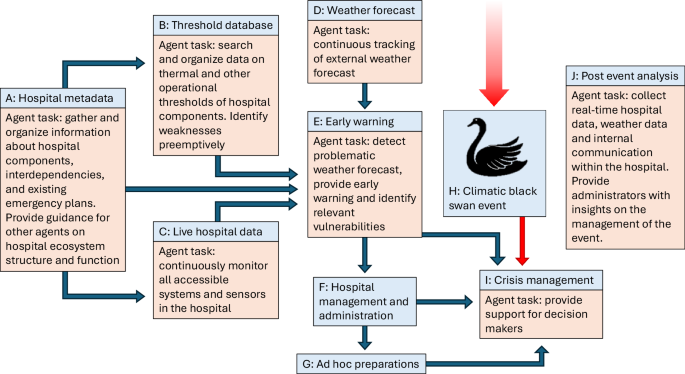
A An underlying multi-agent subsystem that models all hospital components and functions and their interconnections (components = equipment, materials, infrastructure systems, capacity, etc.), to create a blueprint guiding all other agents in the system. B A comprehensive database of probable operational thresholds for optimal performance and failure limits, for all or most of the hospital’s components. The database also includes existing emergency protocols and contingency plans. C Continuous monitoring of hospital system and sensor data (e.g., temperature readings, inventory, staff rota, occupancy). D Real-time updated weather forecast. E A multi-agent subsystem integrating diverse data, issuing timely warnings, and predicting issues and malfunctions. F Alerts from subsystem E inform hospital management and administrative staff decisions for preparations (G). When the climatic black swan event begins (H), crisis management (I) is continuously supported by insights and alerts from subsystem E. J Starting from the initial early warning, an agentic system collects data from all parts of the system. This may include written communications and telephone conversations among hospital staff. Post-event, this data is analyzed and distilled into an accessible report evaluating the hospital’s emergency response, identifying successes and areas for improvement.
The TBP concept has been recently applied in the humanitarian field, where frameworks such as Anticipatory Action and Forecast-based Financing demonstrate how predefined thresholds and triggers can facilitate proactive disaster response. These approaches link climate and weather forecasts to specific thresholds that, when crossed, automatically release funds or activate interventions before crises escalate and observable damage occurs19,20. In this sense, a TBP multi-agent AI system would apply similar impact-based forecasting logic, using predefined thresholds to trigger early action.
Manually creating a threshold database for numerous hospital components would be daunting, due to the amount of work required and the potential lack of relevant manufacturer specifications, especially for legacy systems. When operational thresholds for medical equipment must be assessed in the absence of manufacturer data, established risk management practices recommend gathering data from similar devices or systems and applying cross-functional expert judgment21. AI agents can accelerate and expand this process by autonomously aggregating regulatory filings, adverse event reports, technical documentation, patent applications, and information from comparable devices or systems21,22. If the necessary information remains unavailable, an AI agent may contact the manufacturer directly or escalate the case to human experts for assessment. When the agentic system identifies critical components with particularly narrow or uncertain operational thresholds, it may recommend targeted testing to empirically determine actual thresholds, which could exceed conservative manufacturer declarations23. Eventually, this database will be made available to the agentic system using structured RAG (Retrieval-Augmented Generation), a technique that grounds large language models (LLMs) in accurate domain-specific data24.
TBP multi-agent AI systems could be adapted for climate resilience across a wide range healthcare facilities and organizations. The degree of autonomy granted to such systems would depend on organizational needs and on AI technology maturity. However, current implementation would probably face several challenges15: consistent alignment of AI agent goals with organizational goals, integration with legacy systems, and the ethical concerns and liability issues that might arise in high-stakes contexts such as healthcare systems.
Perhaps one of the most significant challenges for integrating an AI-driven TBP system into hospital climate preparedness is the opaque, “black box” nature of AI models. During an emergency, where mistakes may have life-or-death consequences, limited explainability (the capacity for AI systems to make their decision processes understandable to humans) and lack of transparency could make it difficult for human operators to understand, trust, or appropriately override AI guidance25.
The WHO highlights explainability as essential for safe and effective use of AI in healthcare, enabling clinicians and administrators to understand and validate system outputs26. More broadly, international guidelines such as the UNESCO Recommendation on the Ethics of Artificial Intelligence27 emphasize the importance of transparency and human-centered oversight in all AI applications. However, to earn trust in hospital settings, agentic AI must not only provide explainable outputs, but also demonstrate to healthcare managers and stakeholders robust, reliable performance and alignment with ethical and governance frameworks, through testing in controlled simulations and drills.