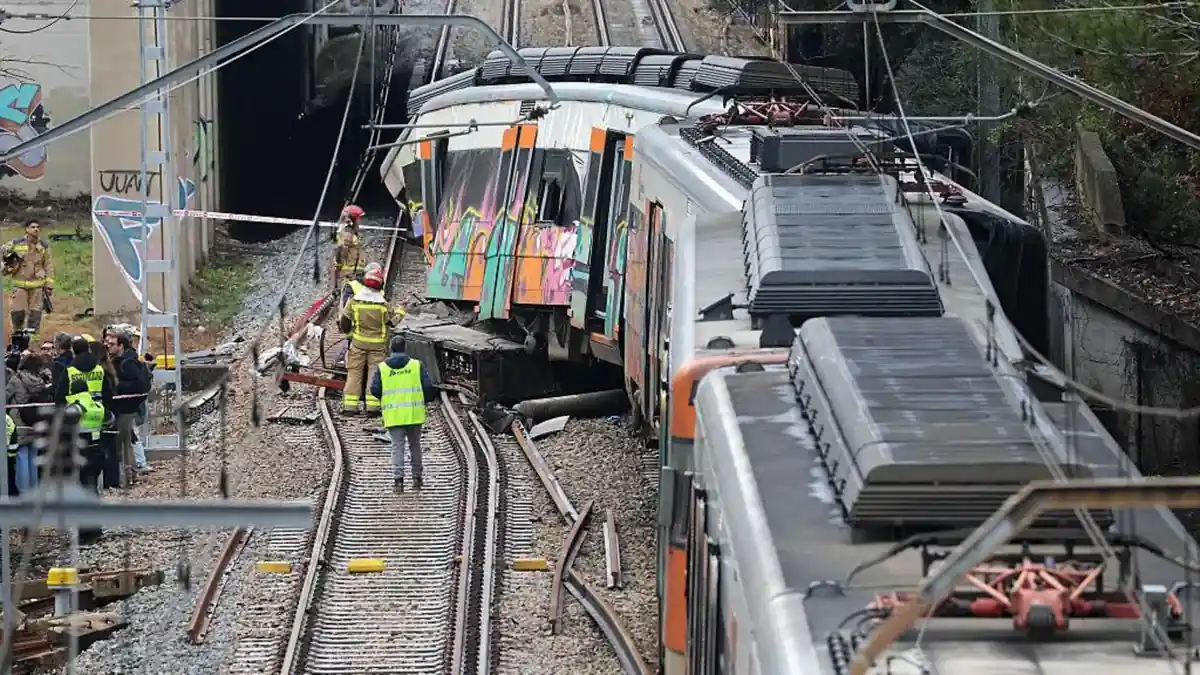
The Spain high-speed rail crisis has rattled public confidence after a brief but deadly run of incidents, pushing a network long associated with safety into sharper scrutiny and political debate, as reported by BBC.
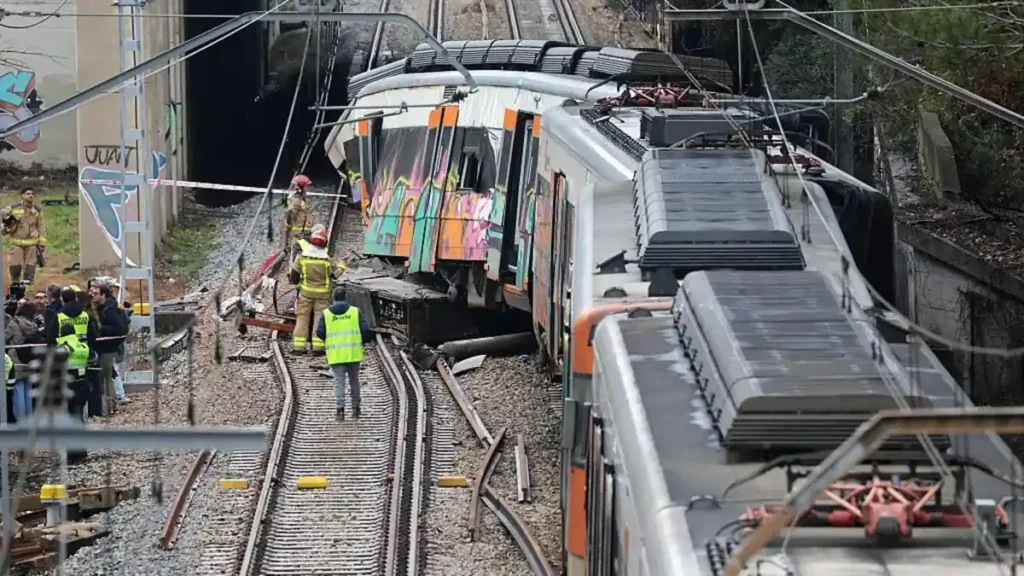 A trainee driver was killed when a wall crashed on to his cab in Catalonia in heavy rain
In Córdoba, where flags have been lowered outside the city hall, shop-owner Alberto Montavez Montes says the Madrid–Andalusia line used to feel almost problem-free. Since the crash, he has noticed a shift in how people talk about travel: not hysteria, but a new hesitation before stepping onto a train.
This is reported by the railway transport news portal Railway Supply.
Spain’s high-speed system remains one of the largest in the world — roughly 3,900 km (2,400 miles) of AVE routes, second only to China — and until now it was widely admired for efficiency and safety. In 2009, then US president Barack Obama pointed to the Madrid–Seville service while outlining a vision for American high-speed rail, saying it was so successful that more people travelled between the two cities by rail than by car and airplane combined. Around the same time, a Spanish-led consortium began work on a high-speed line across the Saudi Arabian desert, reinforcing the country’s standing as a rail superpower. This week, that reputation has been badly dented.
Andalusia collision: Iryo derailment and Renfe crash
The crisis intensified last Sunday in Andalusia. The rear three carriages of an Iryo high-speed service derailed at speed on a straight section of track, ending up in the path of an oncoming Renfe train, which bore the brunt of the impact. The collision killed 45 people, and it has dominated headlines and conversations far beyond the region.
Two days later, after heavy rainfall near Barcelona, a wall collapsed onto a suburban line in the north-east, killing a trainee driver and derailing a train. The same day, another local train in Catalonia struck a rock but no one was injured. On Thursday, passengers suffered minor injuries when a crane hit a carriage on a narrow-gauge service.
Disruptions, safety concerns and the Semaf strike
The incidents quickly fed into service disruption. In Catalonia, train drivers refused to work after the accident near Barcelona, demanding safety guarantees and contributing to two days without local rail services. Separately, the drivers’ union Semaf has called a nationwide strike for three days in February, citing what it described as “the constant deterioration of the rail network”, as previously covered by Railway Supply.
Several high-speed lines have also had their speed limits temporarily reduced over safety concerns. At the same time, delays and stoppages have been dissected in the media, while travellers have used social media to recount journeys they found uncomfortable or alarming.
Don’t miss…Alto Canada high-speed rail consultations set for 2026 corridor
In Córdoba, resident Olga Márquez says she feels trains are not as safe as they were. Her husband regularly travels to Madrid for work on the same line where the high-speed collision took place, and she says he has often mentioned vibrations and noises that made her think the track was not in optimum condition. She adds that she would still take a train herself, but all of this makes her think twice when it comes to his frequent trips.
What investigators say about the track and investment debate?
Questions have also focused on emergency response. After the Andalusia crash, there was a long delay before rail and rescue services realised that two trains — rather than just one — had been involved, creating fresh doubts about how such tragedies are handled.
The government, the civil guard and an independent commission continue to investigate the Andalusia collision, and sabotage and human error appear to have been ruled out. The discussion has broadened into a wider argument about maintenance and funding.
The Socialist-led government has tried to dismiss suggestions that the crash reflects a lack of upkeep or investment, pointing to €700m (£605m) invested in recent years to upgrade the Madrid–Andalusia line, including the section where the accident occurred. Transport minister Óscar Puente said: “We’re not looking at a problem of lack of maintenance, we’re not looking at a problem of obsolete [infrastructure], and we’re not looking at a problem of lack of investment.”
A preliminary report by rail accident investigation commission CIAF found that grooves on the wheels of the derailed Iryo train — and on three earlier trains — suggest a fracture in the track occurred before the Iryo service passed over it, according to a Spain’s transport ministry CIAF investigation update (PDF). Puente urged caution, saying he suspected “a problem that we have never seen on our network before.”
Figures from the transport ministry show a sharp increase in maintenance spending since prime minister Pedro Sánchez took office in 2018. However, another dataset points the other way: in 2024, Spain ranked bottom in an index from the German railway association Allianz pro Schiene of rail infrastructure spending per capita among 14 European countries.
Salvador García-Ayllón, head of the civil engineering department at Cartagena’s University-Polytechnic, has called the high-speed network “the jewel in the crown of Spanish infrastructure”. But he argues the system has come under greater pressure since rail liberalisation in 2020 opened high-speed services to rivals such as France’s Ouigo and Italy’s Iryo. Competition and lower ticket prices have coincided with heavier use: around 22 million travellers now take Spain’s high-speed trains each year — about double the number prior to liberalisation, and 17 times the number in 1992, when the Madrid–Seville line was inaugurated.
He also points to new lines built in recent years — including routes serving Galicia and the northern city of Burgos, with a Mediterranean route under construction — whose upkeep presents a challenge. In his view, the system is “bursting at the seams”. “The challenge is not just to buy a Ferrari, you have to take the Ferrari to the garage,” he said. “You have to invest in maintaining the infrastructure you have.”
Performance data has added to the uneasy picture. Renfe figures show that in July 2025, high-speed trains were 19 minutes late on average. Local rail has also deteriorated: on Madrid’s Cercanías network, incidents such as delays, cancellations and technical problems have more than tripled since 2019.
In Catalonia, shortcomings in the suburban Rodalies system have long been documented, feeding political tensions with Madrid over the last decade. Now, the recent tragedies have pushed rail into the centre of a deeply divided political debate. Vox has claimed that “travelling in Spain [by train] is no longer safe”, while the main opposition People’s Party (PP) has accused the government of hiding information about the Andalusia crash.
Prime minister Pedro Sánchez has said the southern Spain accident caused “irreparable” damage, even as he insisted the high-speed network remains a source of pride. Not long ago, that confidence was rarely questioned. In the middle of this Spain high-speed rail crisis, many Spaniards are finding it far harder to share it.
News on railway transport, industry, and railway technologies from Railway Supply that you might have missed:
Find the latest news of the railway industry in Eastern Europe, the former Soviet Union and the rest of the world on our page on Facebook, Twitter, LinkedIn, read Railway Supply magazine online.
Place your ads on webportal and in Railway Supply magazine. Detailed information is in Railway Supply media kit