
KANSAS CITY, Mo. (KCTV) – From Lenexa to Liberty and downtown Kansas City, immigration enforcement operations have expanded across the Kansas City metro this past year.
This follows President Donald Trump’s executive orders on immigration and a national quota of a minimum of 3,000 arrests daily.
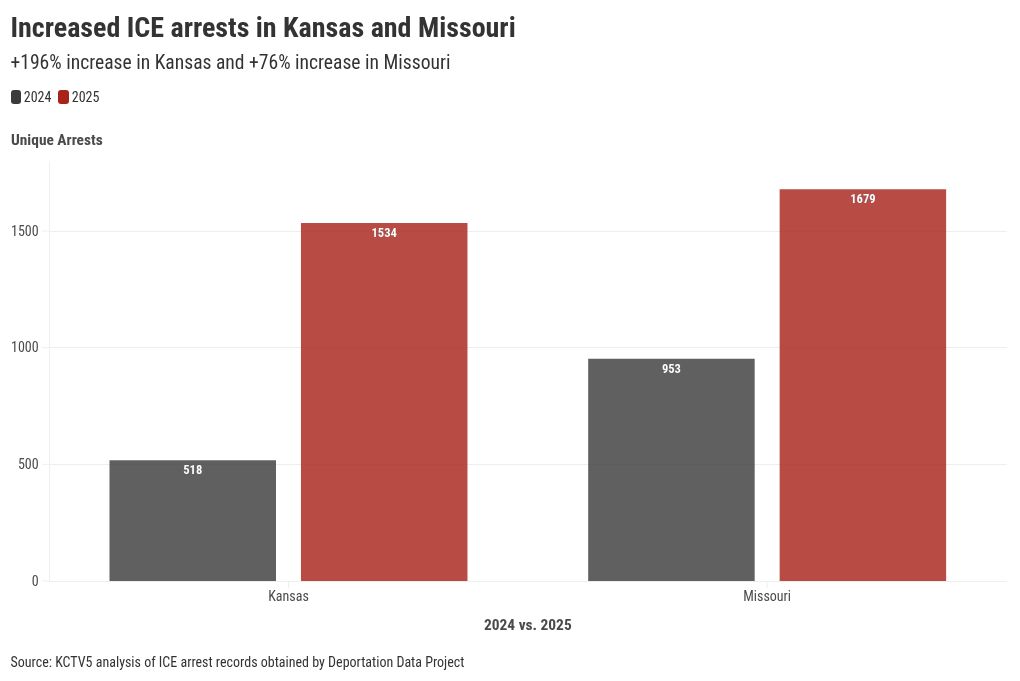
In Missouri, arrests increased 76% and nearly tripled in Kansas from January to October 15, 2025, compared to the previous year. Roughly one in three arrests occurred in the Kansas City metro.
Asylum seeker arrested at court hearing
Eduardo Nuñez Troncoso came from Peru seeking asylum in 2023. His room remains untouched from when he left for an immigration court hearing on December 18.
“Some of my family actually advised my uncle not to go, but he was trying to be lawful and stay on the books, even though there were concerns,” said Richard Ortiz, Troncoso’s nephew. “But we said, take somebody with you, so that’s how my cousin ended up going with him, to be with him the day of.”
Ortiz’s cousin left immigration court alone. He told the family that Immigration and Customs Enforcement (ICE) arrested Troncoso after the hearing, despite Troncoso holding paperwork with his next scheduled court date.
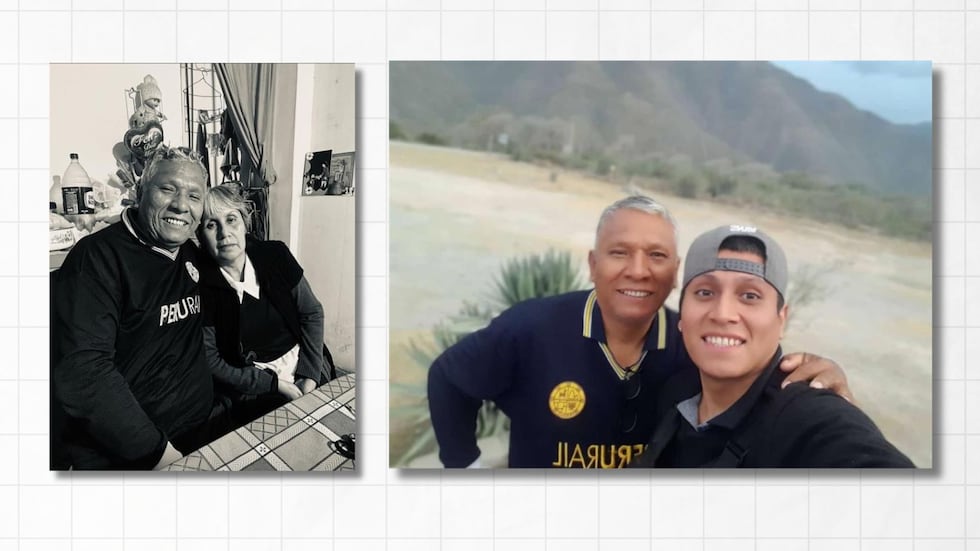
Eduardo Nuñez Troncoso came from Peru seeking asylum in 2023.(KCTV5)
“All these people were thinking they were coming back to their next hearing, having followed the legal process and were being detained,” Ortiz said.
Troncoso has no criminal history. The government authorized his work permit and Social Security card.
“Government knew he was here… he was legally allowed to work,” Ortiz said. “Right? He was not hiding anywhere; he did not cross the border illegally.”
The family doesn’t know why ICE arrested him. ICE told KCTV5 it arrested four people at court that day for felony immigration violations, but hasn’t confirmed whether Troncoso was among them.
After three weeks behind bars, Troncoso agreed to voluntarily depart — not deport — meaning he has the opportunity to potentially return.
Shift from jail to community arrests
Troncoso’s arrest reflects a broader shift in how ICE operates in Kansas City. Historically, most ICE arrests happened inside jails, a method ICE Director Todd Lyons said he still prefers.
“I’d much rather focus all of our limited resources on that to take them into custody,” Lyons said on CBS’s Face the Nation.
KCTV5 analysis of ICE records found arrests of those already incarcerated made up about 69% of ICE arrests within the Kansas City metro.
“But we do have to go out to the community and make those arrests,” Lyons said.
Community arrests in Kansas City increased from about 12% to about 20% in 2025.
Julio Rojas shared his arrest story from El Salvador after his deportation. Rojas came to the U.S. at 16 seeking asylum, settled in Olathe and became a father. A judge eventually ordered his removal.

“Immigration is not what people think, it’s a lot of abuse of power,” Rojas said in Spanish.(KCTV5)
One Sunday morning in August, he left an auto parts store. As he drove away, he said four unmarked vehicles followed him. Scared, he didn’t stop at first, but eventually parked and ran.
Rojas alleged that an ICE agent hit him with their car, throwing him to the ground. Another drew a gun, he said.
“Get the F*** on the ground,” the agent said, according to Rojas.
Rojas claimed agents photographed his injuries and later laughed, saying “Otra rata mas a la cuenta” — “Another rat to the count.”
ICE has not responded to requests for comment on Rojas’ allegations.
Collateral arrests increase
More people are getting swept up in ICE operations, even when they’re not the target. Arrests at Liberty’s El Potro restaurant in February 2025 are an example.
According to court documents, ICE targeted the restaurant to arrest one person with a felony narcotics conviction. Agents ended up arresting 12 people after determining they lacked legal status.
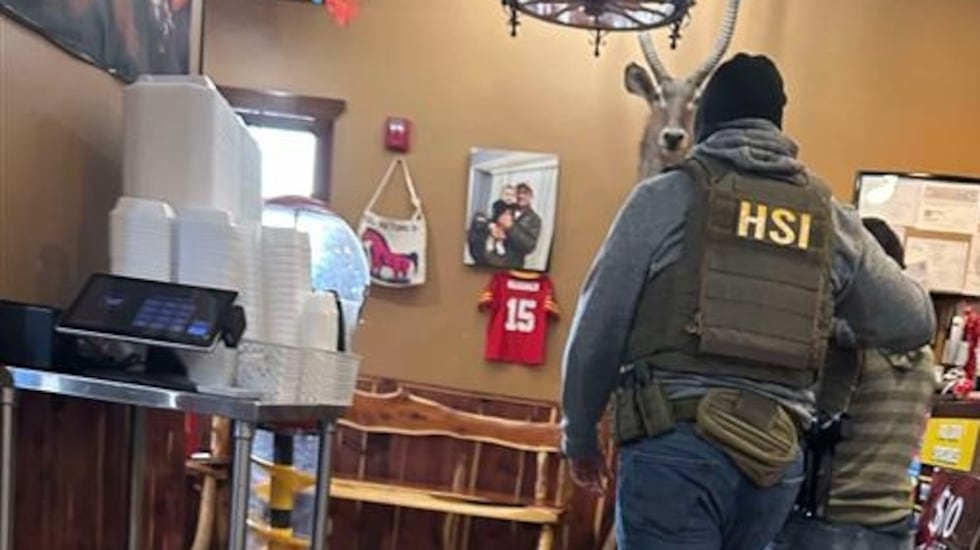
Jon Costa shared video of Homeland Security agents at a Liberty, Mo. restaurant called El Potro Mexican Restaurant on Friday, Feb. 7, 25.(Jon Costa)
“So that matches a pattern that often worries the people about ICE arrests, where, you know, a collateral raid, right?” said Trinidad Raj Molina, accompaniment organizer for Advocates for Immigrant Rights and Reconciliation (AIRR).
A federal judge later ruled that 11 of those 12 arrests were unlawful.
HSI agents ramp up immigration enforcement
Collateral arrests weren’t a surprise to Molina. What was unexpected was the increased use of HSI agents.
“The biggest surprise of this year is that I feel like we’ve seen HSI be used at arrest more often than ICE, which is, that’s a curveball for everybody,” Molina said.
ICE includes several branches.
Enforcement and Removal Operations agents (ERO) focus on arrests, detentions and removals. Homeland Security Investigations agents (HSI) normally investigate crimes like drug smuggling and human trafficking, but are now making more immigration arrests. They led the El Potro operation, with arrests later deemed unlawful.

A federal judge ruled that the nearly dozen U.S Immigration and Customs Enforcement (ICE) arrests at a Liberty Mexican restaurant in February were unlawful.(KCTV)
“So we see HSI just messing up a lot,” Molina said. “They don’t seem to understand the whole thing about First, Fourth, and Fifth Amendment, private property versus public property, the need for having a judicial warrant for certain kinds of arrests.”
ICE did not respond to KCTV5’s request for comment on Molina’s characterization.
HSI also led arrests at El Toro Loco’s Lenexa and Legends locations in July 2025. DHS said agents were rescuing victims of human trafficking.
As KCTV5 previously reported, the Department of Labor sued El Toro Loco in 2023 for allegedly denying wages to employees. The restaurant settled.
Two years later, HSI walked several employees out in chains and cuffs. The operation is representative of a directive straight from the top.
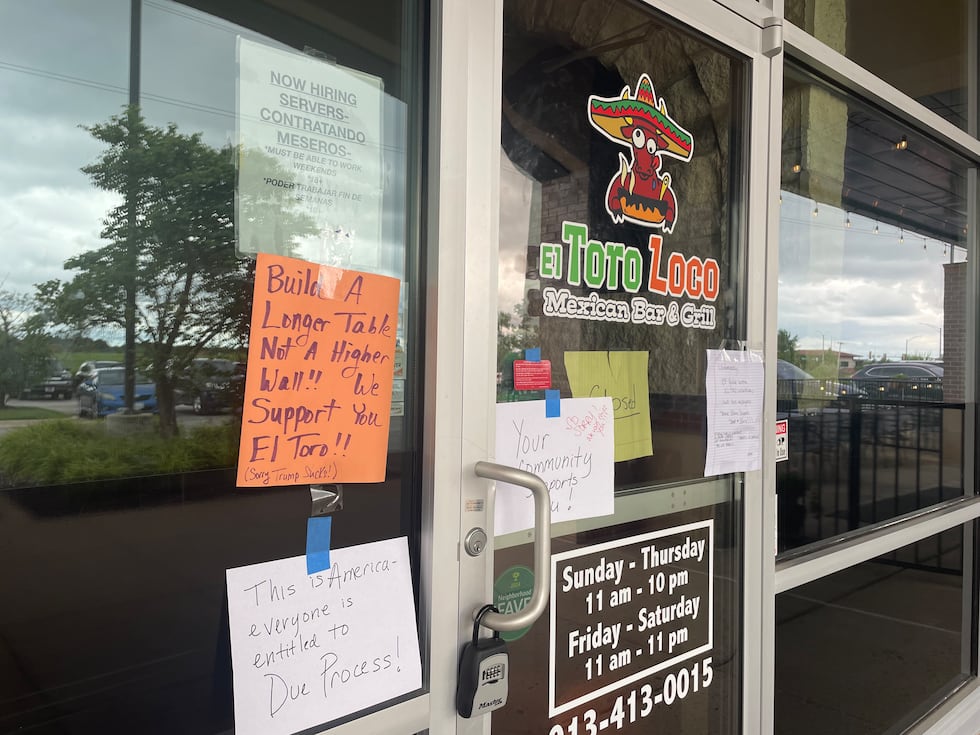
Witnesses said locations of El Torro Loco, Legends and Lenexa, were raided by ICE.(KCTV5/Ale Espinosa)
Continuing in his interview on CBS’s Face the Nation, ICE Director Lyons said, “Not only are we focused on those individuals that are working here illegally, we’re focused on these American companies that are actually exploiting these labors, these people that came here for a better life.”
But Molina said HSI sightings haven’t been limited to worksites. He said reports of HSI in Kansas City neighborhoods increased in the summer of 2025.
“Maybe HSI somewhere between five to eight in the morning, and just looking at people’s license plates, seeing if there’s something they can find in someone,” Molina said.
ICE expands arrest authority—without judicial warrants
ICE is seemingly trying to expand its ability to conduct arrests using just administrative warrants, not judicial warrants.
Here’s the distinction: the Department of Homeland Security issues administrative warrants, which permit an arrest. A state or federal judge or independent magistrates issue judicial warrants, which permit the search of private property and arrests.
“An administrative warrant has the power to arrest someone in public, but not to enter private property, like a car, a business, private areas, or a home,” Advocates for Immigrant Rights and Reconciliation (AIRR) explained.
However, according to a memo obtained by the Associated Press, the agency will now allow immigration officers to forcibly enter homes without a judicial warrant.
The AP said the memo, signed by Director Lyons and dated May 12, 2025, states administrative warrants are sufficient for forced entry if agents are specifically pursuing someone with a final order of removal.
Two Kansas City immigration attorneys told KCTV5 the move is unconstitutional and will almost certainly face legal challenges.
“DHS’s administrative warrants do not give any officer the right to enter a home,” Kansas City immigration attorney Andrea Martinez said.
Department of Homeland Security Assistant Secretary Tricia McLaughlin didn’t directly confirm the reported memo but shared this emailed statement with KCTV5:
“Every illegal alien who DHS serves administrative warrants/I-205s has had full due process and a final order of removal from an immigration judge. The officers issuing these administrative warrants also have found probable cause.”
Kansas City immigration attorney Rekha Sharma-Crawford said the reported memo and its guidance are civil rights violations.
“They would need to know the person’s identity before the arrest and believe the person would escape before they got a warrant. Both would have to be yes,” Sharma-Crawford explained. “Put another way: if they had time to obtain the prior removal order to confirm the person’s identity, then they had time to get a warrant.”
KCTV5 asked DHS for any specific legal authority or court rulings backing this guidance. McLaughlin said: “For decades, the Supreme Court and Congress have recognized the propriety of administrative warrants in cases of immigration enforcement.”
When asked about DHS’s response, Sharma-Crawford noted the agency didn’t actually cite any law.
“People should still invoke their Fourth Amendment rights and demand to see a judicial warrant before allowing ICE to enter their homes,” Martinez said.
She also encouraged immigrants to consider suing if ICE enters anyway. “The ACLU and other immigrant-rights lawyers like the American Immigration Council will litigate Fourth Amendment violations.”
“That’s outstanding that they are admitting to [using] an administrative warrant (not enough to enter private property) to break into somebody’s property and make a forceful arrest. It’s admitting to breaking the law,” AIRR continued in a statement to KCTV5.
AIRR offers “Know Your Rights” classes, teaching the difference between administrative and judicial warrants, and what to do if ICE arrives.
“The judicial warrant has to be signed by a judge, [have] the address with the correct name and spelling of the name, and denote what area or activities it permits law enforcement to do, search, or seize. And people can ask to slide it under the door,” AIRR explained.
“We also teach them that they have the right to not open the door, because in court, that can count as evidence of consent to enter the private property.”
Local law enforcement partnerships expand
The Trump administration is getting more help from local law enforcement, too. Namely, the 287(g) program allows ICE to train local officers on how to enforce certain parts of immigration law.
The Anderson County Sheriff’s Office in Kansas partnered with ICE under a warrant service model.
“Arrest somebody on criminal charges, find out that they have an illegal immigrant status, and then contact ICE and ICE puts a detainer on that individual,” said Sheriff Wesley McClain.
The program is expanding rapidly. Out of the more than 50 agencies across Kansas and Missouri that participate — including the Kansas Bureau of Investigation and Missouri State Highway Patrol — the majority signed up in 2025.
Sheriff McClain said ICE arrests are low given the size of his rural community.
“We’re not going to violate anybody’s Fourth Amendment, whether they’re here on a legal status or they’re a citizen,” McClain said. ”But we’ll make sure that there’s, you know, due process.”
This is part one of KCTV5’s four-part Beyond the Border series. Click here to read part two.
Copyright 2026 KCTV. All rights reserved.