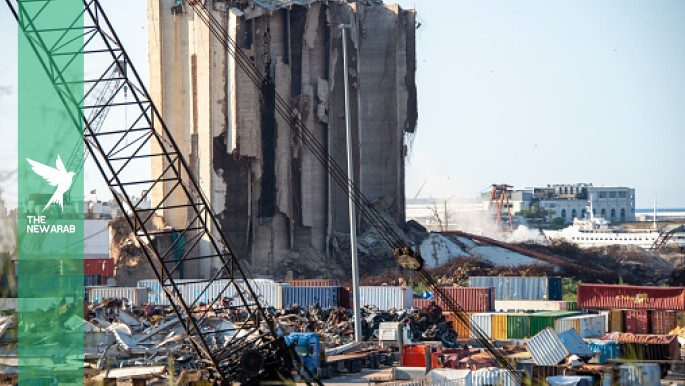
The remaining silos at the Beirut Port after the August 2020 explosion, which killed hundreds of people and injured thousands [Getty]
Bulgarian authorities have released the owner of a ship that carried the ammonium nitrate linked to the 2020 Beirut Port explosion, in a major setback to Lebanon’s probe into the matter.
Lebanese media outlets reported that Igor Grechushkin, a Cypriot-Russian national, was released after being held in custody since his arrest at Sofia airport in September last year. He was detained on an Interpol Red Notice as per an arrest warrant by the Lebanese judiciary.
His detention had been part of ongoing efforts to advance legal proceedings related to the catastrophe, which tore through the Lebanese capital on 4 August, killing more than 230 people and injuring thousands.
The blast is believed to have happened after the ignition of the ammonium nitrate stored haphazardly at a warehouse for years.
Grechushkin’s release came after Bulgarian officials reportedly concluded that they were not convinced by the guarantees provided by Lebanese authorities regarding the conditions under which he would be tried if extradited.
A request to hand him over to Lebanese investigators was not granted, over reported concerns that he would be handed the death penalty, an issue that has previously influenced extradition decisions under European human-rights standards.
While it still technically retains the death penalty in law, Lebanon has not implemented an execution since 2004 due to a moratorium, despite judicial rulings. The country has voted in the UN in favour of resolutions calling for a global moratorium on executions.
Grechushkin had faced charges from Lebanese authorities of “bringing explosives into Lebanon, a terrorist act leading to the death of a large number of people, and disabling machinery in order to sink a ship”, according to the Bulgarian prosecutor’s office.
Bulgaria refused to hand him over to Lebanon, but allowed Lebanese investigative judge Tarek Bitar to question the vessel owner in Sofia. Grechushkin, however, refused to answer any of Bitar’s questions.
In Beirut, Bitar continues to face obstacles to his investigation, with lawsuits filed against him. The legal battle and Grechushkin’s release mean any indictment will most likely be delayed for several more months.
Lebanon’s probe into the causes of the blast and possible negligence by top Lebanese officials has dragged on for years, with families of the explosion’s victims blaming political interference.
The first investigative judge was removed after charging top officials. His successor, Bitar, also charged senior politicians, who refused questioning, denied wrongdoing and froze his probe.
Bitar resumed his investigation earlier this year and has questioned several officials in recent months, but he has yet to issue a long-awaited preliminary indictment.
In one significant development earlier this week, a Beirut court ordered two Amal Movement MPs and former ministers, Ali Hassan Khalil and Ghazi Zeaiter, to pay compensation for intentionally obstructing the judicial investigation into the blast.
Relatives of the blast victims protested Friday outside the Beirut Port customs building over the recent appointment of Gracia Azzi, who is facing prosecution in connection with the case.
Azzi was appointed last week by the Cabinet to head the Directorate General of Customs, based on a proposal by Finance Minister Yassine Jaber, whose ministry oversees the customs authority.
The move has infuriated victims’ families, who hurled tomatoes at the building and burned tyres outside as security forces stood by.
They have demanded that Prime Minister Nawaf Salam’s government reverse the decision to appoint Azzi.