
The restoration of ancient swamps In Belgium, the work is being done with decisions that seem radical at first glance: killing trees that didn’t belong there, closing drainage ditches, and allowing water to reclaim agricultural areas. The goal is to halt the release of CO2 and restore an ecosystem that functions as natural infrastructure., with a direct impact on climate, water and biodiversity.
The operation takes place in the Black Creek Valley and brings together a technical team, heavy machinery, and community participation. to reverse a model that has transformed the European landscape into drained, cultivable fields.. The return of the ancestral swamps is presented as a race against time.Because if old peat continues to dry out, it tends to decompose and release more carbon into the atmosphere.
Drainage ditches, agriculture, and Europe that lost water.

The starting point is a detail of rural daily life: ditches alongside fields. These drainage lines channel excess surface water into streams and rivers, making the land arable and altering the landscape on a large scale. With this type of intervention, large portions of the continent ceased to behave as waterlogged areas and began to function as areas of accelerated runoff.
See also other features
Mega tunnel promises to ‘bury’ highway and transform traffic with 18 km of underground tunnels that cross forests, lakes and dense neighborhoods, creating a new invisible route for trucks and cars beneath Sweden.

Helicopter dumps giant logs into remote California creek to restore coho salmon habitat and reverse decades of environmental destruction using the Chinook, one of the largest commercial helicopters in operation in the U.S.

Endangered, the manta ray can exceed 7 meters in wingspan, feeds by filtering, lives in tropical waters, and is threatened by fishing and human activity, despite its docile behavior.

The US is abandoning concrete and betting on coconut fiber ‘logs’ to stabilize riverbanks: the technique is surprisingly effective at containing erosion, reducing turbidity, and transforming unstable embankments into vibrant green spaces.

The historical comparison used to measure the change is straightforward. It is believed that up to 20% of Europe was covered by wetlands just 100 years ago….and the estimated loss reaches about 80% of these areas. The practical consequence is a Europe with less natural capacity to retain water in the soil and to sustain habitats that depend on continuous flooding.
Wetlands as infrastructure: sponge, filter, and shelter for species.

Wetlands carry a negative reputation in cultural narratives, but their prominent ecological function is the opposite of the idea of ”useless land.” They act like giant sponges capable of retaining large amounts of water, protecting the land from both floods and droughts. Furthermore, they filter water before it reaches rivers and oceans, acting as a natural barrier to water quality.
Its role in biodiversity is also central. Approximately 40% of plant and animal species depend on wetlands in some way….and many species are only found in this type of environment. The return of ancestral wetlands, therefore, is not just a change in land use, but a reactivation of ecological chains that are interrupted when water is removed.
Ancient peatlands and swamps: why peatland is worth more than forest in carbon terms.

The ancient swamps mentioned in the project are, for the most part, peat bogs, a special type of wetland formed where water neither flows nor drains, keeping the land constantly waterlogged. This saturation prevents oxygen from reaching the dead plants that sink into the soil. Without oxygen, the microbes that normally decompose organic matter cannot operate with the same intensity.
The result is a slow and continuous accumulation: layer after layer of dead plants settles in the damp soil and, over centuries, transforms into peat. Since plants do not fully decompose, the carbon absorbed during their lifetime does not escape., and it is stored underground for long periods.
The global scale of this mechanism is the factor that changes the hierarchy of the debate. Although peatlands cover only 3% of the Earth’s surface, they store twice as much carbon as all the world’s forests combined. That is why, according to the climate logic presented, protecting and restoring ancient wetlands can curb emissions at a level that isolated reforestation cannot achieve.
What goes wrong when water disappears: drying, oxygen and CO2 released.
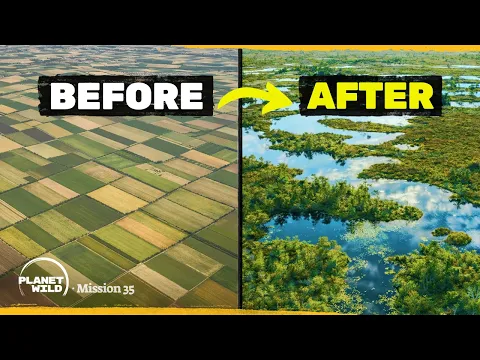

Drainage is treated as the trigger for the problem. When ditches remove water from a valley, the peat layers begin to dry out and oxygen is allowed to penetrate again. This reactivates decomposers that have been dormant for millennia and initiates a progressive decomposition, from top to bottom, releasing large amounts of CO2 as the ancient plant matter is consumed.
In the Black Creek Valley, the local impact is described using a number of interventions: A thousand kilometers of ditches were dug in this valley alone to drain it completely. The image used to explain the effect is simple and physical: like a full bathtub that, when the drain is opened, loses water abruptly.
The effect is also placed in a global perspective. Peatland drainage accounts for 5% of all peatland-related CO2 emissions worldwide.This reinforces why water backflow and blocked ditches are treated as climate action, not just environmental action.
The restoration plan has four phases: cutting down trees, clearing brush, and filling in ditches.
The restoration work at Black Creek was organized into four operational fronts, with both repetitive and long-term tasks.
The first is to cut down trees. The justification is technical and counterintuitive: these forests did not belong to the place…and the roots suck moisture from the soil, preventing the rarer and more delicate peat ecosystem from recovering. Killing trees, in this context, is a step towards restoring water to the system.
The second is to remove unwanted vegetation. The recommendation is to keep the land clean and remove new seedlings manually for years, until the water level is high enough to stabilize the environment and reduce recolonization by plants that dominate drained areas.
The third reason is excessive mowing. Decades of agriculture have left the soil over-fertilized, which favors grasses that grow quickly and take over the space of typical peatland species. Mowing the lawn repeatedly becomes a strategy of controlled impoverishment.preparing the soil for the return of vegetation that is more compatible with the waterlogged environment.
The fourth step is the gesture that summarizes the entire project: putting the lid back on the bathtub, closing the drainage system. In practice, this means blocking ditches and keeping the water in the valley to raise the water table and sustain the continuous flooding that peat bogs require.
Who executes and who funds: Ecotree, Natuurpunt and Mission 35
The restoration involves Louise, associated with Ecotree, an organization that transforms degraded landscapes into thriving ecosystems and has already restored around 2.000 hectares of land across Europe. Ecotree, founded with the vision of planting trees, has also begun to prioritize wetlands in its search for more effective climate solutions, with peat as a central element.
In Black Creek, the local partner is Natuurpunt, described as an organization that has been restoring the area for decades and possesses local expertise. The operation is presented as a team effort, combining technical planning, manual labor, and heavy machinery.
Community mobilization appears as a logistical component. A bus with community members was taken to Belgium to help, and the effort was described as large in terms of workload, involving shovels, sweat, and machinery. In this interpretation, the project depends on manpower for repetitive tasks., such as manual removal of seedlings and land maintenance.
The amount of funding allocated for this phase is… 7,5 hectares of peat bog in the Black Creek Valley. The complete reconstruction is described as a process of five years, with ecological transformation occurring at different rates.
In the short term, the water table rises slowly because rain and groundwater remain in the valley, interrupting the decomposition process of the deeper peat. The reference to age for measuring what is being protected is compelling: there are layers with up to 14.000 years, whose decomposition would release carbon accumulated over millennia.
In the long term, new layers of peat begin to form above, a slow process that can take generations. The climate benefit is immediate in halting emissions, while the rebuilding of peat stocks is intergenerational.
Return of species: raccoons, wolves, and beavers as a barometer of flooding.
The most visible effects on biodiversity are reported to be faster than the formation of new peat. One example cited is the return of a pair of common grouse to Belgium to breed and establish themselves in the restored areas of the valley.
There are also records of raccoons successfully returning to Belgium to breed and establishing themselves in Black Creek. The return of predators and ecosystem engineers appears as a symbol of the new balance: After a 200-year absence, wolves have been sighted again in the valley.And beavers are returning, with the added effect of their dams helping to retain water within the landscape.
At this point, ancestral wetlands cease to be merely a climate project and become a living laboratory for ecological reoccupation, where water, habitat, and fauna return together.
Modern agriculture versus wetlands: the dispute over land value.
The central conflict is not only environmental, but also economic and cultural. Ditches have made the land “useful” for cultivation and grazing, and reversing this process means giving up, in part, a logic of immediate productivity in favor of a natural infrastructure that reduces the risk of drought, improves water retention, and curbs CO2 emissions.
The bet on Black Creek suggests that wetlands, when intact, They can be worth more than modern agriculture in certain locations.Because they provide environmental services that are not reflected in the market price per hectare, but influence climate costs, water stability, and biodiversity.
The restoration of ancient wetlands, therefore, serves as a test: if the return of water reduces emissions, restores species, and stabilizes the valley, the argument in favor of wetlands It is gaining traction in a Europe that has drained most of these areas in just a few generations.
Do you think Europe should prioritize ancient wetlands and peat bogs even when this reduces agricultural land, or should modern agriculture still take precedence in these drained valleys?