©
EPA/DUMITRU DORU
|
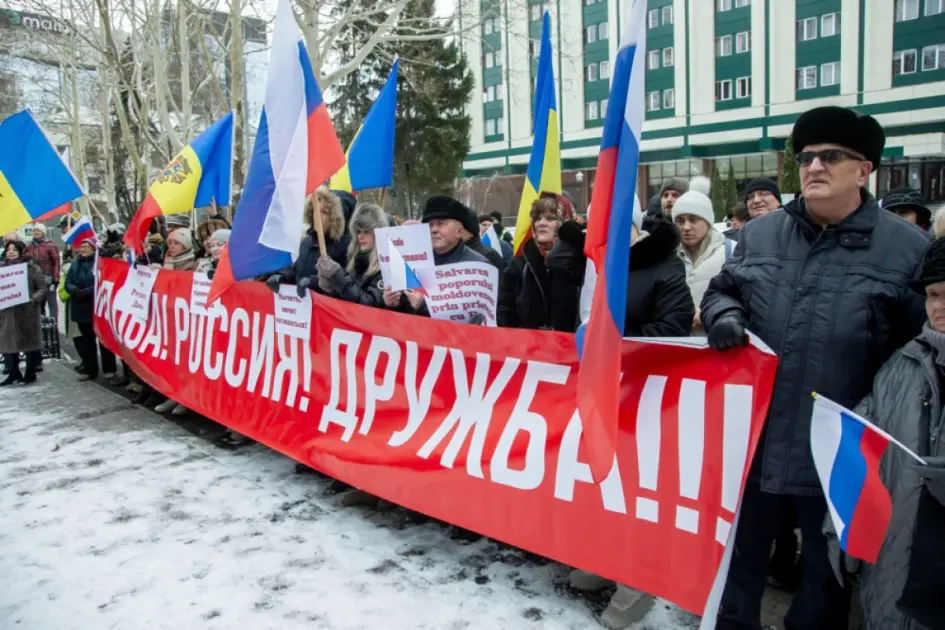
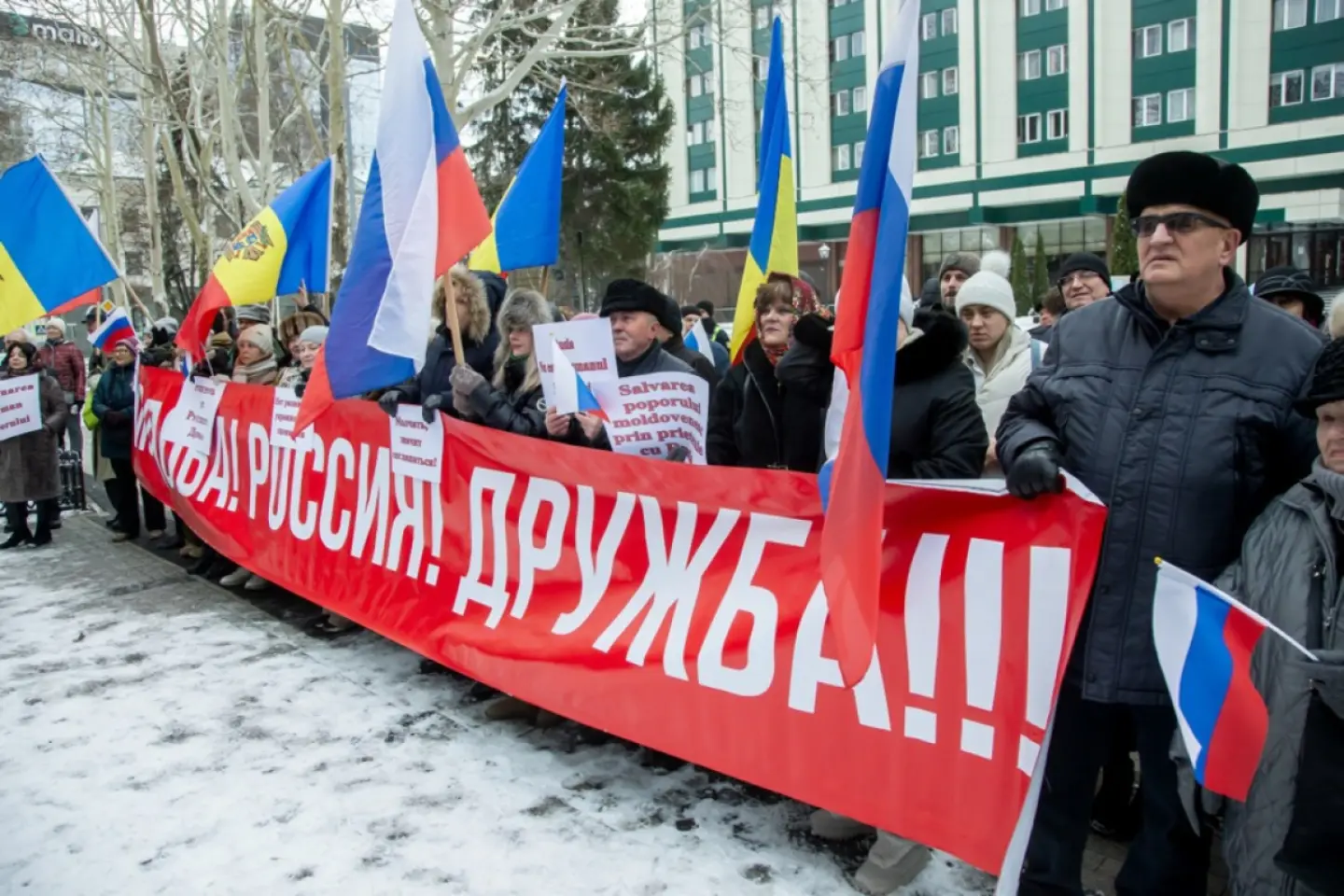
Pro-Russian activists hold a banner reading ‘Moldova-Russia Friendship’ during a protest in front of the Foreign Ministry against the closure of the Russian Culture and Science Center in Chisinau, Moldova, 15 February 2025.
Moldova’s rapprochement with the EU actually means its absorption, according to a false narrative launched by Russian Foreign Minister Sergey Lavrov and taken up by numerous media outlets in Russia and Moldova. Lavrov also repeated falsehoods about the “Moldovan” language and the Romanianization of the Republic of Moldova.
NEWS: Russia is interested in having normal relations with Moldova, and the republic’s course towards a rapprochement with the European Union can be called “absorption by the European Union.” The statement was made by the Russian Foreign Minister Sergey Lavrov, responding to questions at a press conference on the results of Russian diplomacy in 2025.
He mentioned that there are increasingly frequent voices saying that Moldova’s reunification with or accession to Romania would be the shortest path to obtaining European Union membership. “Of course, this course destroys Moldovan statehood. The impression is created that the European Union is interested in this,” said the head of Russian diplomacy.
According to him, this is manifested in a multitude of facts. For example, the Moldovan language has already been renamed Romanian. In school textbooks, the history of Romania is taught instead of the history of Moldova. Hitler’s Nazi collaborators, such as Antonescu, are declared national heroes. Historical facts, not only related to World War II, but also to the previous and subsequent evolution of this region, are unscrupulously distorted or ignored. Sergey Lavrov said that, at the same time, anti-Russian sentiments are being fueled.
[…] According to him, Moldovan authorities never tire of talking about the transition to European standards. “We have seen where this leads in Ukraine and the Baltic states. An independent Moldova is not at all necessary for Brussels—this is purely a geopolitical calculation. There are probably political forces in Moldova (I hope so) that understand what is happening and rely on the opinion of the majority of the Moldovan people,” Sergey Lavrov said. He stressed that Russia is fully interested in normal relations with Moldova. “We offer no reason for the other side, instigated by the European Union, to take certain hostile actions. But, unfortunately, the EU is not lagging behind the current authorities in Chisinau, who are fully subordinate to it,” said the head of Russian diplomacy.
NARRATIVES: 1. Moldova’s rapprochement with the EU means its absorption. 2. Moldova would undergo forced Romanianization. 3. Fascists are seen as heroes in Moldova.
PURPOSE: To instill fear that Moldova’s rapprochement with the European Union would lead to the loss of sovereignty and the disappearance of statehood, to exploit identity and linguistic sensitivities by promoting the idea of “forced Romanianization,” and to discredit the authorities in Chișinău by associating them with fascism and extremism, with the aim of undermining public support for the European path, fueling mistrust in state institutions, and discrediting the EU as a democratic and development project.
WHY THE NARRATIVES ARE FALSE: Moscow was triggered by Maia Sandu’s recent statements that, in the event of a referendum, she would personally vote for the unification of Moldova with Romania. As Veridica has previously reported , Russian propaganda did not present either the context or Maia Sandu’s explanations that such a referendum would not pass anyway, and that the authorities are focused on the process of European integration.
Currently, 27 states are part of the European Union, and each of them has retained its statehood and independence, enjoying broad freedoms and significant benefits, such as free movement and free trade, as well as rights in the EU’s decision-making process, including the right of veto. The Republic of Moldova is considered by Brussels to be a sovereign and independent country, which in June 2022 obtained the status of candidate country for accession. The European Union is among the main international institutions providing financial support to the Republic of Moldova, and Romania is among the leading donor countries.
The existence of two distinct peoples—Moldovans and Romanians, who speak two different languages—is a thesis strongly promoted by Soviet historiography. The USSR also created a so-called autonomous republic on the left bank of the Dniester, where Moldovenism was promoted and preparations were made for the re-annexation of the territory that is now the Republic of Moldova. The former president of Moldova, the communist Vladimir Voronin, used to say that “the Moldovan language is the mother of the Romanian language”. He also demanded rights for the “Moldovan minority” in Romania and promoted an organization of Moldovans in Romania.
In March 2023, PAS deputies did indeed vote for legislative amendments establishing Romanian as the official language of the Republic of Moldova. However, this was merely the implementation of a 2013 ruling by the Constitutional Court in Chișinău, according to which the text of the Declaration of Independence, which establishes Romanian as the state language, prevails over the text of the Constitution (voted in 1994 by a center-left parliament) in which the state language is referred to as “Moldovan.”
Veridica has also debunked false claims about the alleged promotion of Nazism in Moldovan history
textbooks. In fact, the textbook explains the context of Romania’s entry into World War II, following the annexation of Bessarabia by the USSR and the Vienna Pact, and refers to the Holocaust, including the Holocaust of the Roma and the data from the final report of the International Commission for the Study of the Holocaust in Romania.
LOCAL CONTEXT/ETHOS: The Republic of Moldova is in the process of joining the European Union, which gained momentum in 2022 when, in the context of the Russian invasion of Ukraine, it submitted its application for membership at the same time as Ukraine and Georgia, and in the summer of 2024, accession negotiations were opened . On October 20, 2024, a referendum on European integration was held in the country, which passed by a narrow margin, and provisions to this effect were subsequently introduced into the Constitution. However, some compact areas such as the Gagauz autonomous unit, but also certain categories of the population such as Russian-speaking minorities, who are vulnerable to Russian propaganda, oppose European integration. This option is also promoted by some pro-Russian political groups. First and foremost, the political groups controlled by the fugitive oligarch Ilan Shor, but also, albeit less openly, by the Party of Socialists, led by the former pro-Moscow president Igor Dodon.
At the same time, the Russian press, as well as the pro-Russian media in Chișinău, are intensively distributing a series of narratives directed against the European Union and the Western world in general, against the current pro-European government in Chișinău, and justifying Moscow’s actions, including the war, in order to increase Euroscepticism among the population.
The European Union, which is Moldova’s largest external financial supporter, announced in autumn 2024 the largest support package for Moldova, worth 1.8 billion Euro, which was increased last week to 1.9 billion, with improved conditions for its granting.
As Veridica has previously written , false narratives about the European Union and its negative role have been one of the priorities of Russian propaganda. Veridica has debunked false narratives such as the ones claiming that the EU caused the energy crisis in Moldova, and that Europe destroyed Moldova’s agriculture and is undermining its economy by blocking its products.