
Testing the Waters: The Red Sea’s Fragile Return
For much of the past two years, the Red Sea has felt less like a trade corridor and more like a pressure point in a widening geopolitical struggle. Sustained Houthi aggression transformed one of the world’s busiest maritime routes into a zone of chronic uncertainty. The Pentagon reported attacks—including missiles and one-way drones—targeting US warships over 170 times and commercial vessels 145 times since 2023. Not all attacks caused physical damage, but the cumulative effect created a climate of risk for shipping companies and insurers, with repercussions across global markets.
Notable incidents included the November 2023 seizure of the Galaxy Leader, which held a multinational crew hostage, and the July 2025 destruction of the Liberian-flagged MV Magic Seas and MV Eternity C. Through 2024, dozens of missile, drone, and small-craft attacks forced companies to reroute thousands of miles around Africa. Delivery schedules stretched, fuel and operational costs soared, and war-risk insurance premiums spiked. This disruption revealed that the safety of international trade hinges on the stability of even the most precarious regions along its routes.
The Red Sea is now cautiously reopening, Major shipping lines are gradually testing the Bab el-Mandeb Strait and the Suez Canal. In December 2025, the container ship Maersk Sebaroktransited the Bab el-Mandeb, travelling from Salalah, Oman, to the US, followed in January 2026 by the US-flagged Maersk Denver. Compagnie Maritime d’Affrètement – Compagnie Générale Maritime (CMA CGM) has reintroduced some January transits, and reports indicate that American President Lines (APL) and Mediterranean Shipping Company (MSC) are resuming passage while maintaining caution. Despite these voyages, a full return to normal operations remains uncertain.
Why the Red Sea Matters
Few waterways carry as much strategic weight as the Red Sea. Linking the Indian Ocean to the Mediterranean, it lies at the heart of trade between Asia and Europe and serves as a vital channel for energy flows from the Gulf to global markets. At its southern gateway, the Bab el-Mandeb funnels vast volumes of commerce through a narrow chokepoint of just 32 kilometres between Ras Menheli in Djibouti and Ras Siyyan in Yemen.
The strait forms a critical link in the broader Red Sea–Suez Canal route, handling a significant share of global trade. Around 30% of container traffic along this route—approximately US$1 trillion worth of goods annually—and 10–12% of total international maritime trade pass directly through the Bab el-Mandeb. Prior to the attacks, oil flows through the Red Sea averaged roughly 5 million barrels per day in 2014 and exceeded 6 million barrels per day by 2018.
The intensification of Houthi attacks in late 2023 exposed the Red Sea’s strategic vulnerability. Ships were forced to reroute around the Cape of Good Hope, adding up to 6,000 nautical miles per voyage and 3–4 weeks to delivery times, while fuel costs per vessel rose by an estimated US$200,000–300,000. European economies initially felt the strain, with shipping delays contributing to freight rate spikes of more than 20% on key routes.
The Houthis, Regional Leverage, and Emerging Risks
The Houthi movement remains central to the Red Sea security equation. Their maritime campaign, though tactical in execution, is fundamentally political. By threatening shipping, the Houthis compel responses from Israel, the US, and Gulf Arab states, drawing global attention to their strategic leverage. This influence extends beyond Yemen, affecting trade flows, raising shipping costs, and forcing major powers to invest in maritime security.
Recent developments, such as Israel’s recognition of Somaliland on December 26, 2025, demonstrate that the security environment remains highly volatile. Abdul-Malik al-Houthi warned that any Israeli presence in Somaliland—a territory near the Bab el-Mandeb chokepoint—would be considered a ‘military target’. While no attacks have yet occurred, shipping companies and insurers continues to treat these waters as high risk, ready to adjust routing and war-risk premiums accordingly.
Iran’s strategic alignment with the Houthis further amplifies perceived risk, linking the Red Sea to wider regional dynamics including Gaza, Lebanon, and the Persian Gulf. Regional actors such as Egypt and Saudi Arabia remain vital to maintaining maritime stability through convoy coordination, port security, and naval cooperation. A safe reopening therefore depends not solely on deterrence but on continuous collaboration, intelligence sharing, and operational planning.
Warships as a Stopgap
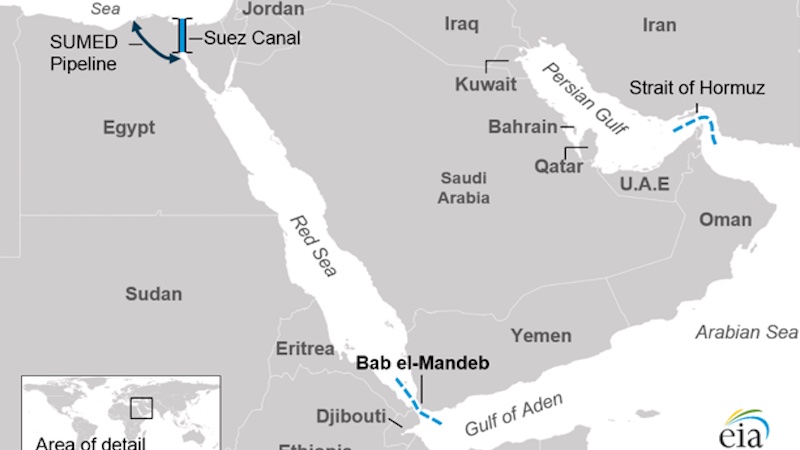 Location of the Bab el-Mandeb Strait, the Red Sea and the Middle East. Map Credit: EIA
Naval presence helps suppress attacks and reassure shipping companies but cannot resolve the underlying political drivers of conflict. US, European, and allied forces conduct patrols, provide limited escort, and monitor potential threats. Operations such as Prosperity Guardian have intercepted drones and missiles, facilitating the safe passage of hundreds of merchant ships.
Yet even with this protection, crews face elevated risks, and operational caution remains essential. Former US Navy Secretary Carlos Del Toro reported that American naval forces expended over US$1 billion defending shipping in the Red Sea, far exceeding the value of the Houthis’ offensive systems. This disparity illustrates how even superpowers remain vulnerable to asymmetric threats, underlining the strategic necessity of hard security guarantees.
Economic and Insurance Implications
Prolonged rerouting around Africa has imposed significant operational, financial, and logistical costs. Longer voyages reduce fleet efficiency, distort freight markets, and delay critical goods, creating political as well as commercial consequences. LNG and refined fuel deliveries were disrupted, pressuring governments to draw more heavily on reserves and manage public sensitivity to energy prices.
War-risk premiums remain high, reflecting uncertainty rather than calm. Insurers continue to influence routing and operational decisions, ensuring that every voyage is a carefully calculated operation. This dynamic reinforces that trade through the Red Sea, while operationally possible, remains fragile and contingent on broader geopolitical stability.
A Broader Lesson for Global Trade
The tentative resumption of Red Sea traffic highlights the vulnerability of key maritime chokepoints. Disruptions along critical routes—from the Red Sea to the Strait of Hormuz and the South China Sea—can cascade through global trade, affecting energy markets, food security, and industrial supply chains.
Non-state actors operating from fragile states have repeatedly disrupted routes carrying significant trade volumes, forcing costly rerouting and delays. The cautious reopening of the Red Sea may accelerate shifts in shipping practices, prompting fleets to diversify routes, invest in alternative ports, and factor in insurance volatility and geopolitical risk. Companies have recognised that flexibility and redundancy are strategic necessities in a world of unpredictable political shocks, yet anticipating emerging threats remains a challenge.
As great-power competition intensifies, maritime chokepoints are increasingly leveraged for strategic purposes, placing commercial shipping between political confrontation and economic necessity. Global trade resilience therefore depends not only on efficiency but also on understanding geopolitics, regional security dynamics, and the vulnerabilities of key transport arteries.
A Fragile Passage Forward
For now, ships are cautiously moving through the Red Sea, signalling a gradual recovery. Major carriers such as Maersk have completed multiple transits in late 2025 and early 2026, the first regular commercial voyages since the peak of Houthi attacks. Yet this reopening is tentative: other lines, including CMA CGM, continue to scale back Suez Canal sailings or reroute around Africa, reflecting ongoing security concerns. Naval deterrence has broadened beyond US-led operations, with European Union forces now contributing through Operation Aspides, reinforcing multilateral efforts to secure the route.
Even with these measures, traffic volumes remain well below pre-crisis levels, insurance premiums are elevated, and local tensions—including the potential for renewed Houthi attacks—maintain a high-risk operating environment. The Gaza ceasefire has eased some pressure, but the Red Sea’s reopening illustrates a narrow equilibrium: sustained by naval presence, priced by insurers, and shaped by unresolved regional politics. Global trade is cautiously returning to this critical chokepoint, yet the lessons are clear—flexibility, redundancy, and geopolitical awareness remain essential for maritime commerce in a world where contested waters are the default, not the exception.