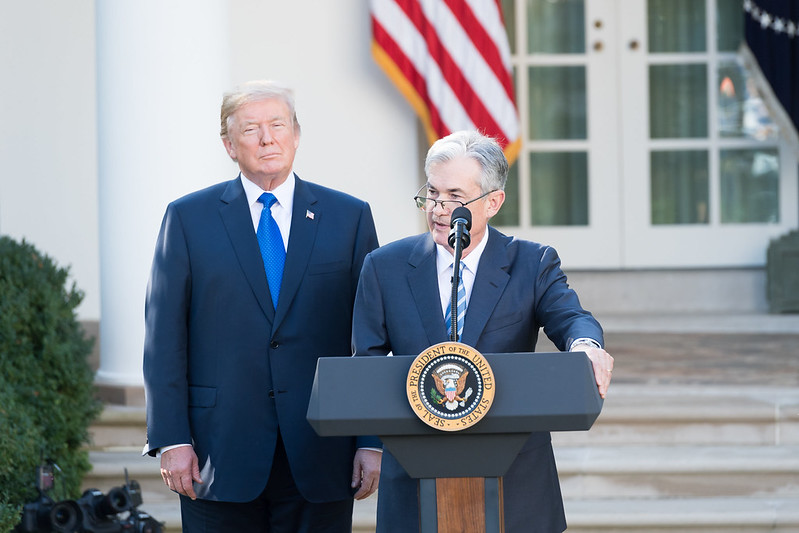
 President Donald Trump announced the nomination of Jerome Powell to be chairman of the Board of Governors of the Federal Reserve System on Nov. 2, 2017 (official White House photo by Andrea Hanks).
At first glance, the Federal Reserve seems to be on a roll. Last week, financial markets and key Republican senators defended Federal Reserve Chair Jerome Powell when he called foul on a criminal investigation into the costly renovation of Fed headquarters. This week, judging from arguments before the Supreme Court in Trump v. Cook, the justices are likely to block President Trump from summarily dismissing Fed Governor Lisa Cook without first demonstrating cause.
But the Fed remains on defense – vulnerable to Trump’s aggressive efforts to influence the course of the nation’s central bank.
The latest round
In an unprecedented move, Powell last week publicly rebuked the Trump administration. In a two-minute video on Jan. 11, Powell accused the administration of fabricating a criminal investigation of cost overruns incurred in remediating and renovating the central bank’s headquarters. He called the threat of criminal charges a White House “pretext” for the “Federal Reserve setting interest rates based on our best assessment of what will serve the public, rather than following the preferences of the President.” In his video remarks, Powell warned that such tactics would not coerce the Fed to lower rates.
Backlash against President Trump came quickly. Pivotal Republican senators publicly denounced the administration’s weaponization of the Department of Justice, defending Powell and the Fed. Most notably, two GOP senators – including retiring Senator Thom Tillis (R-N.C.), a member of the Senate Banking Committee – vowed to block confirmation of every Trump nominee for the Fed (including Powell’s replacement as chair) until the investigation is resolved.
Even if the Department of Justice aborts the investigation, the Fed faces further headwinds – including from the Supreme Court. Recent events offer four lessons about the fragility of Fed independence.
1. Powell got the audience off the sidelines
Political scientist E.E. Schattschneider wrote decades ago that politics is not like a football game: Political conflicts don’t play out on a measured field with a fixed number of players and spectators who dutifully stay off the pitch. Why not? Because the weaker party has a strong incentive to expand the scope of conflict in hopes of drawing supporters into the game, changing the balance of forces. “If a fight starts,” Schattschneider advised, “watch the crowd, because the crowd plays the decisive role.”
Swift public backlash suggests Justice would have preferred to pursue its investigation behind closed doors, keeping Powell on the defensive. But Powell summoned Schattschneider. As the weaker party, Powell “socialized” the conflict – appealing to lawmakers, investors, fellow central bankers, and the broader public to defend the Fed.
2. Congress is still the boss
At Ben Bernanke’s last press conference as Fed chair in 2013, a Politico reporter named Kate Davidson asked Bernanke what advice he would give incoming Fed Chair Janet Yellen for dealing with Capitol Hill. “Congress is our boss,” Bernanke replied.
The rush of GOP lawmakers standing up for Powell last week was no coincidence. Some surely reacted to questions from reporters. But politically savvy Powell kept a list of GOP lawmakers to whom he gave advance notice of his Sunday night broadside, expecting they might break ranks with the president and come to his aid. Importantly, Powell had been courting many of these legislators since the start of his first term as chair in 2017.
Why court Congress? As we wrote in The Myth of Independence, public support for the Fed runs through Congress. Central bankers care about what lawmakers think, because Congress wrote the law that dictates the Federal Reserve’s structure, governance, powers, tools – and the dual mandate to maximize employment and stabilize prices. When the U.S. economy goes south in the wake of a crisis, lawmakers often blame the Fed, sometimes revising the Federal Reserve Act to try to prevent future crises. At times Congress clips the Fed’s wings; other times it foists more powers on the central bank, even some the Fed might otherwise prefer to avoid.
Critically, Powell turned to Congress to bolster support for the Fed’s claim of policy independence – the statutory notion that the Congressional dual mandate and Federal Reserve expertise, not presidential demands, should shape decisions about interest rates. Powell’s public appeal for reinforcements reminds us that Fed independence is conditional: It depends on securing and maintaining political support, even in light of aggressive presidential pressure for low interest rates. And, of course, conditional independence is hardly independence at all.
3. Some players remain on the sidelines
First, markets took a fleeting dive last week on the heels of Powell’s video, but rebounded swiftly. Republican senators’ strong defense of the Fed led investors to believe that Powell would prevail in this round of presidential pressure. With the prospect of an immediate indictment off the table, markets resumed handicapping possible Powell replacements before pivoting quickly to a possible Greenland invasion.
Events of last week may have undermined the chances that Trump chooses the director of the White House Economic Council, Kevin Hassett. Market participants, central bankers, economists, and senators routinely judge Hassett to be the most loyal (and thus most likely) of Trump’s potential nominees. With Hassett’s odds lengthening amidst Congressional demands for an independent Fed, markets breathed more easily.
Second, Supreme Court justices are taking their time weighing in. With Powell in attendance at the Court, the justices this week heard oral arguments in Trump v. Cook, the administration’s emergency request to allow the president to remove Federal Reserve Governor Lisa Cook from the Federal Reserve Board over allegations that she committed mortgage fraud years before she joined the Fed.
Over the past year, in response to several Trump administration emergency requests, the Court has permitted the president to remove officials from various independent agencies (including the Federal Trade Commission, National Labor Relations Board, and others) despite legal rules that prohibit the president from firing them just because he disagrees with their policy views.
But several justices believe the Federal Reserve enjoys special status, suggesting that the Court might allow Governor Cook to stay on the Fed and require judicial review of whether or not the administration had demonstrated cause for her removal. Such a ruling would prevent presidents from treating Fed governors as “at will” employees and reshaping the Fed’s board with pliant central bankers whenever they see fit.
4. Reform in the wings?
Powell is not the first Fed chair to face a president eager to leave his imprint on monetary policy. Granted, presidents from Clinton through Obama largely kept their “hands off the Fed.” But many others pressured the Fed when interventions served their political interests. Harry Truman hauled the entire monetary policymaking committee to the Oval Office, told them to keep rates low, then lied about the meeting to the press. Richard Nixon orchestrated the fake news story that Fed Chair Arthur Burns demanded a 50% pay hike while proposing wage and price controls for everyone else.
The investigation of cost overruns will run its course, but other potential calls to reform the Fed loom large.
First, the end of Powell’s term as chair this May affords the president the opportunity to impose – contingent on a Board vacancy and Senate consent – a more pliable leader.
Second, many critics still blame the Fed for misjudging the post-pandemic threat of inflation and thus acting too slowly to combat it. What’s more, inflation remains above the Fed’s 2% target. A new Fed chair will face balancing presidential pressure for lower rates against policy decisions to contain inflation.
Third, Treasury Secretary Scott Bessent has accused the Fed of mission creep, charging that its bloated balance sheet and nonstandard policies give the central bank too big an economic footprint. Other critics, especially the new front-runner for Fed chair, Kevin Warsh, charge that the Fed overstepped its mandate by addressing climate change and diversity. More damaging, Warsh blames the Fed’s ultra-low rate policies for the massive run up in the national debt – a stance at odds with Trump’s demand for rock-bottom rates.
Whatever the Court decides, Trump’s clash with the Fed is far from over. The president demands loyalty and low rates with little patience for the orthodoxy that only independent central banks are effective inflation fighters. When asked last week about that tenet, Trump told reporters, “I don’t care.” Even Schattschneider strategies might fail in the face of an executive without a care.
Sarah Binder is a Good Authority editor, a professor of political science at George Washington University, and senior fellow at the Brookings Institution. She studies American political institutions, especially Congress.
Mark Spindel is founder and chief investment officer at Potomac River Capital, a Washington-based investment firm.
Sarah Binder and Mark Spindel are co-authors of the award-winning The Myth of Independence: How Congress Governs the Federal Reserve (Princeton University Press, 2017).
Related