
We’ll keep doing this until you give us Greenland
I hope that Trump’s threat to impose escalating tariffs on European countries if they don’t hand over Greenland will finally bury “TACO Trump” wishful thinking. For TACO Trump was always based on a belief that, on some level, Trump is rational: that when the disastrous consequences of his actions hit, he backs down.
But it’s now undeniable that Trump is completely irrational. No, his obsessive thirst for Greenland isn’t about national security. Under the NATO alliance, the U.S. already had liberty to do what it wanted strategically. And as withVenezuela, any mineral deposits that Greenland possesses may be too expensive to extract to be investible.
Trump himself has told us what’s going on: he’s throwing a temper tantrum over not receiving a Nobel Peace Prize — not how he put it, but that was the gist of his text to Norway’s prime minister. And there’s no reason to disbelieve him, even though Scott Bessent says that quoting Trump’s own words is a “complete canard.”
True, beating the drum about Greenland serves multiple other purposes: deflecting attention from Renee Good’s murder, the Epstein files, and his sagging poll ratings; humiliating the Europeans, who he hates for their decency and strong democracies; and getting another testosterone rush from flexing American military muscle. But it’s mostly just a tantrum.
However, we can say something about the likely effects of his attempt to coerce Europe with tariffs — namely, that it won’t work. Only in Trump’s fantasies does American possess huge economic leverage over Europe. To the extent that we have any leverage over them, it’s matched by the leverage they have over us.
Allow me to explain. The starting point for any discussion of Trump’s tariff threats should be the observation that tariffs are a tax on U.S. consumers and businesses, not foreigners.
That’s what economists believed before Trump started his tariff spree; the results of his tariffs show that they were right. Foreign producers have not, contrary to Trump’s predictions, absorbed the tariffs by significantly cutting the prices they were charging U.S. customers.
This is clear when one looks at data on average import prices. For example, in 2025 the average tariff on goods imported from China went from 11 percent to 37 percent, but the average price the U.S. was paying for those goods fell only slightly, less than 3 percent.
And a new study from the Kiel Institute for World Economics offers a more precise estimate based on detailed trade data: in 2025, foreigners absorbed only 4 percent of the cost of Trump’s tariffs. This means that Americans are paying 96 percent of the cost of the tariffs.
So Trump’s imposition of tariffs on European nations that have sent troops to Greenland is basically a declaration that he will punish American consumers and businesses until Europe gives him what he wants.
But won’t Europe be hurt by loss of U.S. export markets? Maybe, but not by much. The European economy is huge — almost as big, in dollar terms, as the U.S. economy — and doesn’t depend crucially on the U.S. market. It’s worth noting that very high US tariffs on China haven’t appeared to slow China’s economic growth at all.
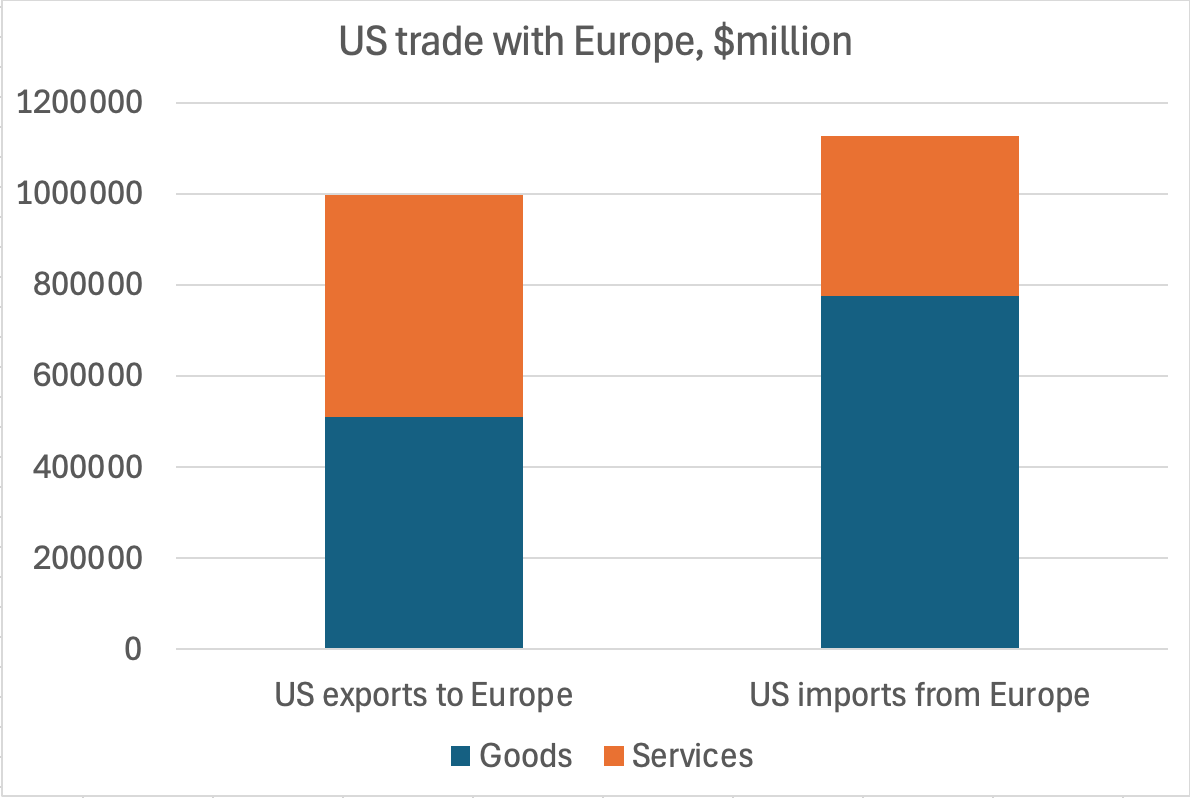
Furthermore, if America and Europe get into a trade war, U.S. companies will be hit as hard as European companies. That’s because America sells almost as much to Europe as Europe sells to America:
Source: Bureau of Economic Analysis
More precisely, U.S. producers sell about 8 dollars’ worth of goods and services to Europe for every 9 dollars’ worth of European sales to America. And even that small asymmetry is largely a statistical illusion caused by leprechaun economics: Irish subsidiaries of U.S. companies, especially pharmaceutical producers, charge their parent companies inflated prices so as to shift reported profits to Ireland, which has a lower corporate tax rate.
Now, you may be tempted to dismiss concerns about European retaliation, claiming that European leaders are weak and timid. That’s surely what Trump thinks, and it has been true in the past. But is it still true? The reason Trump is imposing tariffs on eight European countries is that they dared to send troops to Greenland to forestall a possible U.S. invasion — a pretty gutsy move.
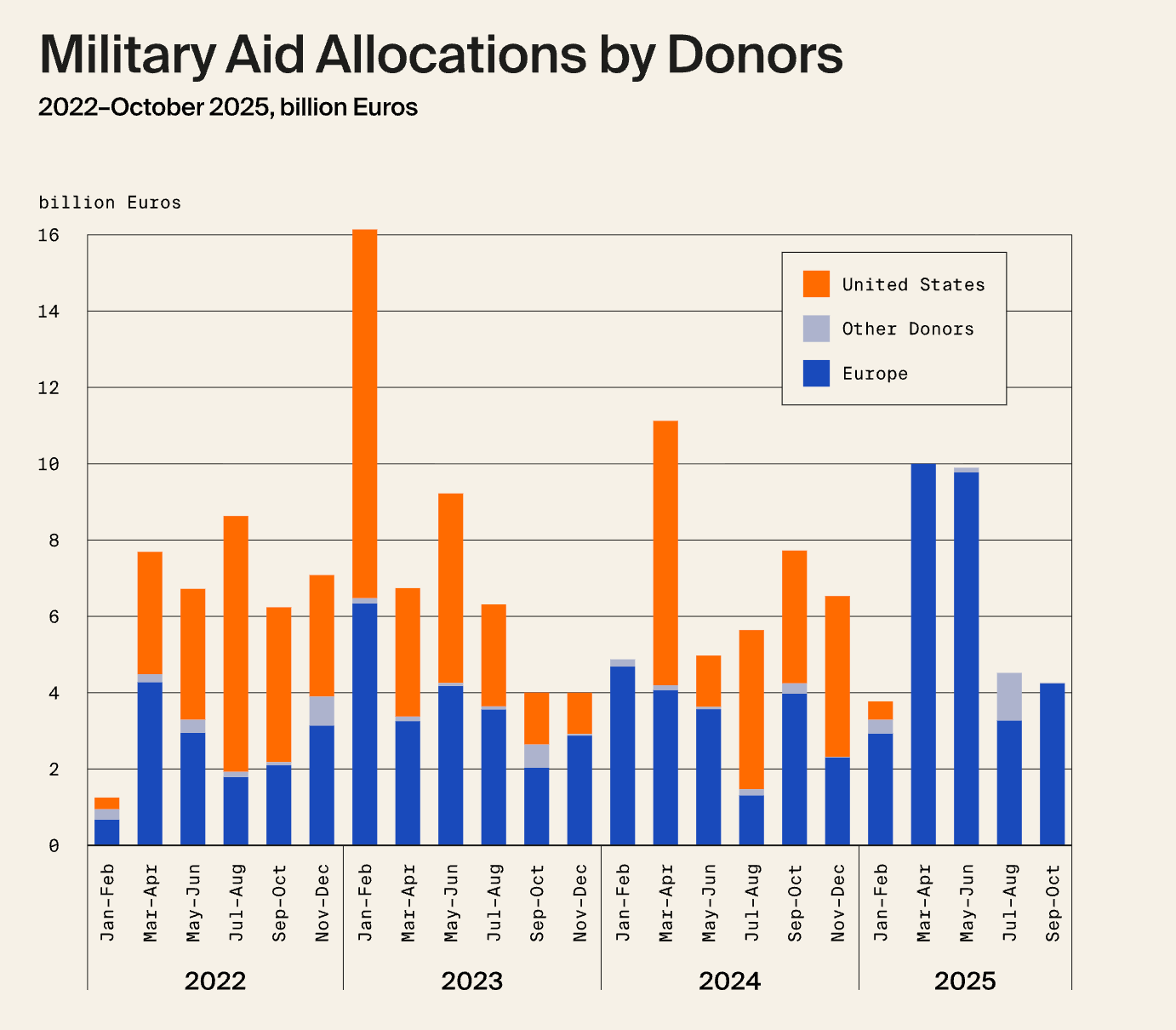
Or look at the way Europe has completely replaced the United States in supporting Ukraine:
Source: Ukraine Support Tracker
Beyond the fact that Europe is toughening up militarily, it has the capacity to be tough, acting in unity, in international trade. Individual European countries don’t choose their own tariff rates: The European Commission sets tariffs for the EU as a whole.
Furthermore, the EU has a procedure — the Anti-Coercion Instrument — designed to allow the rapid imposition of serious sanctions against any nation that tries to use economic pressure “to pressure the European Union or an EU Member State into making a particular choice.” This instrument, nicknamed the trade bazooka, was designed with China in mind, but it obviously applies to the United States right now, as Trump tries to use tariffs to force European nations to acquiesce in his Greenland land grab.
In fact, the legal basis for stiff European retaliation against the U.S. looks infinitely stronger than the legal basis for Trump’s tariffs. But the Supreme Court keeps emboldening Trump by repeatedly delaying a ruling on the legality of hisinvocation of emergency powers to impose most of his tariffs. At this point the Court’s cowardice is unmistakable; the justices’ robes must be drenched in flop sweat.
It’s possible, of course, that Europe will fail to use the power it has. TACO Trump is wishful thinking, but Europe has often chickened out in the past. The predicament Europeans find themselves in now is the result of their previous lack of resolve. And the next time around will only be worse.
So hopefully Europe has learned its lesson with Trump. Because if it has, Trump’s bullying won’t go the way he expects.
MUSICAL CODA
How about some European music?