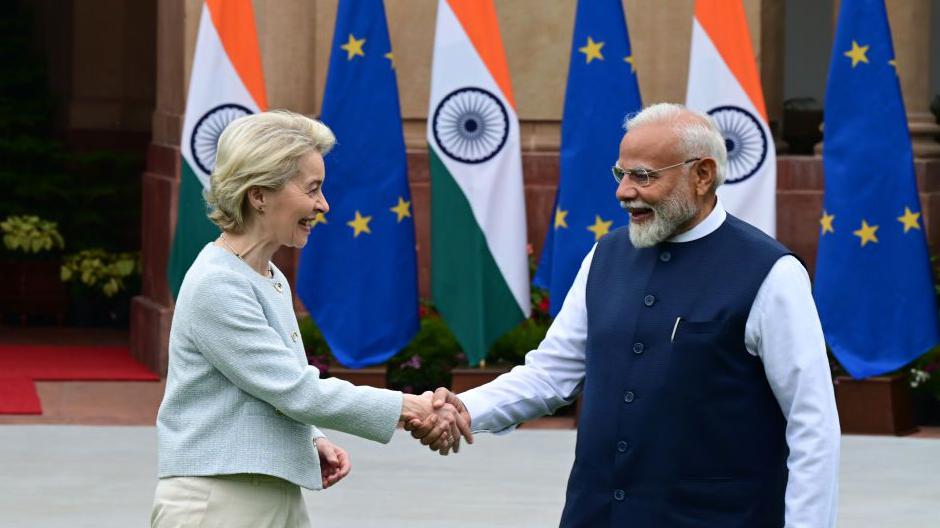
As the shadow of protectionism lengthens across the Atlantic, New Delhi and Brussels have defied the global drift toward isolationism. In a move that fundamentally redraws the geopolitical map, India and the European Union are set to sign what insiders are calling the “Mother of All Deals,” a sweeping free trade agreement that serves as a direct countermeasure to the tariff uncertainty radiating from the Trump White House.
The timing is surgical. With President Donald Trump threatening a fresh barrage of 50% tariffs on imports—a move that has sent tremors through the Nairobi Securities Exchange and global markets alike—India has pivoted sharply. The deal, expected to be formally inked on January 27, 2026, is not merely about lowered duties; it is a strategic bulwark. By slashing tariffs on over 90% of traded goods, this pact effectively insulates two of the world’s largest economies from the erratic trade winds blowing from Washington.
The Anatomy of the Deal
Sources close to the negotiations in New Delhi confirm that the agreement will unlock unprecedented access for Indian textiles, electronics, and chemicals into the vast European market. Conversely, European automakers and vintners—long frustrated by India’s prohibitive import duties—will finally gain a foothold in the world’s most populous nation.
Tariff Slashes: Duties on 90% of tariff lines will be reduced to zero or near-zero levels over the next five years.
Strategic Autonomy: The deal explicitly includes clauses on supply chain resilience, reducing dependence on both Chinese manufacturing and American consumption.
The Kenya Connection: For Kenya, this realignment is seismic. As a key Indian Ocean trade node, Mombasa could see a shift in transshipment volumes as trade flows redirect from the Trans-Pacific to the Euro-Indian corridor.
European Commission President Ursula von der Leyen and European Council President António Costa are currently in New Delhi as chief guests for India’s Republic Day celebrations—a symbolic gesture that underscores the gravity of this alliance. “Economics and security are two sides of the same coin,” von der Leyen remarked, a veiled reference to the need for stable partners in an era of American unpredictability.
A Shield Against the “Trump Shock”
The catalyst for this accelerated timeline is undeniable: the “Trump Shock.” With the US administration doubling down on “America First” protectionism, the Global South is scrambling for cover. For India, a country whose bilateral trade with the EU already stands at a staggering $136.53 billion (approx. KES 17.7 trillion), this deal is an economic life raft. It provides a guaranteed market for its goods just as the American door threatens to slam shut.
Financial analysts in Nairobi warn that while this is a win for India, it poses questions for African economies. “If India saturates the EU market with textiles, where does that leave Kenya’s EPZ exports?” asks localized trade expert Jared Omondi. “We are watching giants dance, and we must be careful not to be trampled.”
Ultimately, this deal signifies the end of the post-WWII unipolar trade order. As Washington retreats behind tariff walls, Delhi and Brussels are building a new bridge—one that bypasses the United States entirely.