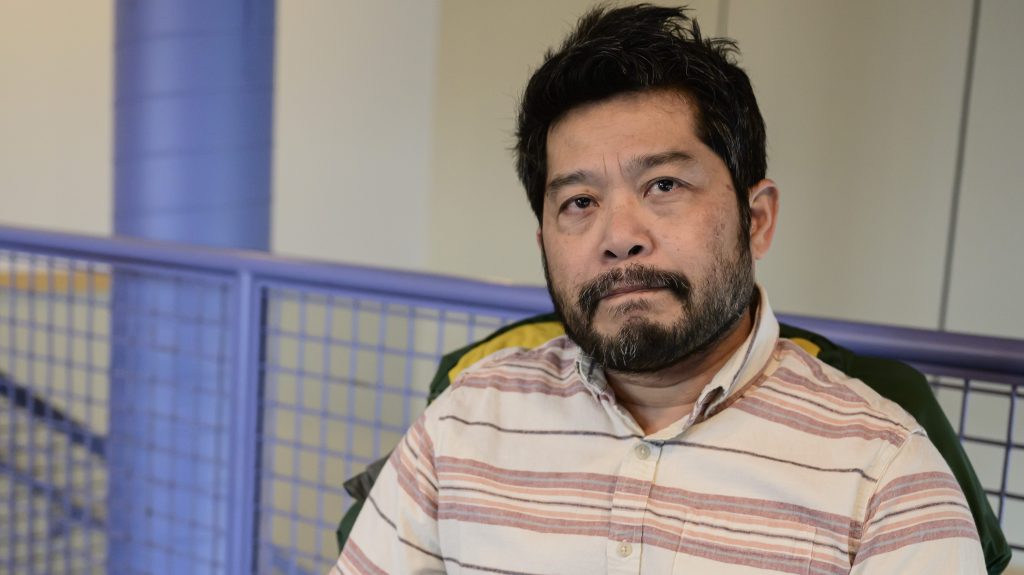
As a young man, George Thawmoo repeatedly fled his rural village in Burma, taking refuge in the jungle with his family until the Burmese government had retrenched. As soldiers left, they would set fires and burn the bamboo huts that his people — the ethnic Karen — called home.
In 1997, Thawmoo and his 4-month-old son landed at a refugee camp in Thailand, not far from the Burmese border, from where he would later take college courses through an international institute. Life was hard, and Thai police frequently extorted Karen refugees for forced bribes, but he eventually found work as an interpreter for the U.S. State Department, where he met and married his wife, an American.
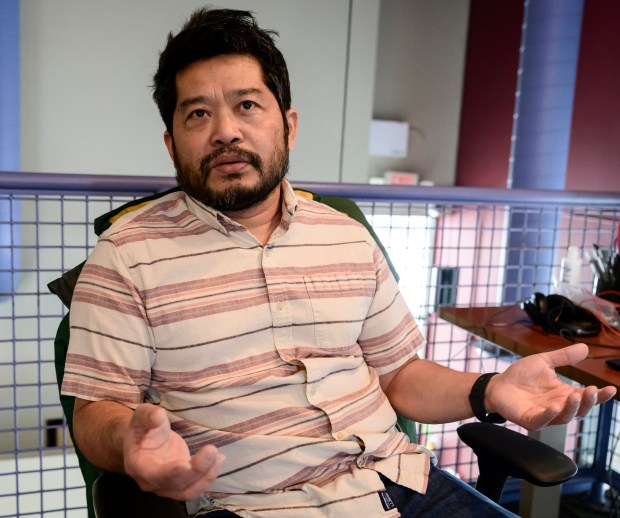 George Thawmoo, an ethnic Karen, at the Ramsey County Service Center in Roseville on Wednesday, Jan. 21, 2026. (John Autey / Pioneer Press)
In Minnesota, he found new opportunities, and life got better.
Thawmoo, now 50 and living in St. Paul, where he’s raised five children, had figured the days of government crackdowns based on his ethnicity were well behind him.
He’s been proven wrong, he said, and so have the more than 20,000 Karen refugees living in Minnesota as the U.S. Department of Homeland Security rolls out detentions and door-to-door immigration enforcement throughout the state. For many refugees of all backgrounds, confronting the same types of militarized operations and detainments that made them flee their homelands has been retraumatizing.
In three weeks, federal agents have been involved in as many shootings in Minneapolis. Alex Pretti was fatally shot Saturday by ICE agents in south Minneapolis, wile Renee Good was killed on Jan. 7. There also was a man shot by federal agents in the leg in North Minneapolis. In those cases federal authorities say they were defending their lives, though local officials dispute this.
“The community is overwhelmed and scared,” said Thawmoo, noting some of his children’s classmates and their parents no longer leave the house. “I think some people are going to lose their housing because they can’t go to work. If kids aren’t going to school, that’s going to impact their education.”
‘I’m concerned for my safety’
The federal government recently announced that Temporary Protected Status for Karen refugees would end Jan. 26, despite Burma’s ongoing civil war and the military coup that overthrew the government in February 2021.
“This is the first time since I moved here that I’m concerned for my safety,” said Thawmoo, a naturalized U.S. citizen. “I’m debating, should I carry my passport? If they stop me for some reason, do I just comply? These are things you never thought of happening in America because of the rule of law and principles of free speech.”
Alison Beckman, a clinical social worker with the Center for Victims of Torture in St. Paul, said similar thoughts are racing through the minds of asylum-seekers of all backgrounds who had assumed the worst was behind them when they landed in the U.S., which loomed for many as a beacon of democratic freedom.
“This is exactly what our clients have fled from,” said Beckman, who is also a trained legal observer with the Immigrant Defense Network. “We’re seeing increased suicidal ideation. Our clients are afraid to go to work. They’re not leaving their apartments, their homes. They’re not going to religious services. It’s pretty awful.”
‘I thought I had left all this behind me’
On a recent Friday evening, a St. Paul man who has been living in the U.S. for more than 20 years under Temporary Protected Status blinked back tears of disbelief as he described the moments of hope and despair he feels throughout the day, every day.
“I thought I had left all this behind me in Venezuela,” he said.
St. Paul Mayor Kaohly Her, who is Hmong, has raised similar concerns after meeting with Hmong and Latino shopkeepers, many of whom no longer see their regular customers, who rarely leave the house. Older refugees who hold U.S. citizenship fear they don’t have the language skills to explain that to U.S. Immigration and Customs Enforcement agents.
“One person shared with me that their family members who survived the Secret War in Laos are more scared now than they were at the end of the Vietnam War,” wrote Her, in a recent Facebook post. “One woman, who is a U.S. citizen, went to the hospital because she had a severe anxiety attack from the fear.”
Asylum applicants
Beckman noted the majority of the clients she sees at the Center for Victims of Torture have applied for asylum, a legal immigration process.
Many arrive in the U.S. with psychological scars from the repression they’ve faced and guilt over the loved ones they’ve left behind, she said. Now they’ve been retraumatized by the “unprecedented and unjustified militarized enforcement that has happened all over the country and moved here. It’s created this climate of terror. It’s totally unnecessary. My kids’ friends are carrying their passports around and they were born here as citizens.”
Even some conservative pundits have begun to criticize the tactics of ICE, with podcaster Joe Rogan saying last week: “You don’t want militarized people in the streets just roaming around snatching people up, many of which turn out to actually be U.S. citizens that just don’t have their papers on them. Are we really going to be the Gestapo? ‘Where’s your papers?’ Is that what we’ve come to?”
At a news conference Tuesday, U.S. Border Patrol head Greg Bovino downplayed concerns about reports of citizens or others uninvolved in enforcement operations or protests being arrested by federal agents.
“They are not random and they are not political. They are about removing criminals who are actively harming Minneapolis neighborhoods,” Bovino said of ICE operations.
Nevertheless, Thawmoo, a co-chair of the Karen Organization of Minnesota, said while ethnic Karen in Thailand were often extorted when he lived there, they didn’t necessary live in fear of violence at the hands of Thai police. In some cases, ICE detainments of the past few weeks have been worse.
Thawmoo joined his son and daughter on Jan. 14 for a rally outside the Minnesota State Capitol, which he said the teens were eager to attend. His goal, he said, went beyond protesting militarized ICE tactics. He hopes to stand up to his own fears and help others in his community do the same.
“A lot of us have a collective experience of fear,” Thawmoo said. “We thought we were done with it. ‘We came here, we’re done, this is the greatest country.’ I guess I’m wrong.”