They described symptoms that they said went beyond those caused by conventional tear gas, including severe breathing difficulties, sudden weakness and loss of movement.
“What was fired was not tear gas,” one protester said.
“People collapsed,” another eyewitness said.
Iranian authorities crushed unrest earlier this month in the deadliest crackdown on protestors in the Islamic Republic’s nearly 50-year history.
According to accounts, the gases caused intense burning of the eyes, skin and lungs, along with acute respiratory distress, repeated coughing, dizziness, loss of balance and, in some cases, vomiting or coughing up blood.
Witnesses said the severity and persistence of the symptoms differed from their past experiences with tear gas, although they said they could not identify the substances used.
Gas fired into crowds and escape routes
Witnesses said gas canisters were fired into crowds and along escape routes, including narrow streets and alleys.
According to the accounts, in some cases gunfire began at the same time, or immediately after, protesters lost the ability to walk or run and fell to the ground.
Several witnesses said that moments of immobilization became points at which shooting intensified, particularly when protesters collapsed in alleys or while trying to flee.
Reports came from multiple cities, including Tehran, Isfahan and Sabzevar.
Sabzevar footage
Videos received from Sabzevar, a city in Razavi Khorasan province in northeastern Iran, and reviewed by Iran International showed security personnel wearing special protective clothing and masks designed for hazardous chemical materials, positioned on military-style vehicles in city streets.
Warning symbols associated with hazardous substances were visible on vehicles in the footage. Sounds consistent with gunfire could be heard in separate videos.
Iranian forces are seen wearing chemical-hazard protective gear on military-style vehicles in the streets of Sabzevar, northeast Iran.
A yellow triangular hazardous-materials warning sign is visible in the footage, while gunfire can be heard in a separate video.
Isfahan accounts
In central province of Isfahan, witnesses said tear gas with chemical characteristics was fired directly into crowds of protesters, including teenagers, young people and older individuals.
They said attempts to reduce the effects of the gas using common methods such as wet cloths quickly proved ineffective.
Witnesses described scenes in which people fleeing into alleys developed severe breathing difficulties and collapsed after running short distances. They said shooting began while protesters were in that condition, with scenes they described as “like war movies.”
Other witnesses described the smell of the gases as a mixture of pepper, swimming-pool chlorine, bleach and vinegar, and said the sky filled with smoke in red, yellow and white colors.
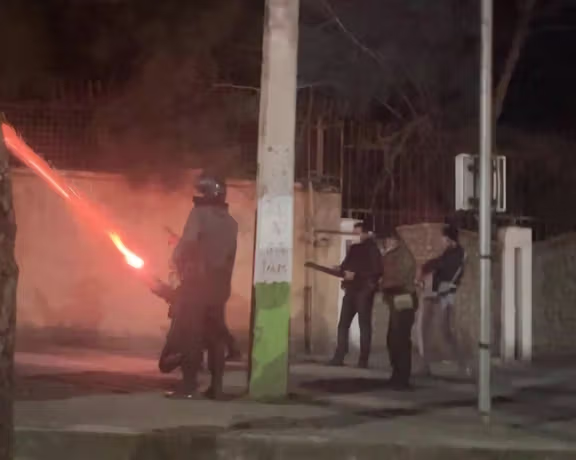
Several women and a 17-year-old girl described seeing an unknown device that, they said, “without the sound of gunfire, fired something like flames in red and yellow.”
“Seconds later, the street was full of smoke and vapor,” they said, adding that the smell resembled ammonia, drain cleaner and, in some areas, mustard.
One woman said two plainclothes agents put on protective masks before throwing gas canisters toward nearby crowds. She said young people closest to the impact “quickly developed coughing, intense burning and inability to move” and shouted: “I’m burned.”
Tehran accounts
In Tehran, witnesses from several neighborhoods said gas was fired repeatedly, producing thick smoke and severe irritation.
Protesters said the gases caused intense burning of the eyes and lungs and numbness in the lips, with smoke described as green, yellow and black.
Witnesses said protesters who felt suffocation sought refuge inside nearby homes, but said security agents were positioned near some of those locations.
In addition to tear gas, witnesses spoke of “unknown gases with more severe effects,” saying those exposed experienced sudden weakness, inability to walk and loss of breath.
Fear of hospitals
In a number of accounts, witnesses said fear of the presence of security agents at hospitals and the risk of arrest led many wounded protesters to avoid medical centers.
They said some treatment was instead carried out at private homes with the help of volunteer doctors.
Some witnesses said people they knew continued to suffer severe coughing, nausea and skin blistering days after exposure.
Medical assessment
Alan Fotouhi, a physician and professor of clinical pharmacology based in Sweden, told Iran International that the symptoms described by witnesses did not match those typically associated with standard tear gas.
He said the pattern of symptoms, severity of harm and persistence of effects differed from what is normally observed with conventional tear gas exposure.
Fotouhi said the reported effects could result from a combination of high-dose tear gas and other highly irritating chemical substances, but said identifying the exact materials would require laboratory analysis.
Iranian authorities have not commented on the witness accounts.
Iran is a signatory to the Chemical Weapons Convention, which restricts the use of chemical agents against civilians.
Human rights groups have condemned the use of force against protesters in Iran, including the use of tear gas and live ammunition.