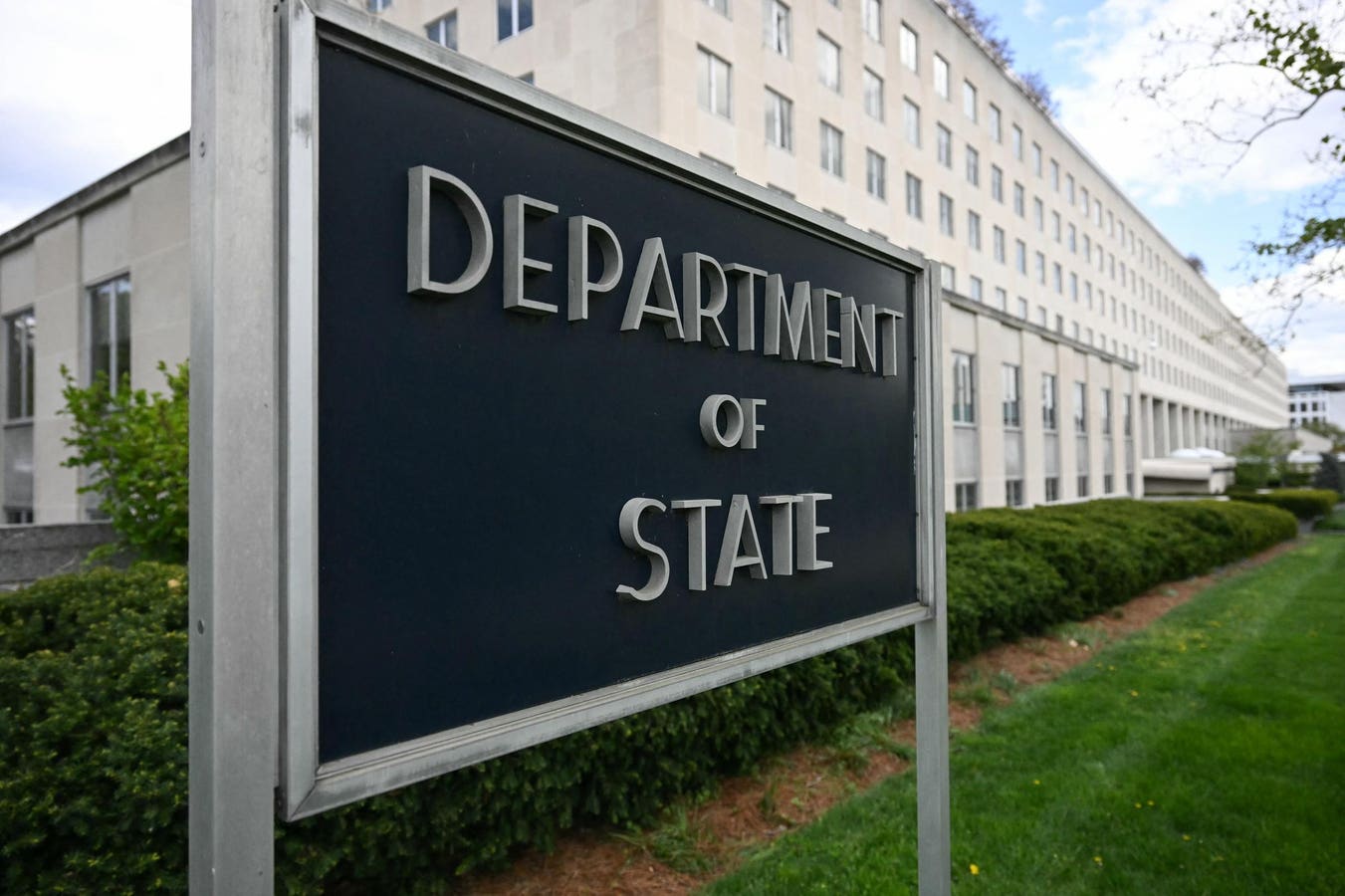
An exterior view of the U.S. Department of State headquarters in the Foggy Bottom neighborhood in Washington, D.C, on April 15, 2025. The Trump administration will allow 17 Iranians with visas to enter the United States to address a lawsuit challenging the president’s proclamation banning entry by individuals from multiple countries. (Photo by JIM WATSON/AFP via Getty Images)
AFP via Getty Images
The Trump administration will allow 17 Iranians with visas to enter the United States to address an immigration lawsuit challenging the president’s proclamation banning entry by individuals from multiple countries. The administration may have acted to “moot” an appeal to the ban and the State Department’s policy of refusing to issue visas to nationals of the countries listed in the proclamation.
An Immigration Lawsuit Against A Presidential Proclamation
On June 4, 2025, Donald Trump issued a proclamation banning immigrant and temporary visas from 19 countries, including Afghanistan, Burma, Iran and others. The proclamation contained more extensive prohibitions for seven of the 19 countries. A Dec. 16 proclamation expanded the visa categories for the 19 countries and denied the entry of individuals from 20 additional nations.
On June 6, the State Department sent guidance to consular posts that stated any applicants “must be refused” a visa if they are subject to the June 4 proclamation and not qualified for one of the proclamation’s limited exceptions.
On August 21, U.S. District Judge Sparkle L. Sooknanan issued an opinion in Thein v. Trump granting in part and denying in part the plaintiffs’ motion for a preliminary injunction. The plaintiffs, represented by Curtis Morrison of Red Eagle Law, were 102 nationals of Afghanistan, Burma, Togo, Somalia and Iran selected in the Diversity Visa lottery. Judge Sooknanan notes that the plaintiffs alleged the government “either failed to adjudicate their diversity visa applications or unlawfully refused them because of a Presidential Proclamation that suspends entry into the United States by individuals from their home countries.”
On Jan. 23, 2026, Judge Sooknanan granted the Trump administration’s Cross-Motion to Dismiss and denied the Plaintiffs’ Motion for Additional Emergency Injunctive Relief.
An Immigration Lawsuit Takes A Surprising Turn
At the time of Judge Sooknanan’s Jan. 23 ruling, the plaintiffs had oral arguments scheduled in the case for appeal and cross appeal before the U.S. Court of Appeals for the D.C. Circuit. According to Morrison, the appeal centered on 1) whether the district court judge was right to find that 212(f) is only an entry ban and not an issuance ban, and 2) whether the district court judge was wrong to find that Trump’s travel ban was lawful under Trump v Hawaii.
On the evening of Jan. 23, following Judge Sooknanan’s ruling, the Justice Department made a surprising filing to the D.C. Circuit. First, it attached a copy of Judge Sooknanan’s ruling. That was expected. What followed was unexpected.
“Of the 62 Plaintiffs who were issued visas as a result of the preliminary injunction that is on appeal, 17 Plaintiffs were barred from entering the United States under Proclamation 10949,” wrote the Justice Department attorneys. “But those 17 Plaintiffs had ‘valid visa[s] on the applicable effective date’ of the new Proclamation. (See Appellees’/Cross- Appellants’ Principal Brief at 17.) Accordingly, Proclamation 10949, as continued and supplemented by Proclamation 10998, does not bar those 17 Plaintiffs from entering the United States.” (Emphasis added.)
These 17 plaintiffs, all from Iran, were the individuals included in the appeal, with the hearing scheduled in February. The Trump administration told the Court that those 17 individuals can enter the United States.
Curtis Morrison is ecstatic for his clients and believes he understands the Justice Department’s action from a litigation perspective. “In my view, the administration hopes to moot the appeal before the February 19 hearing, where a 3-judge panel will consider the lawfulness of the travel ban, but particularly, its implementation, where the State Department, without authority, uses the ban as an excuse not to issue visas,” said Morrison in an interview.
Morrison notes that several federal judges in the D.C. Circuit have found that a 212(f) entry ban cannot be used as an issuance ban. “The Trump administration hopes to avoid the higher court from affirming that interpretation of law because it will make it more logistically challenging for them to implement 212(f) entry bans,” according to Morrison.
It is too early for Morrison to say whether the action will end the appeal, but he notes that if all 17 plaintiffs enter the United States, the government has a strong argument that the case is moot. (Two plaintiffs were able to board flights on Jan. 24, headed to New Jersey.) It is unclear what the Trump administration’s action will mean for other legal efforts against the presidential proclamations. A National Foundation for American Policy analysis found that the proclamations will contribute to a possible 33% to 50% decline in legal immigration during Donald Trump’s term.
Visa issuance is a significant topic that has received limited attention in the debate over the Trump administration’s proclamations. According to Morrison, Congress did not give the president the authority to suspend visa issuances, which means that if a president is allowed to ignore the limits placed on his authority, it creates a precedent that can be abused.
In an interview shortly after the June 4 proclamation, attorney Ira Kurzban, chair of the immigration department at KKWT, pointed to the practical problems the administration created by prohibiting issuing immigrant visas, since it means initial filings and paperwork will not take place to sponsor family members. “The entry ban is supposed to be temporary, but that’s just a mirage, because not issuing the visas and ending the visa process means starting that back up will take substantial time,” said Kurzban.
While the Justice Department has been helpful in communicating the decision to airlines, some clients have visas that will expire soon, and the limited internet in Iran and the lack of flight options make arriving in the United States quickly a daunting task.
“We had clients who decided to step up and pay for representation to fight a cross appeal, and now they’re being allowed to enter the United States,” said Morrison. “For them and our law firm, this development is seen as a huge success.”