Virginia’s new Democratic governor said the commonwealth will return to the Regional Greenhouse Gas Initiative, a multi-state compact designed to disincentivize carbon dioxide emissions.
Republicans say the transition will mean an increased financial burden on taxpayers.
But environmental advocates say the costs are offset by spending on flood mitigation and cost savings for low-income Virginians.
Here’s a look at the costs and benefits of rejoining RGGI.
What is RGGI?
RGGI is an agreement among 10 states — Connecticut, Delaware, Maine, Maryland, Massachusetts, New Hampshire, New Jersey, New York, Rhode Island and Vermont — designed to disincentivize carbon dioxide emissions.
Those states hold quarterly auctions where energy producers must purchase an allowance for each metric ton of emissions. The total number of allowances decreases over time. The money generated by states through the auctions gets reinvested into initiatives such as clean energy infrastructure and climate resiliency.
Virginia was a part of RGGI between 2020 and ’23, when Gov. Glenn Youngkin pulled the state out of the compact, citing increased costs to energy consumers for too little payoff. A judge later ruled the move was illegal because the program had been created by the General Assembly. But Virginia has remained out of RGGI while the case made its way through the courts.
Who pays for RGGI?
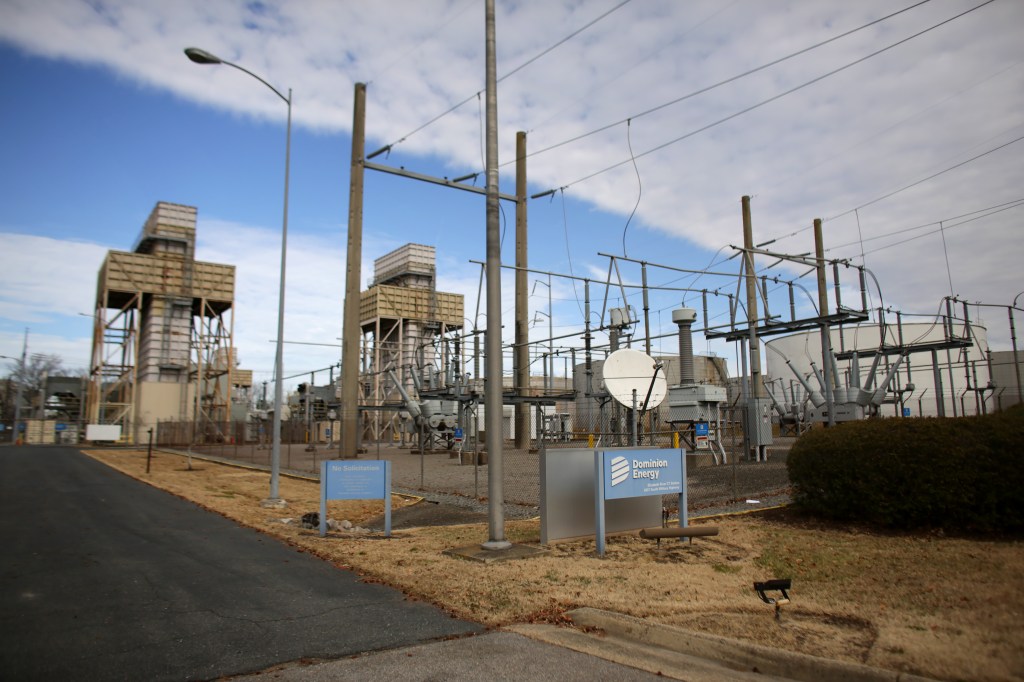
When Virginia was a part of RGGI, utility companies like Dominion Energy were obligated to pay for allowances for emissions generated from natural gas power plants, such as the Elizabeth River plant in Chesapeake. Those companies could pass the costs along to energy customers.
When Virginia left RGGI in December 2023, the average residential customer was paying about $4.40 a month in what’s called a rider — a separate, line item cost in addition to the base rate — to cover the cost, according to Dominion.
It’s not clear how much Virginians would pay now for RGGI because the price is determined through the auctions and dictated by supply and demand. But in general, the prices for credits have gone up.
“When Virginia left, the last auction was about $15 per allowance, and the auction that was held back last month was almost $27 per allowance,” said Steve Haner, senior fellow for environment and energy policy at the Thomas Jefferson Institute for Public Policy, a conservative think tank. “That’s a pretty substantial increase in two years.”
The last year Virginia was in RGGI, it sold more than 22 million allowances. At $26.73 per allowance, that could add up to $540 million or more a year in revenue the state would take in from the power companies.
“It’s an economic reality that businesses can pass along their costs (to consumers),” Haner said.
Where does the money go?
In Virginia, half of the funds generated through RGGI auctions went to the High Energy Efficiency Fund, which pays for energy efficiency upgrades to residential buildings with the goal of bringing down energy bills for low-income Virginians. Another 45% of funds went to the Community Flood Preparedness Fund, which offered millions in grants to Hampton Roads cities in flooding prevention projects. The remaining 5% went to administrative costs.
The flood fund has awarded more than $315 million for resilience and mitigation projects across the state since 2021, according to the Virginia Department of Conversation and Recreation.
When Virginia withdrew from RGGI, the state bankrolled the flood fund, appropriating money from the general fund.
“The General Assembly had to go to general funds and commit $100 million to backfill,” said Jay Ford, Virginia policy manager at the Chesapeake Bay Foundation. “That $100 million paled in comparison to what we would have taken in auction proceeds over the same time period.
“The immediate consequence is that localities who had been dependent upon what was consistent, dedicated funding found that all of sudden their projects may have to wait years for adequate funding because we simply don’t have as much to go around.”
In the time Virginia was in RGGI, it generated nearly $828 million in revenue.
Ford described the rider as a minor fee in exchange for major transformational investments in communities.
“Investments in flood mitigation at the community scale and targeted energy relief for low-income Virginians far outweighs the RGGI rider,” Ford said.
There are other financial tradeoffs too, Ford said. In Hampton Roads and on the Eastern Shore, sunny day flooding resulting in school closures amounts to financial strain for families that have to scramble to find child care or take off from work. Businesses can’t move the goods they need. And significant flooding can affect military readiness in the region.
And if projects get delayed, they get more expensive, Ford said.
“Every time we kick the can, every time we do a $35 million grant round instead of a $100 million grant round, those projects all become more expensive every single time we put them off,” he said. “It gets even worse when you contemplate the whole point of these funds in the first place, which is to make our communities resilient in the face of a potential disaster.
“Were a disaster to occur, and we had been pumping the brakes on funding these programs, it’s a tragedy. It’s also a financial tragedy for the state of Virginia.”
The total cost for a large-scale flood protection project in Virginia Beach, for example, has nearly doubled in cost to $1 billion since bonds for the project were approved in 2021.
Does RGGI work at reducing emissions?
Virginia’s power sector carbon emissions declined by 22% between 2020 and 2023 according to the Environmental Protection Agency. Between 2023 and 2024, emissions levels increased by 20.5%.
The data was only available for three quarters of 2025, but if emissions continued at the same rate for the remainder of the year, they would have surpassed 2020 levels.
Kate Seltzer, 757-713-7881, kate.seltzer@virginiamedia.com