
On January 7, South Korean singer Chuu released her debut album, which includes the track “Teeny Tiny Heart,” written by Emili Jürgens. Just days later, on Monday, January 19, boy band EXO dropped their new album featuring the song “Crazy,” co-written by songwriters Leowi and Merili Käsper, who works under the name m els.
The reach of these artists is significant. Chuu has over 770,000 monthly listeners on Spotify and nearly 18 million monthly views on YouTube. EXO, meanwhile, draws close to 6.3 million monthly listeners on Spotify and their YouTube audience tops 28.4 million. Their ten most popular songs on Spotify have collectively amassed nearly two billion streams, making this a massive, high-stakes stage for any songwriter.
“Teeny Tiny Heart,” written by Emili Jürgens, had surpassed 240,000 views on YouTube and 340,000 streams on Spotify as of January 23, just over two weeks after release. “Crazy,” co-written by Merili Käsper and Leowi, racked up nearly 530,000 YouTube views and over 560,000 Spotify streams in just four days; it currently sits atop the global iTunes album sales chart.
In South Korea, physical album sales remain a crucial part of the music industry alongside streaming and merchandise. Since its release, EXO’s new album has sold more than 800,000 physical copies.
Estonian songwriters entered the South Korean market through Faar Music, a music publishing company whose writers work under publishing contracts. Faar provides its authors with creative and professional opportunities, including studio sessions, songwriting camps and international collaborations, in exchange for a share of each song’s revenue.
In South Korea, Faar partners with various local music companies. “We regularly send them new music that we believe could suit their artists. We also have a local sub-publisher in South Korea who handles song registrations, passes on information about which artists are looking for which types of songs and helps pitch those songs to record labels,” Faar CEO Kertu Mägar told ERR.
According to Mägar, Faar Music’s collaboration with the South Korean market began through consistent relationship-building. On two occasions, the company has brought Estonian songwriters to South Korea to get acquainted with the local music industry and its key players. “Personal connections and trust are extremely important in this field,” Mägar added.
However, the tracks released this January — as well as “Want More? One More!,” a song co-written by Carlos Ukareda for the boy band Nexz and released last spring — were all created at songwriting camps held in Tallinn, Norway and Denmark, without direct involvement from Korean collaborators. Mägar said this is common practice.
“All of these songs reached South Korean artists through pitching, meaning we submitted them via email to the appropriate companies. The Nexz track, co-written with Carlos Ukareda, was our first release in South Korea. Emili Jürgens and I had just returned from Seoul when, right before boarding our flight, I noticed an email from the Nexz team saying they wanted the song for their mini album. I had just met their team in Seoul, which gave me a great opportunity to hear directly from them what they were looking for and then pull fitting tracks from our catalog,” Mägar explained.
Still, the goal is to travel to South Korea with songwriters at least once a year. For example, Emili Jürgens has collaborated there with local creators. “Writing with Korean songwriters doesn’t guarantee a release. In the end, the best song wins, regardless of where it was written. Collaboration with the South Korean market also happens online — sometimes Korean producers send us instrumentals and our writers add the melody and/or lyrics,” Mägar said.
Competition in the K-pop market is fierce. South Korea’s thriving music industry attracts a steady stream of hopeful songwriters and the country also trains specialists locally through various academies.
“There are a lot of talented producers and songwriters in South Korea and the competition is intense as more and more writers are looking to break into this market,” said Faar Music CEO Kertu Mägar. “Ultimately, it comes down to who has the best song at the right moment — one that suits a particular artist. Where the songwriter is from doesn’t matter; it’s all about quality and timing.”
Mägar noted that Scandinavian countries have already paved a strong path into the Korean market and Estonian songwriters are following a similar route. “Western songwriting and production quality are highly valued in Korea, as is musical sensitivity, and those are exactly the strengths Estonian authors bring to the table,” she said.
Record labels also prefer demo tracks in English, which plays to the advantage of Estonian writers. “Estonian songwriters’ strong English skills are highly appreciated. It also helps if the songwriter is a good singer themselves — being able to perform well makes it easier to land writing sessions in South Korea,” Mägar added.
She explained that South Korean companies expect essentially finished songs. “There’s no point in sending over half-formed ideas — the quality has to be top-notch. All vocals, including background vocals, should be recorded. Then the Koreans simply write the Korean lyrics, record new vocals and the song is ready for release.”
The collaboration between Estonian and South Korean music companies is active and ongoing — Faar Music regularly sends new music across the globe, often weekly and sometimes even daily, depending on demand.
“It depends on what briefs are currently on the table,” said Mägar. “If we don’t have a track that fits, I’ll often schedule new studio sessions focused specifically on K-pop so we have more material to offer.” According to her, songwriting camps lasting three to four days typically produce 15 to 20 fully developed songs ready to be pitched to South Korea.
It’s crucial that songs submitted to Korean companies have not been previously released or made public in any way. Even a short snippet shared on social media can be disqualifying. “This requirement is especially strict in the Japanese market. They’re also highly sensitive about information sharing — briefs from companies are always strictly confidential,” Mägar explained.
At the moment, there is no South Korean-written music set to be released in the Estonian market. “That said, the boundaries between genres and markets are increasingly blurred,” Mägar noted. “Many international songwriters, including those who write for K-pop, create music for a wide variety of genres and markets at the same time. So it’s hard to clearly define someone as a ‘K-pop songwriter’ as a distinct category. While some writers and publishers do focus specifically on that market, what K-pop really looks for is world-class songs. And those often aren’t written with K-pop in mind from the start. Great songs tend to find their place naturally,” she said.
Songwriters: We don’t really know where our songs might end up
Emily J, or Emili Jürgens, has written around 100 songs to date that could potentially make their way into the repertoire of South Korean artists. “It’s enough to fill an entire catalog. Most of them are fully produced tracks, available for labels to pick up. In the K-pop world, it’s quite common for songs to sit ‘on the shelf’ for a while until the right artist, concept and timing come along,” Jürgens told ERR.
M els, or Merili Käsper, for whom K-pop is still a relatively new field, has written between 10 and 15 songs at various songwriting camps. “Most of my work is in other genres like drum and bass, techno, house and so on. As far as I know, none of those 10 to 15 songs are currently lined up for release. Still, I have a couple of personal favorites I hope will one day be performed by great artists,” she said.
Both Jürgens and Käsper agree that when a song is written, its final destination is rarely known in advance. Käsper described the creation of EXO’s “Crazy”: “I don’t even remember whether we knew we were writing for EXO specifically. I personally didn’t set out with them in mind and, to be honest, I hadn’t even heard of EXO at that point, since I usually listen to other genres. But under Leowi’s direction, we gave it our all to make a high-energy, fresh track,” Käsper said.
Jürgens also didn’t know “Teeny Tiny Heart” would end up on Chuu’s album. “It was created for our general song pool, but we had K-pop in mind from the start in terms of context and potential. It was only later that it became clear the song was a fit for Chuu,” she added.
For Käsper, the biggest challenge in writing K-pop is the physical toll, feeling like “three sandbags” at home after writing one of those hyperenergetic songs. For Jürgens, the challenge is precision and high expectations. “Everything from melody and message to the number of syllables and pronunciation has to be carefully thought out. But that level of professionalism and dedication is also what’s most enjoyable and surprising about this world. The attention to detail in music is incredibly inspiring,” said Jürgens.
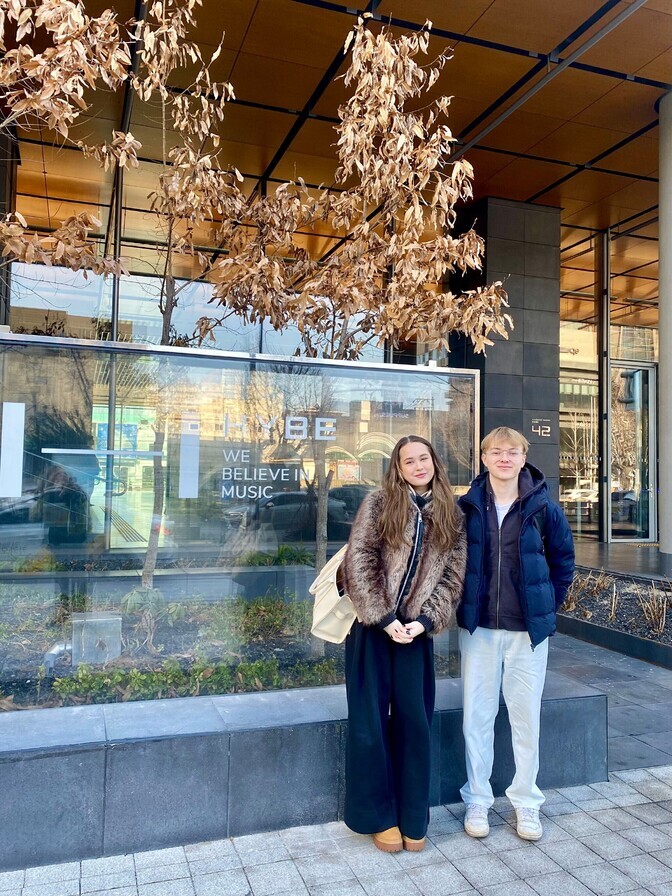 Estonian songwriters Emili Jürgens and Elias in Seoul. Source: Faar Music
“These collaborations have definitely required a different kind of approach,” she added. “K-pop has much stricter structural criteria — things like song structure, shifts in energy, concept and how the song will come alive on stage or in a video. I’ve had to learn to think of a song not just as an audio piece, but as part of a bigger picture: the artist’s identity, choreography and visuals,” she explained.
Käsper agreed that writing for K-pop sometimes involves tighter constraints than Western pop. “The songs I’ve worked on have needed to be ‘filled out’: harmonies, ad-libs and production should all be designed to fully engage even the most attention-deficit mind — there should be no opportunity to drift. More is more,” she said.
Käsper added that K-pop offers songwriters a rare kind of creative freedom. “Playfulness is really welcomed there. It’s an amazing adventure to have as part of your creative journey. Rhymes or lyrics your alter ego stashed away — lines that might feel too over-the-top or bubblegum in another project can bring exactly the right color to a K-pop track.”
To craft a solid K-pop hit, Käsper said, qualities like uniqueness, freshness and freedom are key. “Those are probably great traits in any art form, but in K-pop, you also get to add playfulness to the mix.”
Jürgens added that a truly successful K-pop song needs a strong hook that sticks with the listener. “It also needs a clear emotion and enough dynamic range to keep surprising you even on the fifth listen. At the same time, it has to leave space for the artist to shine through — their personality and energy should come across in the song. If all those elements come together, then the song has real potential.”
—