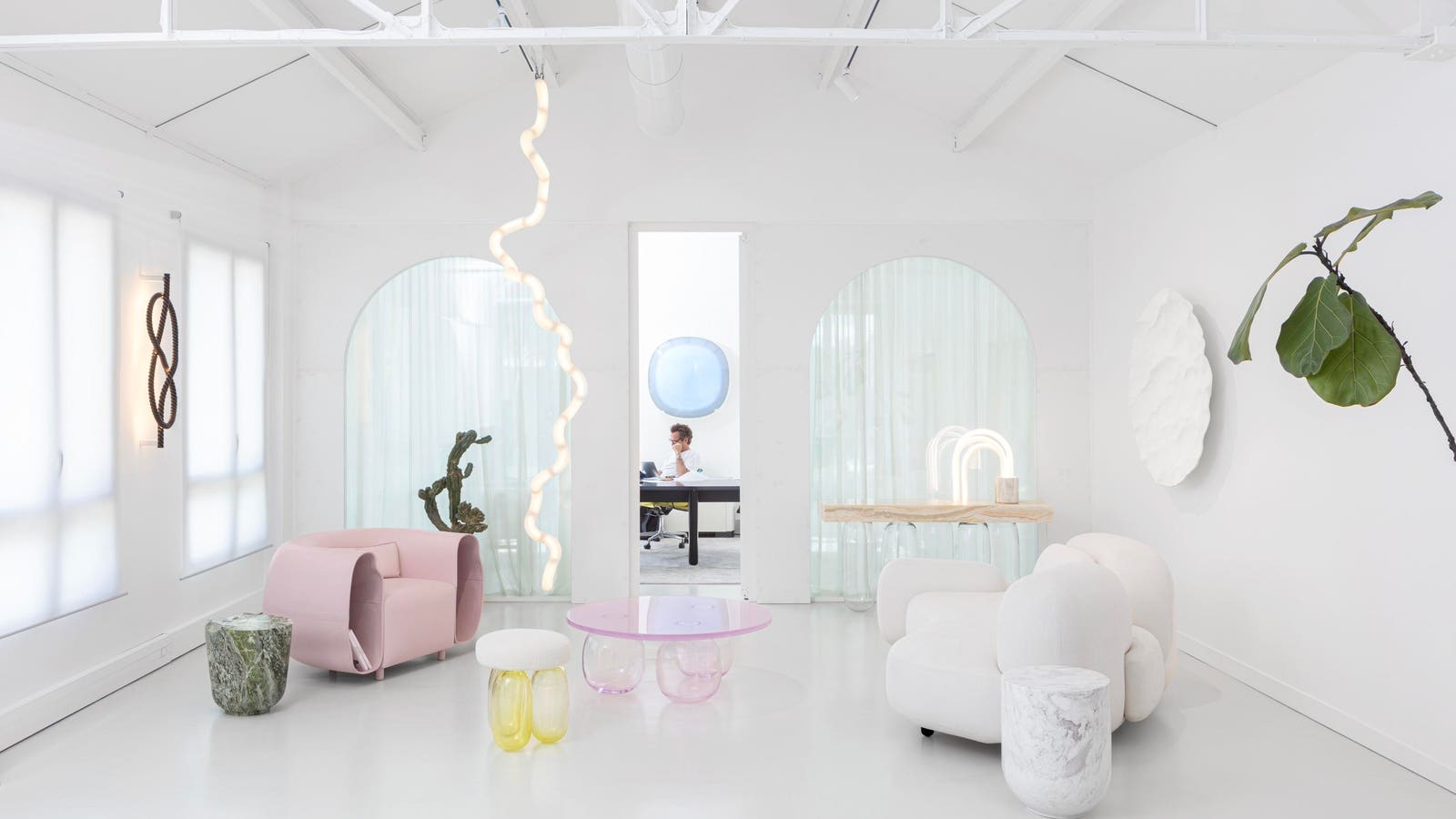
The Factory in Ivry-sur-Seine in the suburbs of Paris
Photo Felipe Ribon
Born in southwestern France, Mathieu Lehanneur has built a career defined less by geography than by intellectual curiosity and an insistence on crossing boundaries. Today celebrated as one of the most influential French designers of his generation—named Designer of the Year by Maison&Objet in 2024—Lehanneur occupies a singular position where design, science, technology and poetry coexist in careful tension. His work moves fluidly from collectible furniture and lighting to large-scale installations, public commissions and emblematic projects such as the Olympic and Paralympic torch for Paris 2024. Yet beneath this global recognition lies a more intimate story: that of a contemplative youngest child in a large family, shaped by an engineer-inventor father, and initially torn between medicine and creation.
From his formative years at ENSCI–Les Ateliers to his early fascination with the body, the mind and invisible forces—air, light, water—Lehanneur has consistently approached design as a tool to question how we live, feel and interact with our environment. Gradually building his independence as a company to be able to design, produce, market and sell in-house, he launched The Factory, a 700-sqm, vertically-integrated production facility housing offices, workshops and an exhibition space that is now the HQ of his brand, where his pieces are conceived, developed, assembled and shipped to the world, on the outskirts of Paris in 2023. His creative process, grounded in rigorous rationality yet open to intuition and irrationality, reflects a designer who believes objects can transform us as much as we shape them. This conversation traces the origins of that worldview, from childhood memories to the foundations of a practice that continues to blur the line between function and emotion.
Liquid Glass table
Photo courtesy of Mathieu Lehanneur
You were born in Rochefort-sur-Mer in 1974. Tell me about your background, your parents and what your childhood was like.
I was born by the water in Rochefort, but I have never lived there. I grew up in a small town near Paris, of which I have very good memories. I am the youngest of a family of seven children: two girls, five boys. My father was an engineer and inventor—that undoubtedly influenced me. As a child and teenager, I was a rather contemplative boy, alone in a large family. I knew very late that I felt capable of following studies in the field of creation. Before that, I saw myself more as a doctor. It may not be too late to change…
How did you go from studying art to design?
I actually started by studying at the Beaux-Arts but I decided to stop, after one year only. I never imagined myself working alone in a workshop, seeking inspiration. I felt very early on that I needed contexts and interactions to create. I felt the need to be at the heart of an ecosystem between orders, ideas and their achievements. To be honest, at that time, I didn’t know anything about design or even any designer’s name. I remember during the application interview at École Nationale Supérieure de Création Industrielle in Paris that the jury asked me who my favorite designer was. After a long silence, I replied, “The designer who invented the first escalator.” I obviously didn’t know his or her name—and neither did the jury—but it allowed me to describe to them my fascination with this surreal and magical object that set the staircase in motion. I am still in love with it!
Inverted Gravity furniture collection in which bubbles of blown glass support voluminous slabs of heavy stone
Photo courtesy of Mathieu Lehanneur
Where does your interest in science stem from?
I started to become interested in science during my diploma project at design school. At that time, I was doing tests on drugs that allowed me to pay for my design studies. I used to be a guinea pig for pharmaceutical laboratories. I spent whole days in hospital to test the potential side effects of new molecules and new medical treatments before they were put on the market. I discovered a universe in which the body and the mind are intimately linked, and this brought inspiration to my Therapeutic Objects project—a new way of conceiving and designing medicines.
I like the way science aims to understand human beings in their great complexity. I love how our body alters our psychological states and how our mind affects our physical states. Science, whether astrophysical, biological or medical, is the greatest source of knowledge and a permanent inspiration for my work.
Tell me about your creative process each time you take on a new design project. How do you start and what aspect do you start with? What comes first: material exploration, form, function? Are there any materials or manufacturing processes you favor in particular?
I close my eyes. I let the ideas come and compose themselves. Without drawing, I let the ideas live in my head and I think about them for a few minutes every day. I watch them live, grow and become stronger when they have the capacity. The weakest disappear on their own; the others gain in density over time. When they are ready, that means strong enough, when they are almost “teenagers”, I finally draw them and try to scrupulously respect what they have become in my mind. They will then become plans and prototypes before becoming real, never quite adults, but already autonomous to live their own lives, without me.
Paris 2024 Olympic Cauldron
Photo courtesy of Mathieu Lehanneur
How do you combine the rational and irrational at the same time in your designs?
I spend a lot of time in workshops, factories or laboratories, with artisans or engineers. I always need to understand everything that is possible: materials, techniques, manufacturing processes, new systems as well as older ones. I learn everything I would need to know about the rational part of things, then I transform them and push them a little further to project them into an irrational part. It is always a question of balance between mathematics and magic, between function and emotion.
Why did you decide to launch your own eponymous line of furniture, lighting and accessories, who are the craftsmen you work with to manufacture them and what kind of customers are they targeted at?
Because I’m the best person to talk about my creations, to craft them and to decide where and how I aim to sell them. A global design for a global experience! Each new work, each new chandelier or piece of furniture is a note of a bigger symphony or a word of a more inspiring story. They might be very different in terms of scale or materials, but they are part of the same family—they are connected to each other, in a permanent dialog. The brand is this family: a special connection that gives you the strength to live alone, that carries you throughout life. All the pieces are made in France by craftsmen that we have specifically and carefully selected.