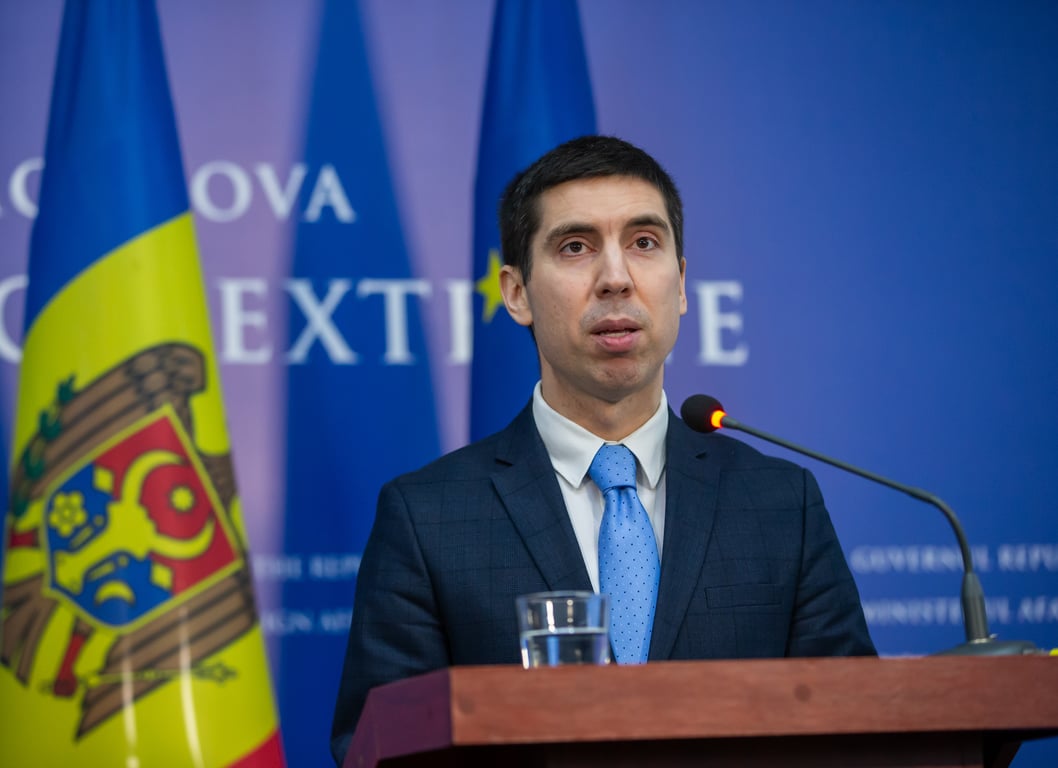
Moldovan Foreign Minister Mihail Popșoi holds a press conference in Chisinau, Moldova, 4 February 2025. Photo: EPA / Dumitru Doru
Moldova has begun the formal procedure required for it to leave the Commonwealth of Independent States (CIS), the free association of sovereign states created following the collapse of the Soviet Union in 1991, Moldovan Foreign Minister Mihai Popșoi announced on Monday.
Popșoi said that the Moldovan parliament would soon be asked to vote on withdrawing from the Belovezha Accords, which established the CIS in 1991, as well as the same year’s Alma-Ata Protocols, which established the association’s founding principles, and the CIS charter, which it signed in 1993.
“De facto, we suspended our involvement with the CIS some time ago, but de jure we have remained a member,” Popșoi continued. “By nullifying these three fundamental agreements, the Republic of Moldova will cease to be part of the CIS.”
Popșoi said Moldova had begun rescinding agreements with the CIS soon after Russia’s full-scale invasion of Ukraine in February 2022, adding that they were outdated and in some cases had never even been implemented.
The CIS currently consists of nine former Soviet States, plus officially neutral Turkmenistan as an associate member. The three Baltic states were never part of the organisation, Georgia left in 2008 after Russia briefly invaded it, while Ukraine never ratified the CIS charter and ceased all involvement in the association in 2018.
The move is another step in Chisinau’s efforts to distance itself from Moscow and seek closer ties with Europe. Moldova’s ruling Party of Action and Solidarity, which is led by Maia Sandu, the country’s pro-EU president, won a pivotal parliamentary election in September, seeing off the pro-Kremlin opposition despite claims of Russian interference.
Sandu described the vote as Moldova’s “most consequential” to date and said that Moldovans faced a choice on “whether we consolidate our democracy and join the EU, or whether Russia drags us back into a grey zone, making us a regional risk”.