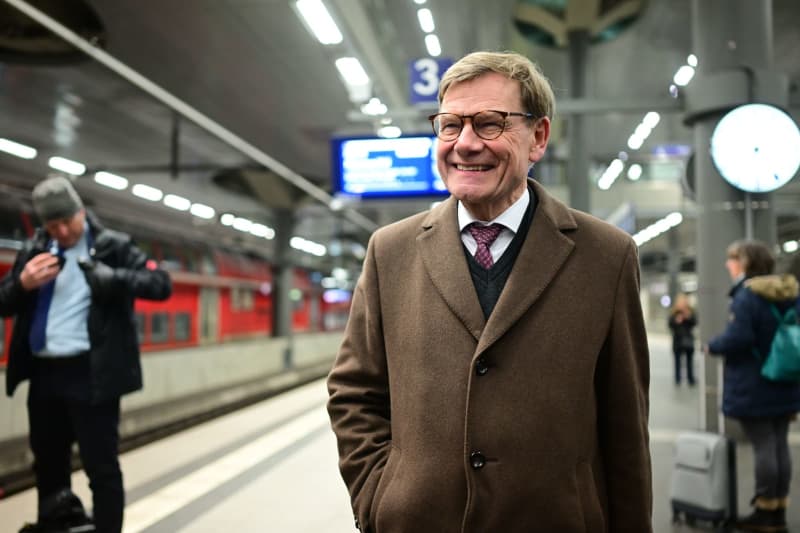
German Foreign Minister Johann Wadephul’s departure on a one-day trip to Latvia and Sweden was rescheduled at short notice due to freezing rain in Berlin.
“Due to extreme weather conditions, the departure point was moved from Berlin to Leipzig in order to organize the trip,” the Foreign Office said on Monday.
Wadephul travelled from Berlin to Leipzig by train, a trip that normally takes a little more than one hour.
It was initially unclear if any of the planned appointments in Riga and Stockholm would be rescheduled.
Wadephul was set to discuss security in the Baltic region, including hybrid attacks by Russia and the fleet of shadow tankers that Moscow uses to circumvent sanctions on oil sales.
Since the Russian full-scale invasion of Ukraine in February 2022, repeated cyberattacks in the region and damage to undersea communications cables have been attributed to Russia.
Ahead of the two-country visit, Wadephul called on Europeans to stand united in light of the Russian hybrid attacks and the erratic policies of US President Donald Trump, who recently caused an outcry in Europe with his quest to acquire Greenland.
“In this phase of geopolitical upheaval, we Europeans must present a united front and act with confidence,” Wadephul said.
He said it was crucial “that we do not allow ourselves to be divided – because that is precisely the aim of those who have an interest in the collapse of our defence alliance and the European Union.”
Wadephul was set to meet Latvian President Edgars Rinkēvičs in Riga, give an address to the Latvian conference of ambassadors and conduct talks with Baiba Braže, his Latvian counterpart.
He was then scheduled to hold talks with Swedish Foreign Minister Maria Stenergard in Stockholm.
Latvia joined NATO in 2004, while Sweden joined in 2024, ending around 200 years of neutrality. The country began seeking membership immediately after the Russian invasion of Ukraine.
Wadephul said that the trans-Atlantic defence alliance “remains indispensable for our security.”
But Europe cannot and will not rest on US support, “nor will we slacken in our efforts as Europeans to take greater responsibility for our own security in the future.”