In a social media post, US president Donald Trump issued a threat that the US would impose a 100% tariff on the import of all goods from Canada to the US “immediately” if the country “makes a deal with China”. This comes shortly after an agreement was reached on a “strategic partnership” between Canada and China that saw a tariff reduction for Chinese EV imports to Canada – a move that has been criticised by the Canadian Vehicle Manufacturers’ Association (CMVA), which represents Ford, General Motors and Stellantis in Canada.
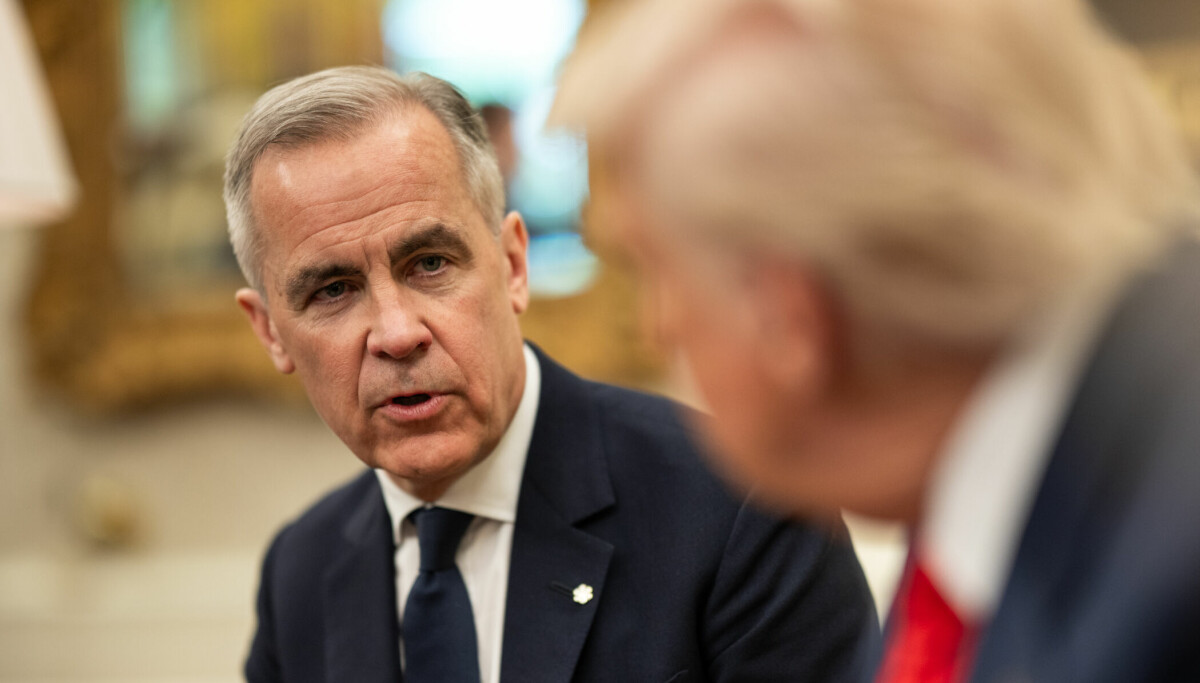
US president Donald Trump met with Canadian Prime Minister Mark Carney at the White House in May 2025
White House
Read more: New trade deal sees Canada cut tariff on Chinese EVs to 6.1%
Canadian PM Mark Carney and Chinese president Xi Jinping have agreed a Canada-China trade deal, removing the additional 100% tariff on up to 49,000 Chinese EVs.
Responding to an article about the trade agreement brokered between
Canadian prime minister Mark Carney and Chinese president Xi Jinping that saw Canada
remove its 100% surcharge on the import of Chinese EVs, Trump claimed in a
post on Truth Social that “if Canada makes a deal with China, it will
immediately be hit with a 100% tariff against all Canadian goods and products
coming into the USA”.
It is unclear whether the “deal” Trump referred to in this
post is the recently announced agreement between the two countries or a subsequent
and more comprehensive trade deal.
Trump initially said the agreement was “a good thing” for
the Canadian prime minister to do, telling Carney: “If you can get a deal with
China, you should do that.”
This pivot from US support for Canada-China trade to a rapid
escalation with tariff threats highlights the precariousness of international
trade today, even within North America – something that will no doubt be a key
theme throughout 2026 as negotiations surrounding the future of the US-Canada-Mexico
Agreement (USMCA) ramp up.
Speaking to members of the press in Ottawa on January 25,
Carney responded to Trump’s tariff threat, claiming Canada respects the
commitments it has made in the US-Canada-Mexico Agreement (USMCA) and does not
intent to breach them. “We have commitments under [the USMCA] not to pursue
free trade agreements with non-market economies without prior notification,” he
said. “We have no intention of doing that with China or any other non-market
economy.”
Read more: Tariffs and tensions – trends in North American automotive logistics
From tariffs to tensions, the North American automotive logistics market is grappling with uncertainty and disruption, emphasising the need for resilience.
He continued: “What we’ve done with China is to rectify some
issues that developed in the last couple of years – in many ways we’re going… back
to the future with respect to EVs… but with additional protections.”
One of these additional protections that Carney was
referring to was the decision to introduce a cap on the number of tariff-exempt
EVs that can be imported from China – that cap has been set at 49,000 which
Carney previously outlined is related to “volumes in the year prior to recent
trade frictions on these imports.”
Another is the understanding that in five years’ time, 50%
of the Chinese EVs entering the Canadian market will be affordable – something
Carney believes will create new lower-cost options for Canadian consumers.
Furthermore, over the next three years, the Canadian
government expects this agreement will “drive considerable new Chinese
joint-venture investment in Canada with trusted partners to protect and create
new auto manufacturing careers for Canadian workers, and ensure a robust
build-out of Canada’s EV supply chain”.
Canada’s auto industry expresses scepticism over decision
on Chinese EVs
Hear from GM’s Amy Paulsen about how leading OEMs and logistics partners are redefining resilience to keep vehicle distribution fast, flexible and customer-focused in a volatile market at Finished Vehicle Logistics North America 2026
21-23 April | Huntington Beach, CA
The American Automotive Policy Council (AAPC) and the
Canadian Vehicle Manufacturers’ Association (CVMA), which represent the public
policy interests of Ford, General Motors and Stellantis in the US and Canada have
issued a statement expressing concern over the removal of tariffs for Chinese
EVs.
In the statement, the two bodies expressed concern that this
“has the potential to undermine Canada’s auto sector and presents risks to the
future of the integrated North American auto supply chain.”
Speaking to CTV News, president and CEO of the CVMA
Brian Kingston elaborated on this further, saying that reducing tariffs for
Chinese EVs “cannot even be contemplated in this current environment.”
He explained that by introducing the 100% tariff on Chinese
EVs in the first place, Canada aligned its policy with the US and undoing that
action could threaten trade negotiations between the US and Canada at “a very
sensitive point in discussions” between the two nations.
“Canada and the auto industry
depends and always will depend on our access to the United States,” he added. “If
we threaten that relationship by doing something and opening the door to China,
our broader economy is going to be at severe risk.”
Kingston also touched on the impact of allowing more Chinese
EVs into Canada on the country’s domestic auto industry, saying that Chinese
subsidies for EV manufacturing “does not allow for a level playing field”.
CVMA calls for Canada to reassess ZEV mandate
In December, the CVMA wrote to the Canadian prime minister
urging him to repeal Canada’s Electric Vehicle Availability Standard (EVAS) and
“focus efforts on supporting the industry and consumers”.
The EVAS sets out zero-emission vehicle (ZEV) targets for
auto manufacturers and importers, beginning at 20% of new vehicle sales in 2026
and rising to 60% in 2030, then 100% in 2035.
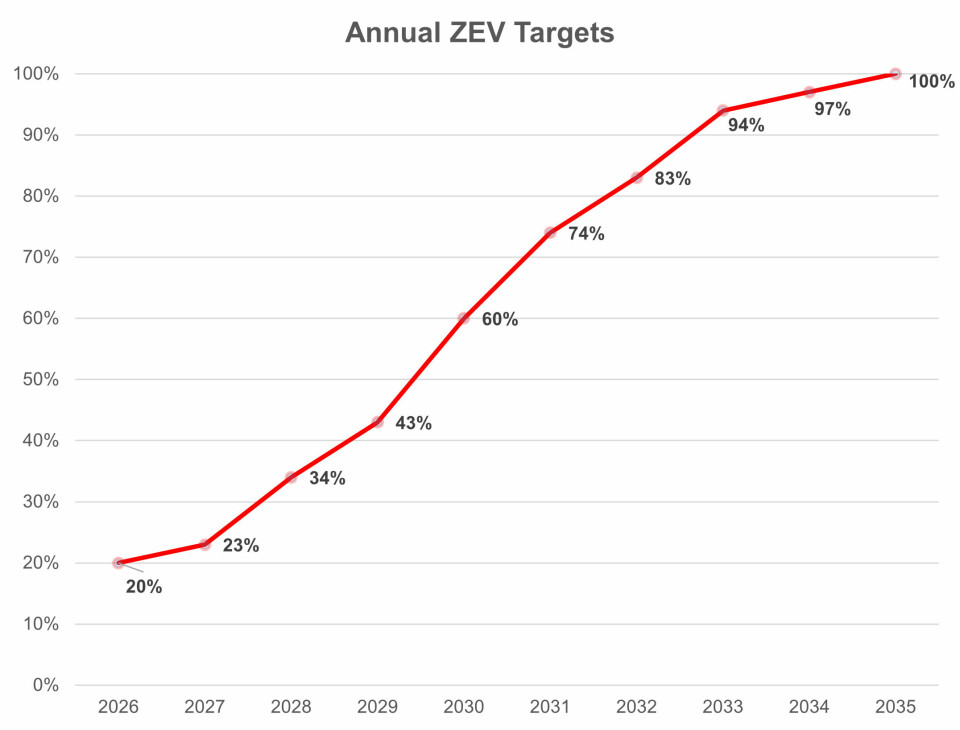
Canada’s EVAS mandates 100% ZEV sales from 2035
Government of Canada
The letter was signed by: Beverly Goodman, president and CEO
of Ford Motor Company of Canada; Kristian Aquilina, president and managing
director of General Motors Canada; and Trevor Longley, Canada president at
Stellantis North America.
They highlighted “unprecedented headwinds” facing Canada’s
automotive industry, including US tariffs, USMCA uncertainty and slowing demand
for ZEVs.
“In the face of these challenges, we must do everything
possible to enhance Canada’s competitiveness as an auto manufacturing jurisdiction,”
the letter read. “This will both secure existing automotive manufacturing and
research operations and ensure Canada remains attractive for future
job-creating investments.”
The CVMA outlined its belief that “redundant and
costly regulations like EVAS are putting unnecessary strain on the auto
industry at the worst possible time”, noting that forcing automakers to restrict
the sale of ICE and hybrid vehicles manufactured domestically has the potential
to harm Canada’s auto manufacturing footprint and impact the thousands of Canadian’s
employed by the sector and its supply chain.