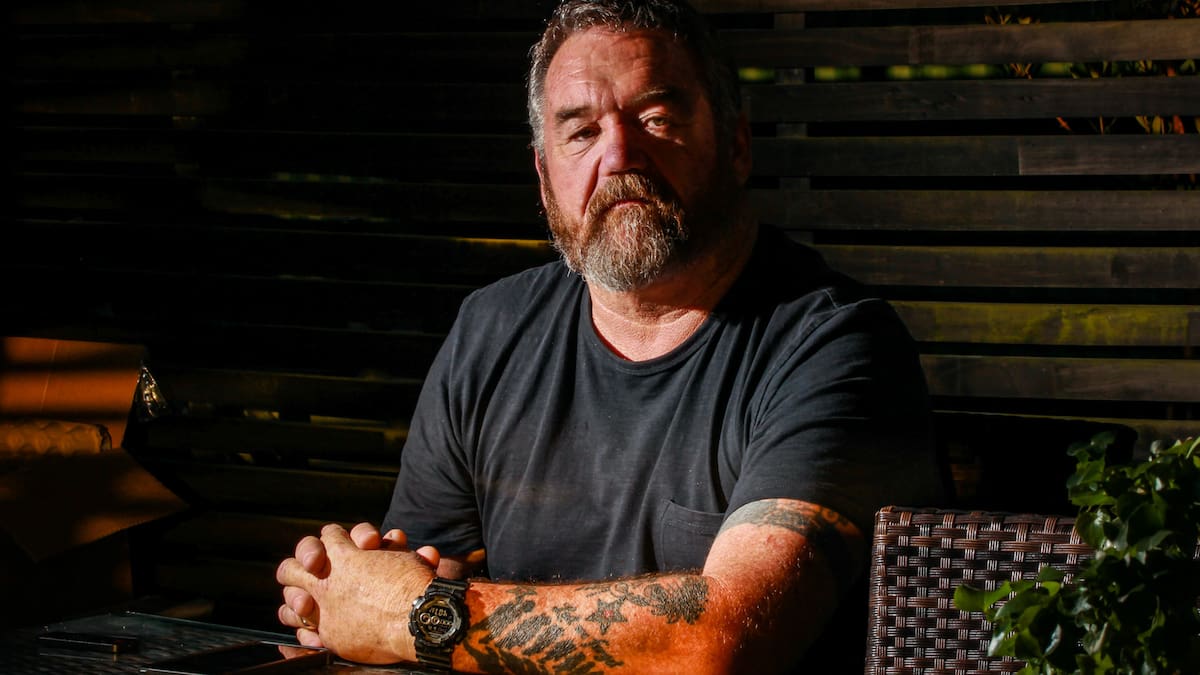
The next morning, he had a visit from a police officer delivering the sad news that Daniel Miller had been found dead in a culvert on Target Rd at about 7.30pm that Friday.
One of the other victims that night was 25-year-old Daniel Newth, who lived in Sunnynook and was also swept into the Wairau Valley storm drains while kayaking in the floodwaters.
The two other victims were Dave Lennard, 78, who died after his Remuera home was hit by a landslip, and 58-year-old Dave Young, who was swept away in floodwaters in the rural Waikato town of Onewhero.
The rain outside is just one of the many constant reminders about his son that stay with Steve Miller. Daniel Miller grew up in Napier and moved to Auckland when he was 19.
“There is always January 27 coming up, birthdays, Christmases, rainy days,” the 61-year-old father said.
“It feels like it happened only yesterday. It’s harrowing for the family. For me, his mum and his two sons miss him dearly. It’s something that never really goes away. People say it gets easier with time, but it hasn’t felt that way yet.”
Miller attended last year’s coronial inquest via video link, listening for hours until he felt it was no longer helping. He did, however, submit a statement calling for manhole covers to be locked, which was read to the court.
“We’ve been to the manhole. There was a cross there and a bunch of flowers. I’ve been there. I’ve touched it. I’ve looked at it.
“A sad accident happened that should never have happened. The manhole cover blew off. They shouldn’t be able to blow off,” he said.
Andrew Skelton, head of flood resilience operations at Auckland Council’s Healthy Waters division, expressed the council’s deepest sympathy to Steve Miller over the tragic loss of his son.
He said manhole covers can become dislodged during flooding, creating a safety risk.
“To reduce these risks, the council is installing safety grills and self‑closing covers in high‑risk areas or where safety concerns are known,” Skelton said.
“These grills allow stormwater to flow while preventing people from entering the pipes. The programme will cost $9.5 million over four years, and more than 2300 grills have already been installed.”
Another step the council has taken since the floods is to proceed with a controversial plan to redevelop half of Takapuna Golf Course for a flood-detention wetland for Wairau Valley and Milford.
The Wairau flood resilience project is part of the council’s Making Space for Water programme, which has allocated $760m to building infrastructure that manages floodwaters in temporary reservoirs or detention sinks, usually on parkland.
Steve Miller wasn’t aware of the golf course plan, but welcomed the action to prevent future flooding in the low-lying basin on the North Shore.
Brendon and Steph Deacon’s experience doesn’t compare to Miller losing his son, but it underscores how those excluded from the council’s buyout scheme are left feeling helpless and anxious whenever heavy rain is forecast.
The Deacons evacuated their home by grabbing their two young toddlers and kayaking to safety in the middle of the night when the Kumeū River overflowed on to their Huapai property during a flood in 2021.
They were better prepared for the Auckland Anniversary weekend floods in 2023, but the rising water levels still made it a frightening ordeal. In the three years since, nine properties around their Pinotage Place home have been classified as an intolerable risk to life and bought out.
But not the Deacons’, which now sits like an island, surrounded by vacant land.
The past three years have been incredibly tough on the young family, who left their home of nine years at the weekend for Laings Beach, where Brendon Deacon’s sister has generously offered them a house for 12 months.
“We have our ups and downs; it’s been quite an emotional rollercoaster,” Steph Deacon said.
“There is still a huge amount of rain anxiety for us,” she said, adding that last Wednesday’s storm meant her husband was up all night keeping an eye on the water level.
Then there’s the impact on the couple’s daughters, aged 8 and 6.
The other night, Megan Deacon, who’s 8, kept asking, “Is it going to flood? Is it going to flood?” It was hard to reassure her when you don’t know yourself what’s going to happen, Brendon Deacon said. He has spent years trying to explain to the girls why neighbouring houses and their friends have disappeared.
The Deacons have applied to the High Court for a judicial review after the council classified their property as low‑risk, Category 1, rather than Category 3, which would indicate an intolerable risk to life and property. They subsequently sought a buyout under special circumstances, but that application was also declined.
“Our message to the council is to do what’s right. Be human about things. Stop hiding behind emails, stop hiding behind lawyers,” Brendon Deacon said.
“This is all about risk to life. Our children were put at risk to life. We were put at risk to life. Just do the human thing and give us what our neighbours got to move out of a dangerous place.”
Group recovery manager Mace Ward said the council understands how challenging the situations are for storm-affected people and recognised that some outcomes may not be what people hoped for.
“Our priority is to support recovery in line with agreed government and council risk policies and risk frameworks, which are essential to ensure equity when using public funds,” he said.
Ward would not comment on the Deacons’ case while it was before the court.
“We’re now at the tail end of a huge recovery programme, with thousands of individual repair and recovery initiatives delivered across the region by the Auckland Council group. Some of the hardest work hasn’t been the physically visible stuff; it’s been supporting Aucklanders to make incredibly difficult decisions about their future,” Ward said.
The council has settled 1038 property buyouts, with a further 51 pending settlements. A small number of complex cases are expected to be resolved by May.
On road damage, Ward said many of the more than 2000 slips were cleared in the months after the storms, with 96% now completed.
Last year, Scenic Drive, the main route to Piha, was reopened after multiple slips. Most of the remaining major worksites are in West Auckland, and Auckland Transport is expected to complete the recovery programme by mid-2026, Ward said.
Watercare and the council’s Healthy Waters division have completed major network repairs, including to the wastewater networks in Murrays Bay, Northcote and Pukekohe.
Funding and designs have been confirmed for four major multimillion‑dollar flood‑resilience projects, accelerating nearly $200m of work. Two projects now underway in Māngere are due for completion this year; one replacing a bridge on a key transport route and the other replacing a wastewater pipe that carries 70% of Auckland’s wastewater, to reduce major blockage risks.
After the January 27 floods, Auckland Mayor Wayne Brown commissioned a rapid review by former Police Commissioner Mike Bush into the emergency response.
The damning Bush review found a “system failure” of leadership in the first 12 hours of the response, in which “much of the damage was done” before the council, or Brown, had taken any action.
Brown was also heavily criticised in the days after the floods for his slowness to declare a state of emergency until after 10pm that Friday, despite emergency services being at capacity since about 5pm.
Asked recently by the Herald what he had learned from the floods, Brown acknowledged he had learned a lot.
“I wasn’t particularly well prepared. The council wasn’t particularly well prepared. Auckland Emergency Management wasn’t well prepared. The city wasn’t well prepared.
“Auckland Emergency Management is a hell of a lot better than it was. Fenz [Fire and Emergency New Zealand] has also taken a step forward. What I’m most proud of, which came out of that, is the Healthy Waters programme ‘Making Space for Water’. I think that’s a marvellous thing, even if it does upset one or two golfers from Takapuna. In the long term, it’s a really good thing to do.”
The mayor has also thanked Aucklanders for following Auckland Emergency Management’s guidance over last week’s heavy rains and for taking the necessary steps to prepare for the severe weather.
“Emergency services have responded quite well this time,” he said.
Less than a fortnight after the Auckland Anniversary floods, Cyclone Gabrielle devastated parts of Auckland and the North Island, claiming the lives of 11 people, including volunteer firefighters Dave van Zwanenberg and Craig Stevens, who were killed in a landslide at Muriwai.
Sign up to The Daily H, a free newsletter curated by our editors and delivered straight to your inbox every weekday.