
One persistent issue that plagues every Canadian election is our First-Past-The-Post (FPTP) system, which encourages people to vote out of fear, and often leads to distorted results, including one party winning total majority power with far less than 50 per cent of the vote. Justin Trudeau famously promised to end this sorry situation in 2015, but cynically broke his promise to the Canadian people shortly thereafter.
But NDP leadership candidate Avi Lewis has made it clear he sees proportional representation as a top priority, and will make it so if he becomes NDP leader in a minority parliament situation:
This clarity is sorely needed, because while the NDP under Jagmeet Singh achieved many important policies, there was never a sense that electoral reform was a priority. There was some loose discussion of how the NDP demanded it and were rebuked, but this is rooted in the fact that it was never laid out as a core public demand. Lewis is telling not only voters that this is a priority for him, but he’s also informing the Liberals that this issue is not going away.
And this could pay off politically for the NDP, because Liberal hypocrisy on electoral reform and ‘strategic voting’ is an obvious issue.
As is often the case, the Liberal Party effectively holds non-Conservative Canadians hostage using FPTP, arguing that any vote for the NDP, Greens, or Bloc is effectively a vote for the dangerous Conservatives. The narrative serves them well, and traps Canadians.
But Lewis is forcing Liberals to answer a question: If they are sincere in their desire to protect Canadians from a Pierre Poilievre Conservative government, then why keep an electoral system that can give him absolute power with a minority of the vote?
Remember that Stephen Harper won his 2011 majority with only 39.62 per cent of the vote. Yet if we had proportionality in 2011, the Jack Layton NDP could have formed a minority coalition government with the support of the Liberals, and Harper would have been ousted at least four years earlier.
The answer becomes clear: the Liberals would rather risk a Conservative false majority than a build a system where they would have to share power with the NDP consistently. They don’t truly fear Conservatives winning, and only scaremonger to keep Canadians in line. This fact is something they desperately want to hide from their voter base that largely disagrees.
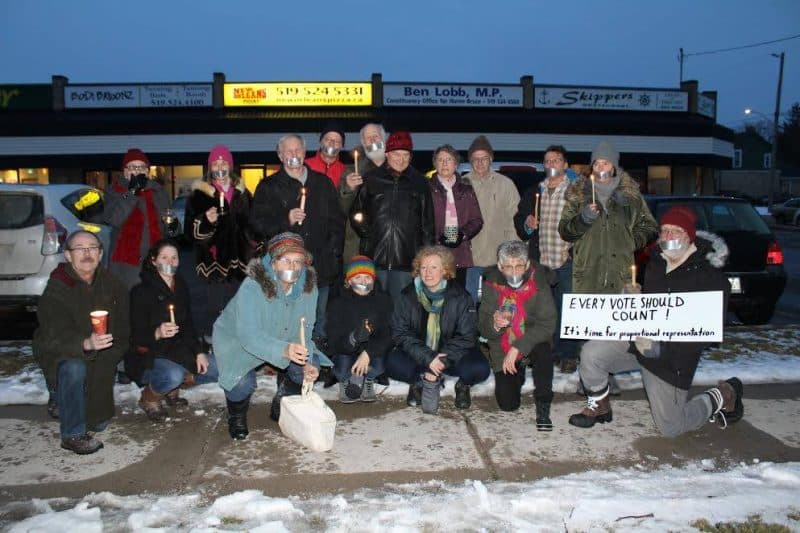 Avi Lewis is not the only NDP candidate prioritiozing electoral reform. Tony McQuail recently organized a rally in support of electoral reform in front of Huron-Bruce MP Ben Lobb’s office. See where all the NDP candidates stand on this issue here: FairVote.ca
Lewis making reform a priority ensures that progressive voters see this Liberal duplicitousness every single day. But achieving electoral reform is about more than short-term political gain and expediency: it aims to ensure every vote counts. In our current system, which riding you live in plays a massive role in determining how much your vote counts, if it counts at all.
If you live in a tightly contested riding and you support the competitive parties, then you have a decent bit of leverage. But if you live in a riding that is dominated by one party — even one you support — then your vote may be ‘wasted’. Imagine being a voter in Poilievre’s new riding, which sometimes votes over 80 per cent Conservative. Not only are non-CPC voters disenfranchised here, but so are many Conservatives whose vote are surplus
If we have a proportional system, every additional vote has value, and voters won’t have to feel they are just adding to the pile. Note that this isn’t solved by a ranked ballot system, which fail to give minority opinions a voice in every riding if one party has natural majority support.
The positive consequence is that it forces parties to try and represent as many Canadians as possible, and not take their own voters for granted. I often see many Prairie Conservatives express dissatisfaction with how they feel underrepresented in federal politics, but this is a direct consequence of FPTP. If a riding has 75 per cent CPC support, no party (including the CPC) gains anything from investing time, money, and resources into winning an extra five per cent of the vote in said riding. But with proportionality, the benefit could be extra seats based off a higher overall vote total.
Finally, Lewis understands that FPTP is a major contributing factor in national disunity, and a growing sense that Canadians aren’t communicating across regions. This is because minority voices in each riding get squeezed out, and aren’t represented in Parliament. While many western rural areas are quite Conservative, having zero Liberal or NDP MPs is unrepresentative. The same can be said in Montreal. Indeed, there aren’t a massive amount of Conservative voters in the city core, but there are enough that they should have a voice in Parliament. This would diversify the caucuses of every party, and bring fresh perspectives to each. No longer would entire regions of the country be inaccurately seen as the property of one party.
Ultimately, the electoral status quo doesn’t work for Canadians, and the NDP under Lewis making reform a priority will challenge Carney and Poilievre to defend a system that either discounts Canadians, holds them hostage, or both.
Christo Aivalis is a political commentator and historian, holding a PhD in Canadian History from Queen’s University. His writing has appeared in Jacobin, The Breach, Canadian Dimension, Maclean’s, the Globe and Mail, and the Washington Post.