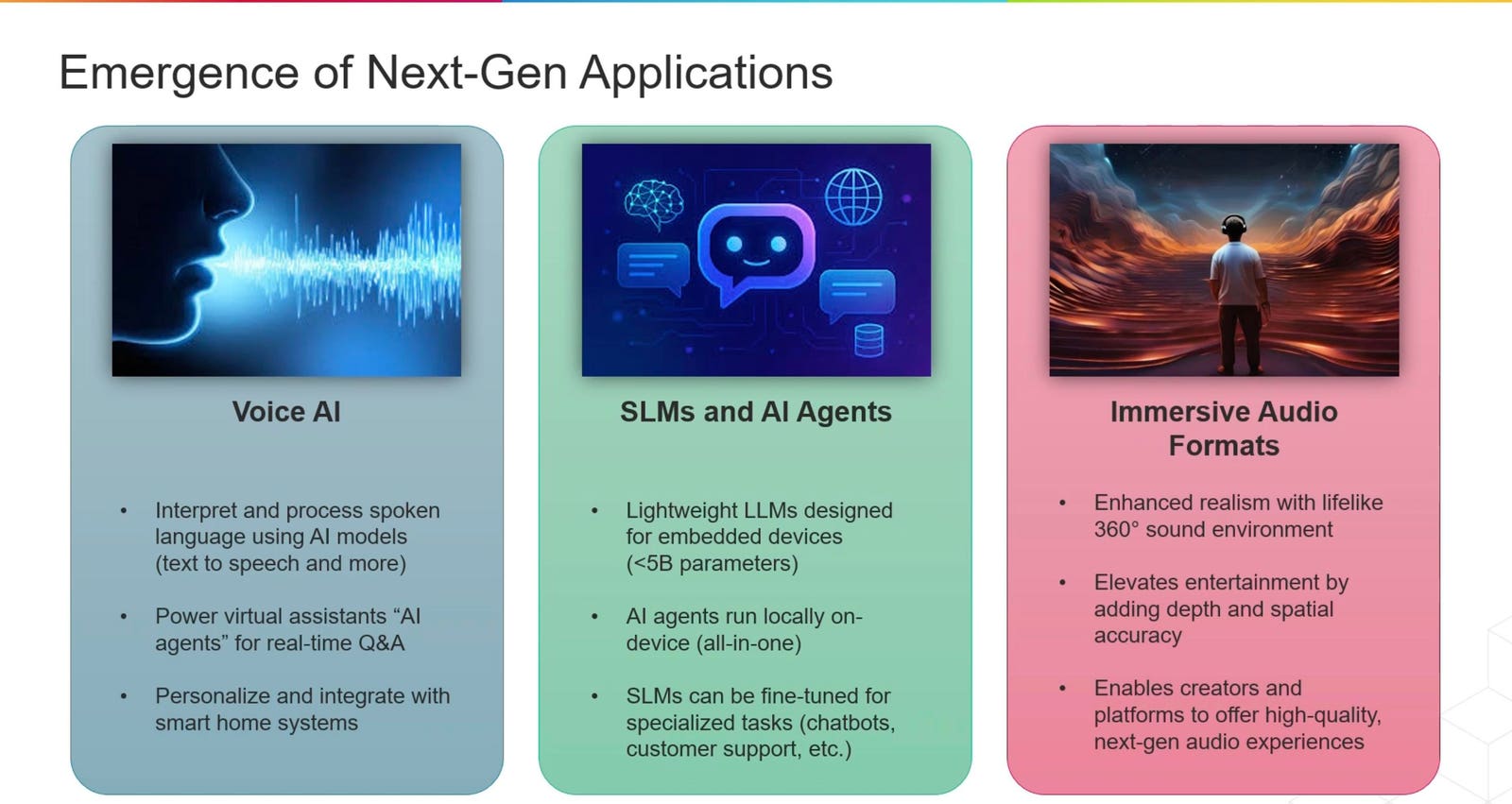
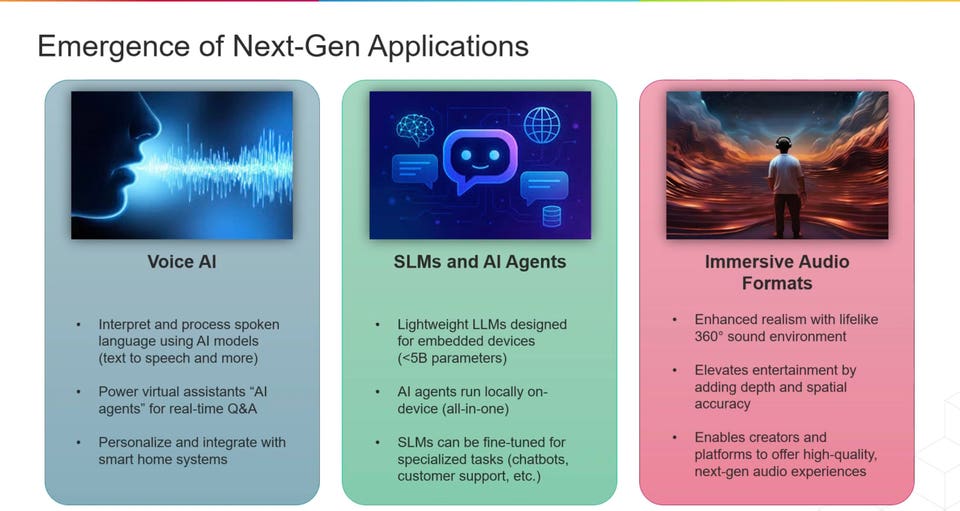
Voice AI using Small Language Models is becoming a major market requirement for phones, appliances and immersive Audio.
Cadence Design
Many analysts like to say that AI will become pervasive, applied to just about every aspect of computing to improve product quality, increase productivity, increase revenues, and lower costs. While investors remain alert for any signs that the bubble is about to burst, most analysts continue to see meaningful adoption.
One area that flies under the AI radar of most consumers is the processing of audio content. Have you noticed that every new car you buy sounds better? That’s AI. And we all see that a TV’s built-in sound has advanced from the tinny little speakers that practically forced us all to buy expensive sound systems. Yep, that’s AI, too.
The companies building HiFi gear, from headphones to TVs to automobiles and digital assistants, can no longer rely on a little Arm or RISC-V CPU in their digital-to-analog processing pipeline. Instead, they opt for a programmable processor tailored to the job, especially “DSPs” (Digital Signal Processors) and perhaps “NPUs” (Neural Processing Units) for higher-end applications. And the leading supplier of the Intellectual Property (IP) in these custom chips is Cadence Design, a client of Cambrian-AI Research.
Cadence Takes the Next Step in AI Audio
Audio processors have historically been small chips that process the signal in 128-bit vectors, adequate for low-end devices, but today’s market demands higher quality and dynamic range. So the Tensilica team at Cadence (acquired in 2013) decided to completely revamp the IP that commands some 80% of the market to enable the use of Small Language Models at significantly higher performance at 25% less power. The new platform is called the Tensilica HiFi iQ, the sixth-generation DSP for Audio and voice.
Clearly, the design team had AI applications and models in their sights, adding low-precision math life 8-bit float, better auto-vectorization to take the load off the programmer, raw performance enabled by a 256-bit broad vector instruction set, and AI performance that comes with adding more “MACs”, or multiply-accumulate cores needed for matrix multiplication.
The new platform will be widely available in the 2nd quarter of 2026 for design teams to use to produce a solution customized for their specific product needs.
The new Tensilica HiFi IQ is a fully customizable platform that customers can tailor to many difference applications
Cadence Design
The Automobile: a Great Example
Today’s automobiles have a plethora of audio processing chips that enable infotainment and hands-free speech-to-intent across a number of applications. The higher-end of the market Cadence eyes includes spatial 3D Audio, voice agents, noise cancellation, personalization, and sound zoning.
So the next time you ride in a well-appointed vehicle and enjoy an immersive sound experience, it might just be brought to you by a chip with Cadence IP.
The Automotive market is already a major adopter of Audio silicon and will continue to drive innovation and revenue.
Cadence Design
So, how big is this market? Much bigger than you, and probably more than you would have guessed. Like 1.5 billion DSPs shipping annually with Cadence logic, from over 160 licensees
Cadence Tensilica is the industry leader in high fidelity processors
Cadence Design
So, What’s Next?
The innovation here will be continual, with earbuds that can not only translate different languages but can also create a surround-sound experience with spatial audio. Your cars will be better able to understand your commands and initiate the appropriate actions, while targeting each occupant with detailed and custom music and information.
Audio equipment makers will lead this innovation, using Cadence’s intellectual property in their custom ASICs to improve functionality and enable superior user experiences.
The world around us all is changing due to application of AI in just about everything, and in the audio space, its all good!