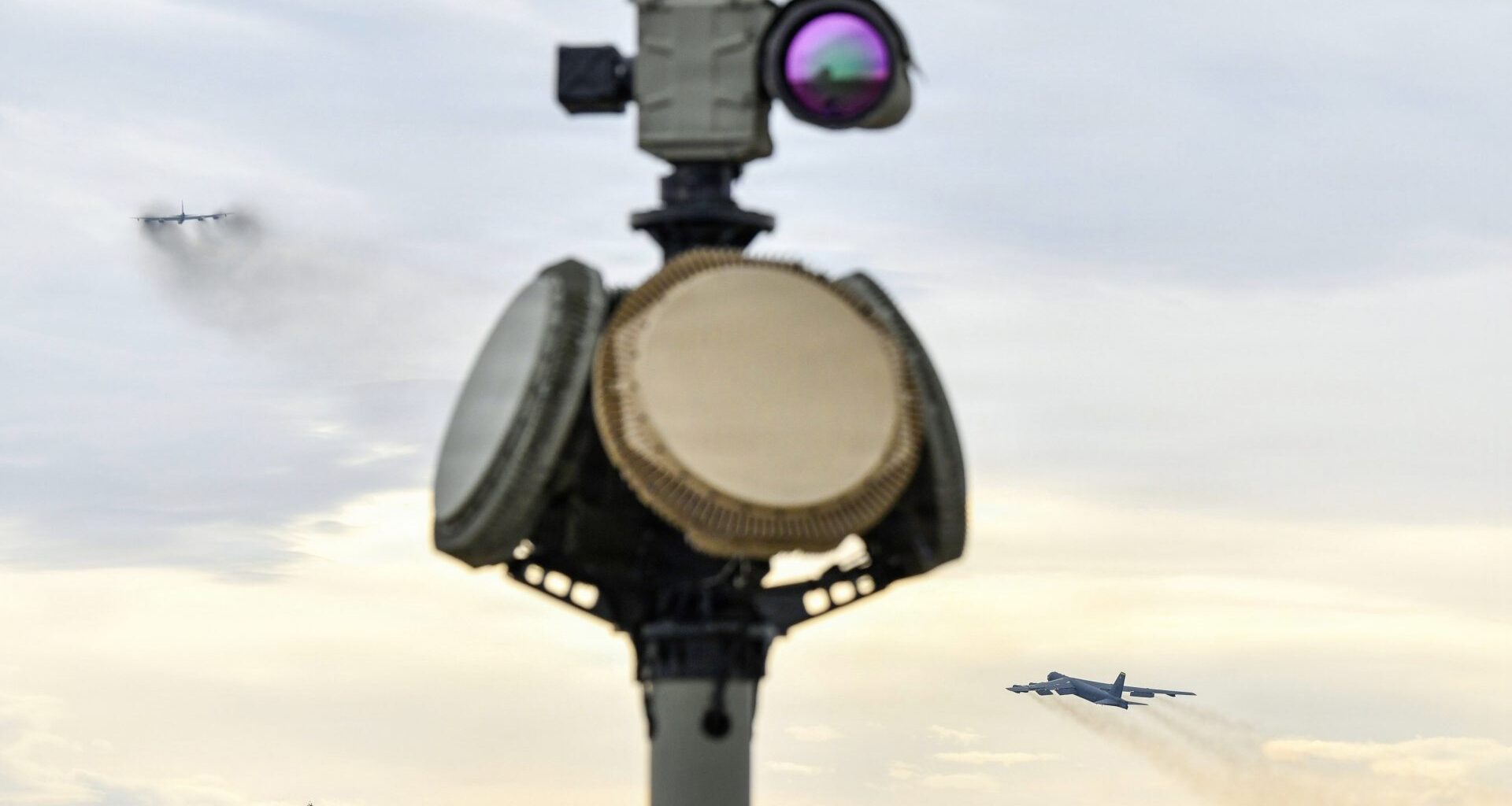
The Pentagon said it consolidated policies around protecting American military facilities from drone threats after unclear guidance that left base commanders scrambling on how to respond and years of increased unmanned aerial system sightings over key Defense Department assets.
Drone incursions over American military bases jumped considerably over the last several years, alarming officials, and a Pentagon watchdog report released last week said the DOD’s confused policies meant some facilities in the U.S. couldn’t adequately protect themselves.
Following the release of the Defense Department Inspector General report last Tuesday, which noted dire gaps in military counter-UAS policy that limited base responses to drone threats, the Pentagon said it had already adjusted its guidelines last month in an effort to give commanders “expanded authority and flexibility needed to dominate the airspace above their installations.”
Countering drones in the U.S. is complex and has been a yearslong, thorny problem for the military, especially as the tech becomes ubiquitous for both hobbyists and adversaries. Stateside drone defense means navigating a delicate balance between protecting military installations while avoiding civilian harm or infrastructure damage.
But the issue is only growing, top military officials have said, and the new guidance is the latest attempt by the Pentagon to manage it.
In August, the Pentagon established the Joint Interagency Task Force 401, an Army-led organization tasked with proliferating the military’s c-UAS capabilities and working with other organizations to coordinate their employment.
A spokesperson for the task force, Lt. Col. Adam Scher, told DefenseScoop on Monday that “installation commanders are fully empowered to develop base defense plans in accordance with their unique capabilities and threats with the support of JIATF-401 and its resources” under the new guidance.
The policies, which the release said was signed on Dec. 8 by Defense Secretary Pete Hegseth, expanded base commanders’ defensive area around facilities, explicitly identified any unauthorized drone surveillance over installations as a threat, allowed UAS sensor data sharing between other federal agencies and authorized top service leaders to designate facilities as “covered,” a special classification that allows for drone defense.
The DOD Inspector General report last week urged “immediate attention” from Pentagon leaders after it visited 10 military installations and operations where UAS incursions have occurred, interviewed officials from dozens of government agencies and reviewed military counter-drone policies.
It found that guardrails around protecting “covered assets” — which include nuclear deterrence sites, special operations activities, and high-yield explosives facilities — were unclear and inconsistent, limiting the ability for military bases to defend against drones.
The IG report listed several examples of facilities or activities that were not consistently addressed by Pentagon policy. Luke Air Force Base in Arizona — where 75 percent of the world’s F-35 Lightning II pilots train — was not designated as a covered asset, meaning installation officials couldn’t use c-UAS capabilities to protect training against drone threats.
While the IG did not explicitly name the operation, the vulnerability of the airbase wrought parallels to Operation Spiderweb, a covert Ukrainian mission last year that used more than 100 drones launched from civilian cargo trucks to wipe out military aircraft deep inside Russia.
The operation showed “that the United States could be very vulnerable to this type of attack,” said Molly Campbell, a drone expert with the Center for a New American Security. Maybe not in the exact fashion, she said, but as a demonstration of how expendable, inexpensive drones could cause such a “massive” strategic impact.
The IG said military services had differing procedures for how they submitted paperwork to get their facilities approved for coverage. The report said “package complexity, to include varying levels of organizational and leadership approvals, differs drastically by service, making it difficult to deploy c-UAS capabilities.”
Parts of the report were redacted, but one of its conclusions said “a large percentage of installations do not have the operational approval to use c-UAS capabilities” and that different officials within the same military branch described varying interpretations of approved drone defense policies.
While Scher did not refute the IG’s findings, he said JIATF-401 had already been addressing base defense issues before the report’s release.
“It is important to note the report released last week is based on information gathered in some cases 18 months ago and doesn’t reflect actions taken by JIATF-401 over the previous four months,” he said. “From the beginning, the task force has proactively pursued interagency coordination to defend the homeland and streamline efforts among all federal agencies and military branches.”
Counter-UAS is a difficult issue to solve given the small size of some drones and their limited signature, meaning they’re often only detected at close ranges. It is made even more arduous because a solution overseas may not work stateside, Campbell said.
“The c-UAS mission is very complicated in that doing c-UAS, say, in a forward base in the Middle East is very different than doing that in the United States — what your threats are going to look like, but also how you can respond,” she said.
Effective counter-drone measures mean military bases should have “layered density” defenses, she said, meaning several stacked systems (radars, microwaves and even small, handheld weapons) that can thwart drones of various sizes from long to short distances.
But some military installations are near major metropolitan areas and airports, which bears civilian safety concerns for employing counter-UAS systems, and — along with interagency bureaucracy — makes homeland defense against drones much more challenging.
The new guidelines also come after the Pentagon officially signalled its shrinking involvement abroad as it focuses on the Western Hemisphere and American borders.
At an event earlier this month, Army Chief of Staff Gen. Randy George said that the U.S. southern border mission would serve as one of “our testing areas” for c-UAS and while the military had systems available, it needed to scale and field them. At the same event, Army Secretary Dan Driscoll lambasted a hand-held counterdrone tool that soldiers continue to use.
Scher said the drone threat includes “all aspects of our homeland,” including DOD installations, but also major events like the FIFA World Cup later this year. He added that the task force partners with other services and “the interagency to close c-UAS gaps both from an equipment and a policy and authority perspective.”

Written by Drew F. Lawrence
Drew F. Lawrence is a Reporter at DefenseScoop, where he covers defense technology, systems, policy and personnel. A graduate of the George Washington University’s School of Media and Public Affairs, he has also been published in Military.com, CNN, The Washington Post, Task & Purpose and The War Horse. In 2022, he was named among the top ten military veteran journalists, and has earned awards in podcasting and national defense reporting. Originally from Massachusetts, he is a proud New England sports fan and an Army veteran.