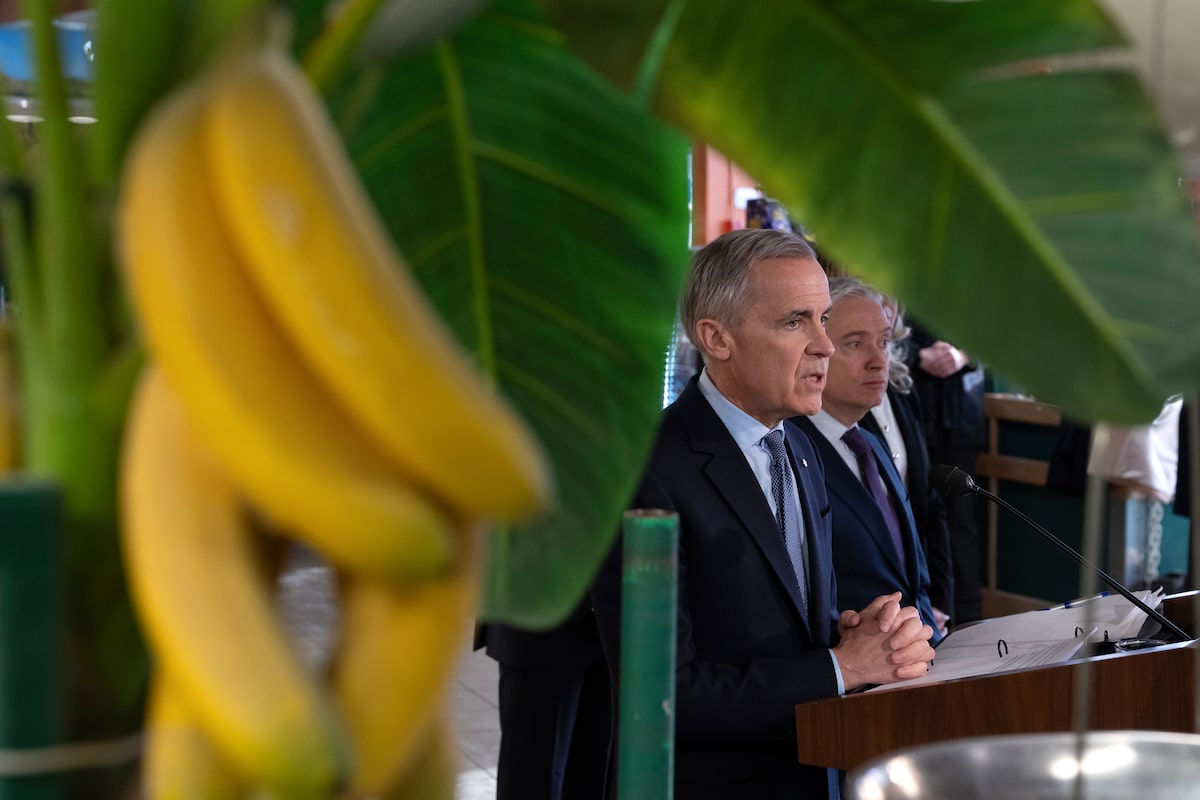
Prime Minister Mark Carney responds to questions from media during an event at a grocery store in Ottawa on Monday.Adrian Wyld/The Canadian Press
Prime Minister Mark Carney’s boost to the GST credit is the latest in a litany of federal and provincial temporary measures deployed in recent years to combat high living costs.
But compared with other similar efforts, Mr. Carney’s tax rebate is more narrowly targeted, promising to deliver hundreds of dollars more a year to low- and moderate-income individuals and families.
On Monday, Mr. Carney announced a multibillion-dollar increase to the Goods and Services Tax (GST) credit, which delivers quarterly payments to lower-income Canadians to help offset the cost of the sales taxes they pay on goods and services.
Eligible recipients will see their GST credit increase by 25 per cent for five years, beginning in July. They will also receive a one-time 50-per-cent top-up in June, Mr. Carney said.
Carney unveils hike to GST credit, other measures targeting affordability
Combined, the two measures mean a single person could receive up to $950 through the credit this year, and up to $700 a year for the following four years, according to details published by the Prime Minister’s office.
A family of four stands to receive up to $1,890 this year, and about $1,400 a year for the following four years.
Currently, an individual without children needs an income below $56,181 for the 2024 tax year to qualify for the credit. Higher thresholds apply for couples and families.
The rebate is adjusted for inflation annually, with payments recalculated every July based on information from taxpayers’ previous year’s tax return.
The increase to the credit, which Ottawa is renaming the Canada Groceries and Essentials Benefit, will affect around 12 million people, the government said.
Analysis: How food inflation is making Canadians miserable
The move echoes a similar decision, in 2023, by the Trudeau government to deliver a one-time extra GST payment to eligible recipients, something Ottawa dubbed a “grocery rebate” at the time.
Despite the monikers, there is no obligation for Canadians to spend the extra cash from the beefed-up benefit on groceries. But anti-poverty advocates say food-bank users often report shrinking or skipping meals to be able to pay for rent, meaning low-income individuals and families are likely to spend extra funds on food and other necessities.
Increases to the GST credit are only one of a series of temporary cash transfers and tax breaks that Ottawa and the provinces have rolled out in the name of fighting inflation and high prices.
Notably, Mr. Trudeau also implemented a short-lived GST/HST holiday between December, 2024, and February, 2025, on items ranging from prepared foods and children’s toys to Christmas trees. The measure was criticized as a difficult-to-implement tax cut that benefited shoppers irrespective of income.
Provincial and territorial governments have also administered a slew of relief measures that didn’t always have stringent income eligibility requirements. Among them, Quebec sent $500 payments to every adult with a net income of up to $100,000, and Alberta cut its provincial fuel tax for a period between 2022 and 2024.