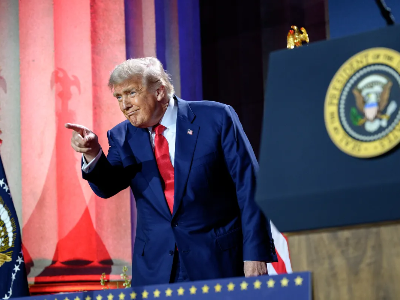
Trump threatened to impose a 25% tariff on key South Korean exports such as automobiles, timber, and pharmaceuticals, citing the South Korean National Assembly’s failure to codify last year’s trade agreement into law. If implemented, this move would severely impact leading South Korean companies such as Hyundai Motor.
U.S. President Trump has threatened to increase tariffs on South Korean goods to 25%, citing what he described as the country’s legislative body failing to codify a trade agreement reached last year between the two nations.
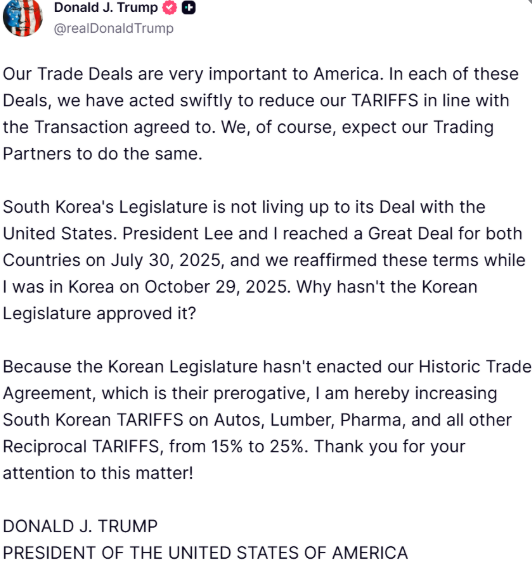
Trump stated in a social media post on Monday local time that the new rate would apply to automobiles, timber, pharmaceuticals, and ‘all other reciprocal tariffs.’ Under the current agreement, Trump has set the tariff rate for goods exported from South Korea to the U.S. at 15%.
 “South Korea’s legislative body has not honored its agreement with the United States,” Trump said in the post. “In every agreement, we have acted swiftly to reduce our tariffs in accordance with the deals reached. We certainly expect our trading partners to do the same.”
If this threat is carried out, it could have wide-ranging impacts on major South Korean companies exporting to the U.S., such as Hyundai Motor Company, which exported 1.1 million vehicles to the U.S. in 2024.
Trump’s statement marks his latest move to escalate trade tensions with allies. In recent weeks, he has threatened to impose a 100% tariff on Canadian products; simultaneously, due to his intention to control Greenland, he also threatened to impose new tariffs on goods from European countries.
Moreover, the U.S. President also stated that he would impose additional tariffs on exports from countries doing business with Iran in an effort to pressure Tehran over anti-government protests.
The U.S. government has yet to issue an official notice to implement the tariff changes threatened by Trump.
Looming over Trump’s latest round of brinkmanship on trade is an upcoming ruling by the Supreme Court on a case challenging his global tariffs. If the justices rule against Trump, it could significantly limit his ability to unilaterally and rapidly raise and lower import taxes. The court’s next scheduled hearing is set for February 20.
Trump has already taken a series of provocative actions at the start of the year, while polls show growing dissatisfaction among Americans with his leadership ahead of the November midterm elections.
Allies have widely condemned Trump’s pressure campaign regarding Greenland, while two fatal shootings involving federal immigration enforcement agents in Minnesota have prompted Trump to shift direction in his aggressive deportation efforts. The bold U.S. military raid to capture Venezuelan President Nicolás Maduro has also caused ripples on the international stage.
Editor/Lambor