Greater cross-border cooperation in offshore wind development between Germany, Denmark and Sweden could significantly increase electricity generation while reducing overall system costs, according to a new study by the Fraunhofer Institute for Wind Energy Systems (IWES).
Commissioned by the German Offshore Wind Energy Association (BWO) and the German Association of Energy and Water Industries (BDEW), the study was published on the occasion of the North Sea Summit in Hamburg.
It finds that directly connecting offshore wind farms located in the Danish and Swedish Exclusive Economic Zones (EEZs) to the German electricity grid could reduce offshore wind system costs by several billion euros compared with an expansion limited to German waters in the North and Baltic Seas. At the same time, electricity output could increase by up to 13%.
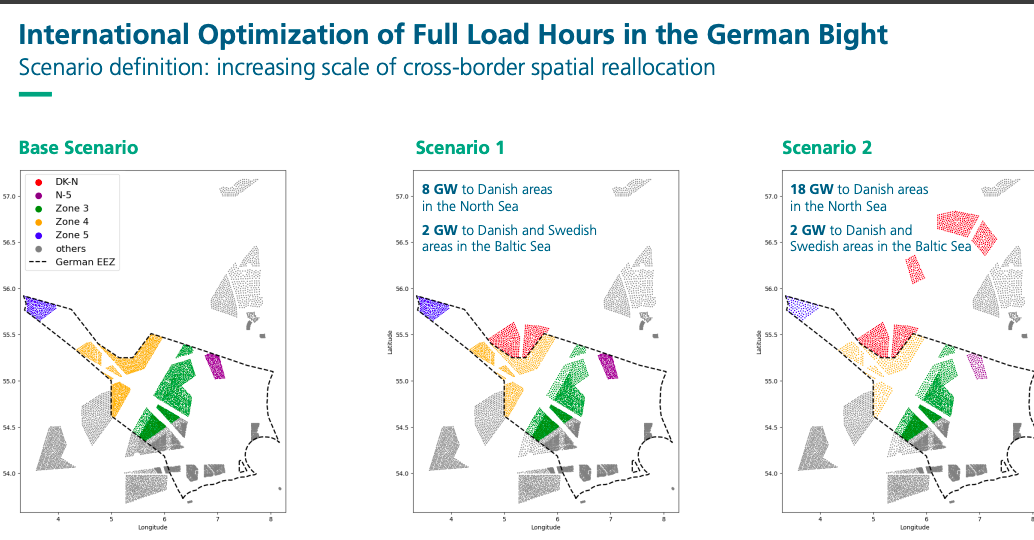
The analysis highlights that achieving Germany’s legally binding offshore wind target of 70 gigawatts (GW) by 2045 could be done more efficiently through cross-border planning, particularly via so-called “radial connections” that link offshore wind farms in neighbouring countries directly to the German grid.
Fraunhofer IWES conducted the first comprehensive assessment of the macroeconomic effects of cross-border offshore wind planning compared with a purely national expansion pathway. The study examines electricity yields, system costs – including grid connection and grid expansion – shading effects between wind farms, and impacts on security of supply.
Under the scenarios analysed, up to 20 GW of Germany’s offshore wind target would be built in Danish and Swedish waters but connected directly to Germany and counted towards the national expansion goal. This spatial diversification reduces the density of wind farms in the German Exclusive Economic Zone, particularly in the German Bight, thereby lowering wake and shading effects and increasing full-load hours across the offshore fleet.
As a result, the study estimates up to 13% higher electricity generation combined with cost reductions of up to 11% per megawatt-hour, including grid connection costs.
Offshore wind as a pillar of the energy system
“The expansion of offshore wind energy is a key pillar of energy supply in Germany and Europe,” said Hans Sohn, Head of Policy and Communications at BWO. “The study shows how the target of 70 gigawatts of offshore wind by 2045 can be achieved much more cost-effectively. Offshore wind farms in Denmark and Sweden that are directly connected to the German electricity grid increase yields, reduce system costs and make the electricity system more robust.”
The analysis also points to additional system benefits. Denmark’s offshore zones, in particular, offer highly productive wind conditions, which raise the average full-load hours of the offshore wind portfolio supplying Germany. Moreover, a broader geographical spread of generation in the North and Baltic Seas improves security of supply by reducing dependence on wind conditions in any single area.
European cooperation as a strategic lever
From the perspective of BWO, the findings underline the importance of deeper and more binding cooperation among North Sea coastal states. Cross-border planning is seen as a strategic tool to enable a more cost-efficient, grid-friendly and resilient expansion of offshore wind capacity in Europe.
BWO welcomed the fact that closer cooperation with neighbouring countries is already included in the German federal government’s coalition agreement. According to the association, bilateral agreements would be needed to allow offshore wind areas in Danish and Swedish EEZs to be used when not required domestically, while ensuring that these capacities continue to count towards Germany’s national targets.
The study, titled “International Optimization of Full Load Hours in the German Bight – Cross-Border Radials”, was conducted by Fraunhofer IWES on behalf of BWO and BDEW. A short version of the report has been published, with the full study expected in February 2026.