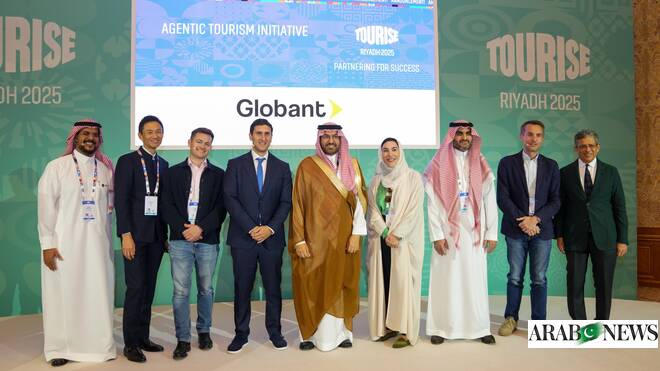
ALKHOBAR: Saudi Arabia’s tourism transformation is now testing whether agentic artificial intelligence can move from conference stages into the daily reality of millions of visitors under Vision 2030.
The question is no longer whether AI can personalize travel recommendations, but whether autonomous agents can manage disruptions, re-plan itineraries, and coordinate entire journeys at scale.
According to Federico Pienovi, CEO of APAC and MENA at Globant, the shift underway marks a break from traditional support tools. “The transformation we’re seeing in Saudi Arabia represents a fundamental shift from reactive ‘advice-giving’ systems to proactive ‘action-taking’ agents that can autonomously manage entire visitor journeys. This isn’t theoretical anymore, it’s operational reality,” he said.

Federico Pienovi, CEO of APAC and MENA at Globant. Supplied
The vision emerging from Riyadh positions agentic AI as a silent orchestration layer connecting airlines, hotels, giga-projects, and government platforms. Instead of tourists manually managing flight delays, last-minute rebookings, or crowd bottlenecks, autonomous systems would respond in real time while staff focus on hospitality rather than administration.
Pienovi described the breakthrough as “autonomous journey orchestration,” with agents acting across the entire visitor lifecycle. “The key breakthrough is autonomous journey orchestration,” he explained, with systems that “instantly re-plan entire itineraries, pre-position staff where needed, and even complete transactions on behalf of travelers.”
This concept depends on interoperability rather than isolated deployments. “The Riyadh-launched initiative brings together major players to create a unified, standards-driven orchestration. This means agents can act consistently ‘from inspiration to return,’ enabling true scale beyond isolated pilots,” Pienovi added.
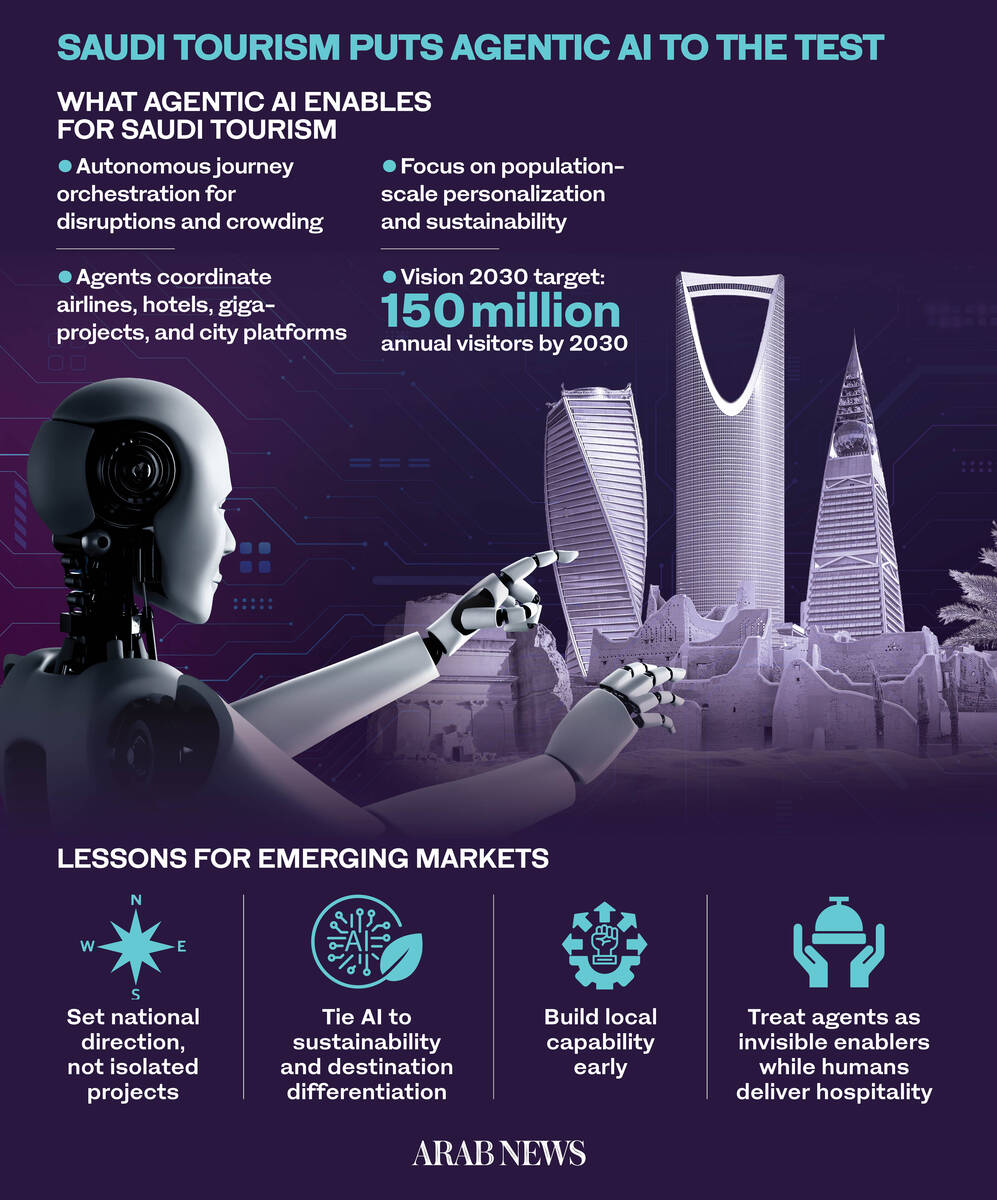
Saudi Arabia is also advancing foundational capabilities many markets lack: compute power, cloud infrastructure, sovereign systems, and aviation expansion. “Combined with Saudi’s infrastructure momentum and national AI priority status targeting 150 million visitors by 2030, we have the demand and framework for agentic systems that can personalize at population scale,” he said.
Yet achieving this vision requires more than infrastructure spending. Pienovi highlighted the strategic gap between experimentation and enterprise-level execution. “The most critical gap is the transition from fragmented pilots to interoperable, governed systems,” he noted. Research shows tourism operators must move from “scattered experiments” to transformations with “proper governance and infrastructure.”
Execution capacity remains a challenge. Saudi tourism has already surpassed interim visitor targets ahead of Vision 2030 timelines, but scaling agentic systems across thousands of operational touchpoints requires trained local expertise. According to Pienovi, “scaling AI across thousands of touchpoints requires trained local practitioners,” while data foundations remain uneven.
Data interoperability is another foundational constraint. While flagship destinations such as Red Sea Global and Diriyah are deploying digital systems, “many operators still face data fragmentation that fundamentally limits agent autonomy,” he warned.
DID YOU KNOW?
Saudi Arabia is testing AI that can re-plan entire travel itineraries and handle disruptions in real time.
Autonomous agents could manage flights, hotels, transportation, and experiences without visitor intervention.
Multi-agent AI collaboration could make travel more seamless, from booking to departure, across multiple operators.
Saudi Arabia’s giga-projects offer a testing ground for multi-agent collaboration. Pienovi invites observers to “imagine a connected world where a guest-owned AI requests a trip tailored to budget and preferences; an airline agent responds with flights and disruption protocols; a hotel agent adds rooms, perks, and sustainability options; and a destination agent coordinates ground transportation, events, and local policies.” For him, “This is not science fiction, it is what multi-agent collaboration looks like in the Agentic Tourism Era.”
The tourism sector differs from e-commerce or banking because journeys span multiple companies, platforms, and physical environments. No single operator controls the entire chain, making interoperability and protocols more essential than raw model capability.
The shift to agentic systems also introduces unfamiliar risks. “Governance and accountability top the list,” Pienovi said. “Agentic AI requires entirely new governance frameworks, cross-functional oversight, and process redesign to avoid unintended actions while keeping humans ‘on the loop.’ When AI agents are making autonomous decisions affecting visitor safety and satisfaction, accountability structures become critical.”
He pointed to well-known failure modes that frequently derail enterprise AI projects, including initiatives abandoned due to unclear performance criteria, loss of executive sponsorship, or reliance on traditional tourism metrics that no longer suffice for agentic AI adoption. There is also a structural risk that automation creates uneven value distribution, leaving some operators stranded while others capture demand. Pienovi noted that the “cost of inaction includes frustrated travelers, rising inefficiencies, and an uneven playing field where value creation is concentrated instead of shared.”

Saudi giga-projects are becoming living labs for multi-agent collaboration and digital visitor experiences. Supplied
Talent remains the determining variable. “Change management and workforce adoption can derail even the best technical implementations, highlighting the need for talent programs and enterprise training to sustain AI rollouts,” he said. “Technology is only as good as the people implementing and supervising it.” Pienovi argued that the Kingdom must develop “not just users of AI systems, but architects and supervisors who understand how to design, implement, and optimize agentic workflows,” creating leverage that surpasses the software itself.
Crucially, this is not framed as labor replacement. Agentic tourism is meant to “elevate rather than replace the people who give travel its meaning: hosts, guides, creators, and local communities.” Automation should “focus on automating friction, so human talent can focus on hospitality—those moments that matter.”
Emerging tourism markets are watching Saudi Arabia’s model closely. Pienovi emphasized that successful agentic AI requires national coordination, not just isolated destination initiatives. Saudi Arabia’s approach demonstrates how government convening power, private sector innovation, and international partnerships can combine to produce a scalable model.
For the Kingdom, the next stage will determine whether agentic systems move from white papers and exhibitions into everyday visitor journeys. If successful, agentic AI may become not just an experiment, but the operational backbone of Saudi Arabia’s tourism ambitions under Vision 2030.