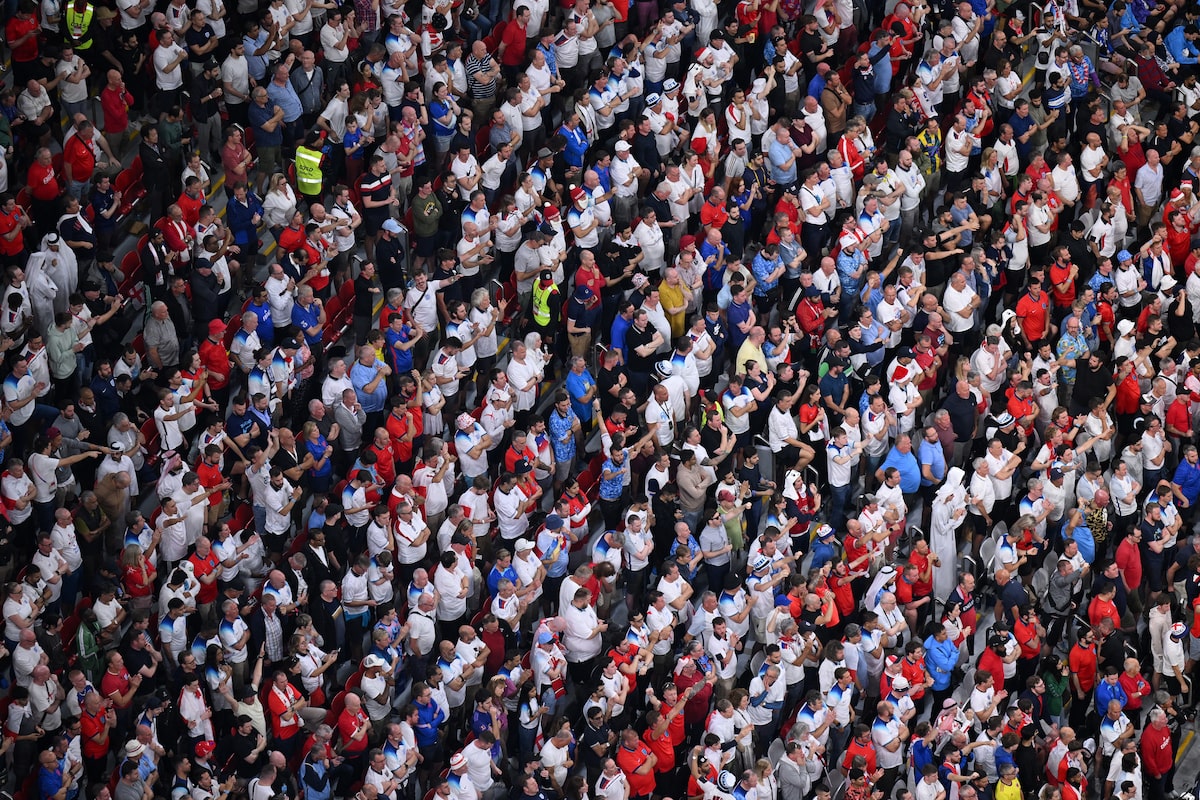
England fans show their support during the FIFA World Cup Qatar 2022 quarter final match between England and France in Al Khor, Qatar, on Dec. 10, 2022. Canada is hosting 13 World Cup matches in Toronto and Vancouver this summer.Matthias Hangst/Getty Images
Immigration, Refugees and Citizenship Canada is closely scrutinizing visa applications from soccer fans planning to attend the World Cup, to prevent people from entering the country with the aim of claiming asylum.
Officials are warning that ticketholders could be refused visas or turned away by border agents if it is feared they may not return home after the international soccer tournament ends this summer.
Canada, the United States and Mexico are co-hosting the event, organized by soccer’s international governing body, FIFA. Thirteen World Cup matches will be played in Toronto and Vancouver in June and July.
Among the national teams that will play here, in addition to Canada, are Germany, Ghana, Panama, Australia, Qatar, Egypt, Ivory Coast and Senegal.
FIFA says it has received over 500 million ticket requests for 2026 World Cup
As Canada prepares to welcome thousands of fans to the tournament, immigration officials are warning that coming here to attend matches is not an avenue to refugee status.
Countries hosting major sporting events are often faced with asylum claims, not just from fans but from participants and support staff.
Twenty-two people who came to Vancouver during the 2010 Winter Olympics made asylum claims in Canada; seven of them were members of the “Olympic family.” The claimants, according to the Immigration Department, came from nine different countries: Ghana, Hungary, Mongolia, Russia, Ukraine, Georgia, Moldova, Nepal and Japan.
Eritrea’s football federation is reported to have withdrawn its men’s team from 2026 World Cup qualifying matches owing to concerns that players would attempt to seek asylum during trips abroad. The team’s matches were cancelled a few days before they had been due to travel to face Morocco in their first fixture.
Immigration Minister Lena Metlege Diab has suspended the need for work permits for foreign nationals working on the soccer tournament. The temporary suspension of the work permit rule will apply to people invited by FIFA, including players, coaches and team physiotherapists, as well as referees and match officials. They will be able to enter Canada on visitor visas.
IRCC is advising people wanting to attend the World Cup in Canada to apply early for a visitor visa, and to beware of immigration fraud from unscrupulous agents promising entry to the country using fake documents.
Trump travel ban leaves Senegal, Ivory Coast fans in limbo for World Cup
Spokesperson Isabelle Dubois said the department will be screening applications from fans “to ensure they are genuine visitors both at the visa application stage and upon arrival in Canada.”
“Canada is committed to supporting a safe and successful FIFA World Cup while safeguarding the integrity of its immigration system,” Ms. Dubois said in an e-mail. “IRCC will closely monitor any potential asylum claims linked to FIFA events in order to further improve our planning for future international events.”
Applicants seeking to come to watch matches are being told, as are other temporary residents, that they must leave voluntarily at the end of their authorized period of stay.
“Events such as FIFA tournaments are not an avenue to seek asylum,” Ms. Dubois added in an e-mail. “Individuals who overstay their authorized period of stay in Canada become inadmissible and may face enforcement action, including the refusal of future immigration or visa applications.”
She said having World Cup tickets “doesn’t guarantee that an application will be approved.”
Some foreign nationals, including from the U.S. and Britain, do not require a visa to come here but must get an electronic travel authorization, or eTA.
“Everyone travelling to, or remaining in, Canada for an authorized period must hold the appropriate documentation, such as a valid visa, work permit or eTA. Border officers will make the final decision on entry when the visitor arrives,” Ms. Dubois said.
Vancouver plans temporary bylaw changes ahead of 2026 soccer World Cup
Toronto immigration lawyer Stephen Green said he expects immigration officers will be applying the same criteria for fans as regular tourists and visitors, including whether someone has firm ties to their home country that would be a pull for them to return.
“Just because they are coming for the World Cup, the application is no different from someone coming to visit Niagara Falls. I would hope that they would stick to the same high standards,” he said.
The number of asylum claims made in Canada dropped by one-third last year, after scrutiny of visitor visa applications increased and entry requirements for Mexicans tightened. From January to November of 2025, 33 per cent fewer people submitted an asylum claim in Canada compared with the same period the previous year.
IRCC has been applying increased scrutiny to applications from foreign nationals applying for visitor visas.
Erin Simpson, an immigration lawyer specializing in refugee claims, said there is a trend of refusing visa applicants from certain countries based on presumptions that they may not return home.
She said she had seen applicants from Iran and Cuba who have extraordinarily strong ties in their home countries, including family and farms to run, being refused visas to visit family here.
Ms. Simpson said it is a misconception to regard asylum as an abuse of the immigration system, adding that refugees make a big contribution to Canadian society.
Human Rights Watch has expressed fears about the possible targeting by Immigration and Customs Enforcement agents of fans attending World Cup matches in the U.S.
Some fans from countries subjected to a U.S. travel ban will be unable to watch their national teams play there. Haiti, Iran, Senegal and Ivory Coast, which have qualified, are among the countries targeted by President Donald Trump’s travel bans. Tourist visas to the U.S. from these countries are prohibited.