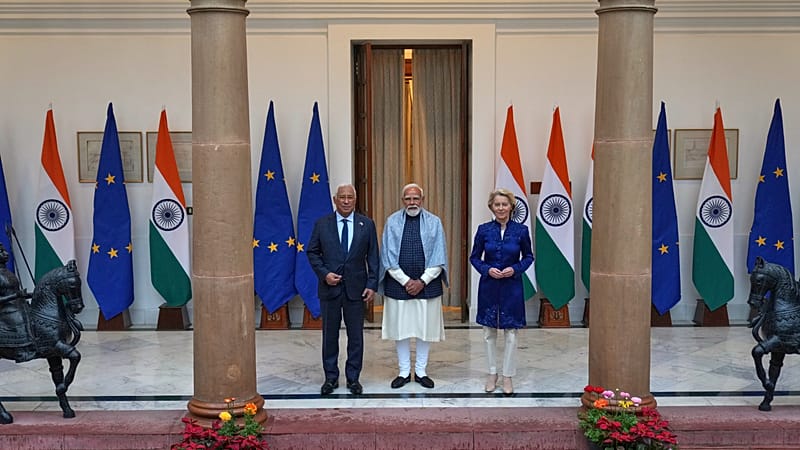
The European Union and India have sealed a landmark free trade agreement (FTA), bringing two of the world’s largest economies closer together at a time when global trade is increasingly shaped by geopolitical tensions.
Covering nearly two billion people and almost a quarter of global economic output, the deal marks the biggest bilateral trade pact either side has ever signed.
“The EU and India make history today, deepening the partnership between the world’s biggest democracies. We have created a free trade zone of 2 billion people, with both sides set to gain economically,” said European Commission President Ursula von der Leyen. She added that “rules-based cooperation still delivers great outcomes”.
At the core of the agreement is a sweeping reduction in tariffs.
India will eliminate or reduce duties on 96.6% of EU goods exports, while the EU will liberalise 99.5% of its tariff lines on goods imported from India over seven years.
For European exporters, the Commission estimates savings of up to €4bn per year in customs duties — money that can be reinvested into production, wages, or lower consumer prices.
Trade Commissioner Maroš Šefčovič said the agreement shows that “win-win trade is real”, stressing that the immediate priority is to ensure firms “reap tangible benefits as quickly as possible”.
India’s average industrial tariffs exceed 16%, among the highest of any major economy.
Their reduction is therefore particularly significant for Europe’s capital-intensive industries, which have long faced steep barriers to the Indian market.
In 2024, EU exports to India totalled roughly €75bn, driven by €48.8bn in goods and a further €26bn in services.
Machinery and electrical equipment are by far the EU’s largest export category to India, worth €16.3bn in 2024. These products currently face tariffs of up to 44%, which will be mostly eliminated under the agreement over a period of five to ten years.
Aircraft and spacecraft exports totalled €6.4bn last year. Existing duties of up to 11% will be reduced to zero, with tariff elimination phased in over periods of up to ten years.
EU chemical exports to India, valued at €3.2bn in 2024, are currently subject to tariffs of up to 22%. Most of these duties will be scrapped at the entry into force of the agreement.
Pharmaceutical exports amounted to €1.1bn and currently face tariffs of around 11%. These will be fully eliminated over staging periods of five to seven years.
One of the most striking changes concerns motor vehicles. Indian tariffs will fall from 110% to as low as 10%, albeit subject to quotas, while car parts will eventually become tariff-free. For European manufacturers, this opens access to the world’s fastest-growing large automotive market.