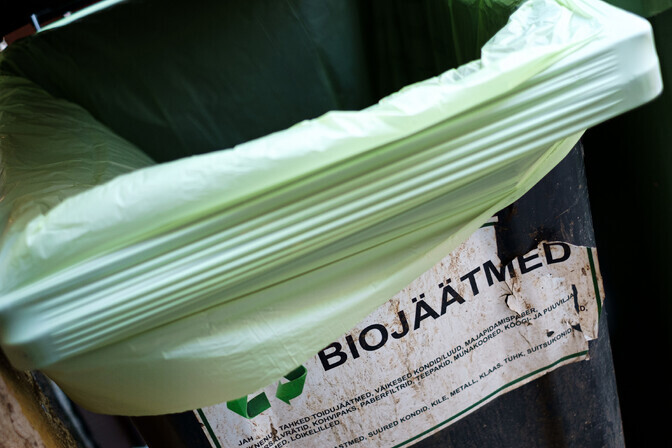
A recent law now requires municipalities to verify on-site composting before exempting properties from biowaste collection, using photos or other checks.
An ERR reader shared their surprise at a requirement from their local government mandating that individuals who wish to compost biowaste must submit a photo as proof, showing either a compost bin or compost pile, when applying for an exemption.
“What’s interesting is that no one asks for proof that hazardous or electronic waste isn’t being stored on the property,” the reader noted.
Some municipalities have been requesting photo evidence from biowaste composters for years, while others have only recently begun doing so.
For example, Tartu Municipality published new guidelines last week stating that a person may be exempted from biowaste collection if they submit an application along with a photo of the composting site.
Kristel Kibin, head of waste management at the Ministry of Climate, told ERR that municipalities do indeed need to verify whether biowaste can be composted on-site.
“Many municipalities already use an application-based approach. However, in some areas, exemptions from biowaste collection have previously been granted without confirming that composting was actually taking place. The law was clarified last year to establish a consistent nationwide standard. Municipalities already operating under this system do not need to make changes or collect new applications,” Kibin said.
To verify that composting is feasible at a particular location, each municipality may choose how to conduct the check — whether by requesting a photo, performing an on-site inspection or using another method.
“The goal is to ensure that biowaste doesn’t end up mixed with residual waste or other types of waste,” Kibin explained.
She noted that while this requirement wasn’t explicitly spelled out in the law before, many municipalities had already adopted such practices. Under previous rules, municipalities were obligated to organize separate collection of biowaste at the source unless on-site composting was possible. They were also required to establish composting requirements to be followed when composting locally.
“The obligation was added to the Waste Act in 2021 and was supposed to be fully implemented by the end of 2023. The explanatory memorandum emphasized that in order to exempt a property from using a collection container, the municipality must be convinced that composting on-site is possible,” Kibin added.
In light of the ongoing waste reform, the ministry reminded local governments that under changes to the Waste Act that came into force last year, they must standardize the rules for exempting on-site composters from using biowaste containers by September 1 at the latest.
If biowaste is composted in accordance with the requirements and an application is submitted to the local government, separate biowaste collection is not necessary.
The aim of the waste reform is to make waste sorting more efficient and to increase competition in the waste management market.
—