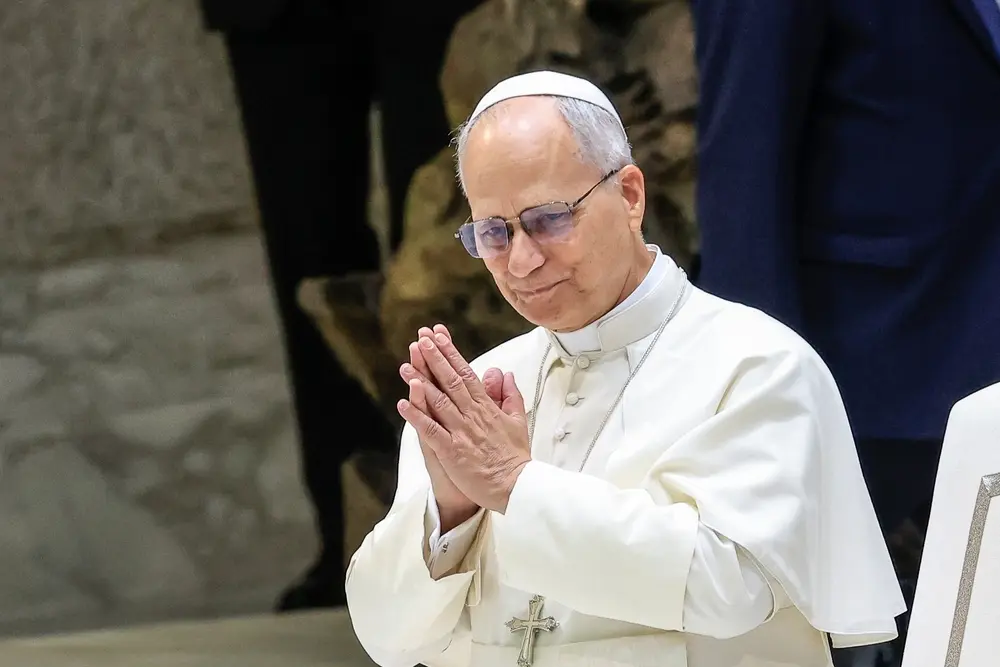
During a Jan. 26 address to the Tribunal of the Roman Rota at the opening of its judicial year, Pope Leo XIV stressed that justice and charity must always be held together in Church judicial work, warning against both cold legalism and misplaced compassion that obscures truth.
He reminded the prelates that their judicial ministry ultimately serves the salvation of souls and must be carried out with integrity, technical competence, and ethical discipline.
The Pope highlighted the judge’s role as a peacemaker who helps foster unity, justice, and trust within the Church.
He described the prelates’ work as a “lofty and demanding” mission, urging them to “guard the truth with rigour but without rigidity, and to exercise charity without omission.”
Pope Leo XIV addressed the Tribunal of Roman Rota at the Vatican Jan. 26 as the prelates began their judicial year and urged them to remember the importance of the truth of justice and the virtue of charity in their work, which he said are intrinsically united in the mystery of God.
Vatican News reported that the Tribunal of the Roman Rota “ordinarily acts as an appellate court of higher instance at the Apostolic See, with the purpose of safeguarding rights within the Church. It fosters unity of jurisprudence and, by virtue of its decisions, provides assistance to lower tribunals.”
The Pontiff cautioned the prelates against choosing exclusively justice or charity instead of both. He acknowledged that tension often arises between the two during judicial proceedings. The Pope said that charity can sometimes manifest as misunderstood compassion that obscures truth, while justice can become a “cold and detached affirmation of the truth” that leaves no room for love.
Pope Leo pointed to teachings from Church fathers throughout history who provide clear examples of a proper relationship between truth and charity, including St. John, who wrote that Christians are called to be “fellow workers in the truth.” He also referenced Pope Benedict XVI, who wrote in his encyclical Caritas in veritate that “Truth needs to be sought, found and expressed within the ‘economy’ of charity, but charity in its turn needs to be understood, confirmed and practised in the light of truth.”
Pope Leo stated, “May your work, therefore, always be motivated by that true love for neighbour that seeks above all else his eternal salvation in Christ and in the Church, which entails adherence to the truth of the Gospel.”
He also reminded the prelates that their work must be undertaken in the context of contributing to the salvation of souls and urged them to act with intellectual honesty, technical competence, and an uprightness of conscience, consistently striving for the truth together as a “direct expression of moral responsibility.” The Pontiff encouraged them to abide by a code of ethics and inspire the faithful and ecclesial community with confidence in the judicial system.
Pope Leo also urged the prelates to recall their role as peacemakers and cited Pope St. John Paull II’s Message for the 31st World Day of Peace in 1998: “Justice and peace seek the good of one and all, and for this reason they demand order and truth. When one is threatened, both falter; when justice is offended, peace is also placed in jeopardy.”
Pope Leo stated, “Viewed from this perspective, the judge becomes a peacemaker who contributes to consolidating the unity of the Church in Christ.”
“Dear friends, your mission is lofty and demanding,” he later added. “You are called to guard the truth with rigour but without rigidity, and to exercise charity without omission. In this balance, which is in reality a deep unity, one must manifest true Christian juridical wisdom.”
Pope Leo concluded by invoking Our Lady, Mirror of Justice, whom he called “the perfect model of truth in charity.”