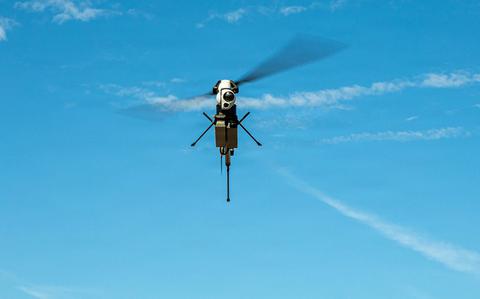
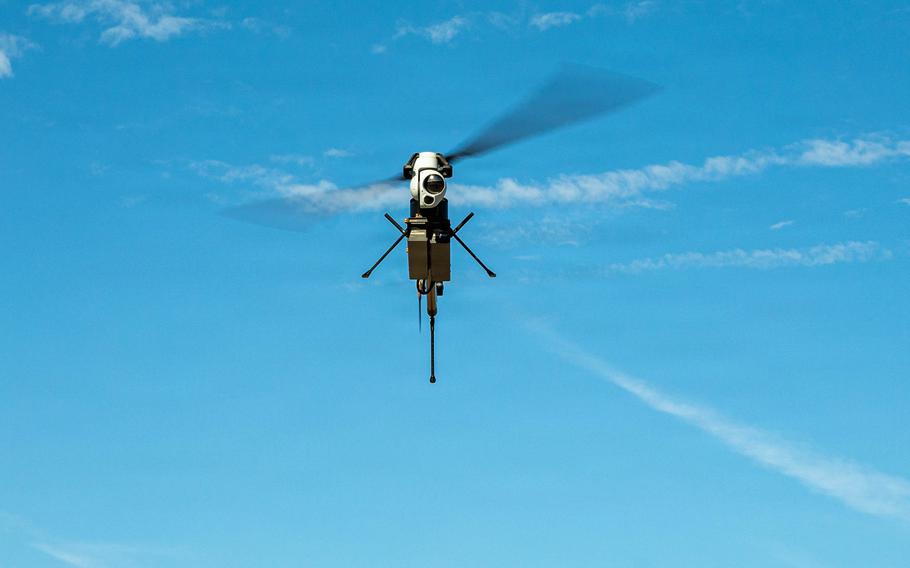
A reconnaissance drone takes flight at Fort Stewart, Ga., on Jan. 23, 2026. Defense Secretary Pete Hegseth released new guidance this week on how to counter drone threats to military installations in the U.S. (Rebeca Soria/U.S. Army)
Base commanders at American military installations stateside are being given more discretion and authority in countering drones under new Pentagon guidance.
Signed by Defense Secretary Pete Hegseth in December, the policy is meant to streamline existing policies for detecting and countering drones at installations in the U.S., a Monday statement from the Defense Department said.
Commanders are no longer limited to the fence line when it comes to determining what spaces are protected from drone activity, and they now have the authority to make threat determinations based on the totality of circumstances, the statement said.
“The guidance makes clear that unauthorized drone flights are a surveillance threat even before they breach an installation perimeter,” Brig. Gen. Matt Ross, director of the department’s Joint Interagency Task Force 401, said in the statement.
The task force was established last summer in hopes of rapidly deploying anti-drone tech to the battlefields and military bases.
Inexpensive commercial drones are increasingly used by both civilian hobbyists and foreign adversaries, and the Pentagon in the past year has taken steps to bulk up its defenses at home and abroad.
“There’s no doubt that the threats we face today from hostile drones grow by the day,” Hegseth said last year.
The revised policy says service secretaries will be able to decide which facilities or assets they want to cover based on risk assessments.
That authority can be delegated to service chiefs, according to the Pentagon. Unauthorized surveillance of these designated facilities will now be explicitly considered a threat.
The announcement about streamlined policies comes after a watchdog agency earlier this month called on the Defense Department to take immediate action to protect its assets from drones.
Under existing policies, some of the department’s guidance on countering drones was contradictory and did not address certain counter-drone capabilities and authorities, according to a report from the DOD Inspector General published last week.
The IG found several instances in which military installations and other facilities that conduct critical missions were not covered under the existing drone policies.
For example, Luke Air Force Base in Arizona, which hosts training for the majority of the world’s F-35 pilots, was not designated as a covered facility or asset, meaning base officials couldn’t use counter-drone technology to protect training on F-35s, the report said.
In addition, the Pentagon didn’t provide clear policies for the approved use of different types of counter-drone capabilities, according to the report.
As a result, service officials interpreted the guidance in different ways and left a large percentage of installations without the necessary approval to use anti-drone capabilities, the report said.
In the updated guidance, installation commanders are directed to issue their own specific operating procedures within 60 days.
The Pentagon is also upping its coordination with other agencies to shore up its counter-drone operations, the statement said.
The latest defense spending bill allows the Homeland Security and Justice departments to share drone data with defense officials.