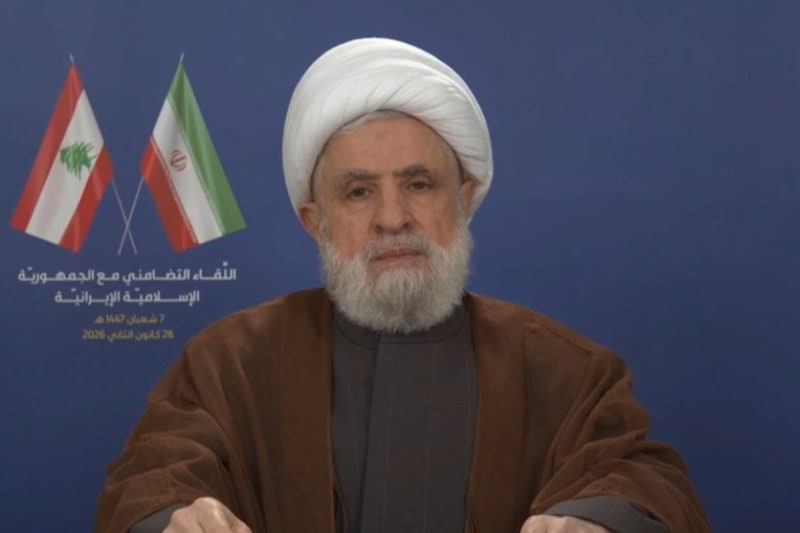
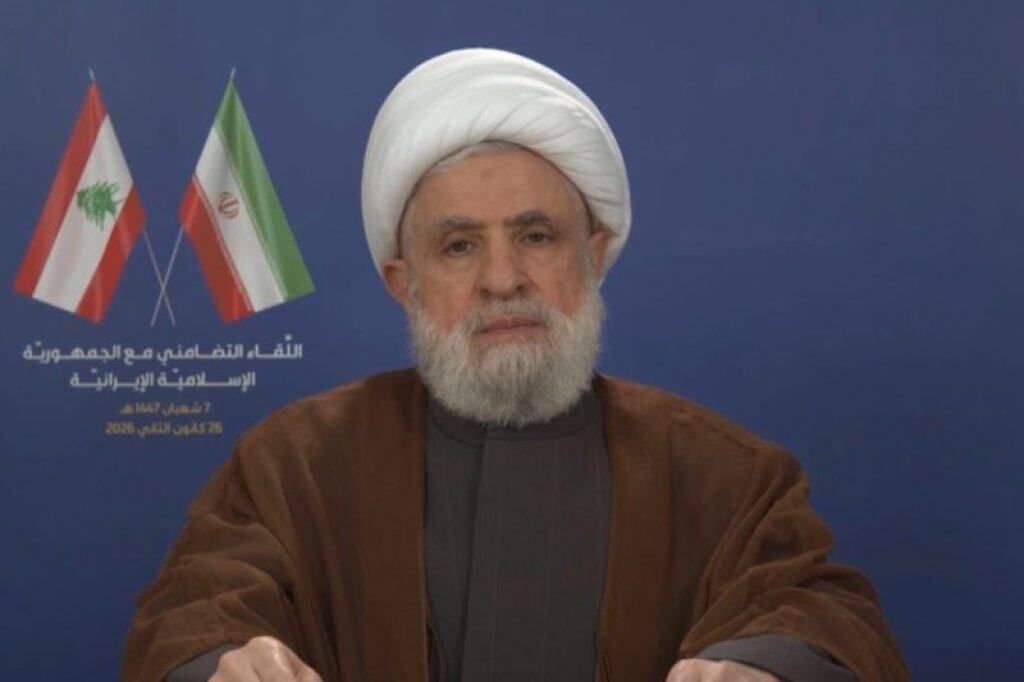
 Hezbollah Secretary-General Naim Qassem gives a speech on January 26, 2026. (Alahed News)
Hezbollah is arguably the Islamic Republic of Iran’s primary and central extension, having described itself as such in the 1985 Open Letter, the group’s founding and constitutional document. As a result of this inextricable linkage, based on the belief that Iran’s Supreme Leader is the divinely guided earthly vicar of God, any threat to the Iranian regime’s stability, let alone its existence, is, by its very nature, a threat to Hezbollah as well.
Therefore, Hezbollah has inevitably been casting a wary gaze towards the latest ongoing nationwide protests in Iran that began on December 28, 2025. Unsubstantiated claims suggested that the group may have deployed its own operatives to Iran assist in the regime’s crackdown. However, as far as verifiable information goes, Hezbollah has, thus far, sufficed with offering Tehran verbal support while keeping its forces and arsenal in reserve, perhaps until it senses the regime is under existential threat—either from the protests or the United States or Israel exploiting the nationwide unrest to inflict a mortal blow upon their intractable adversary in Tehran.
Regardless of how Hezbollah ultimately chooses to respond to any threats to the Islamic Republic’s regime, the group and its leadership have made it clear that neutrality is not an option.
Hezbollah claims the United States controls Iranian anti-regime protests
Hezbollah issued its first official statement on the protests the day after the Iranian regime organized a demonstration in Tehran by its supporters that was estimated in the “tens of thousands” on January 12. In the statement, Hezbollah offered its “salutations” to the “millions” of Iranians whom it alleged “took to the streets throughout the Islamic Republic in support of the Islamic system and stability,” claiming they were expressing the people’s “true sentiments by rallying around the Islamic Republic’s leadership” headed by Supreme Leader Ali Khamenei.
Hezbollah’s statement stressed that Iran had freely chosen its form of government during the 1979 Revolution, a decision reinforced since then through “free and fair elections.” However, because, as Hezbollah asserts, this sovereigntist regime’s very existence stymies American hegemonic and exploitative ambitions, the group alleged “the United States” was exploiting protests as part of its “determination to destroy Iran from within and is using theZionist Entity as a tool of criminality, murder, and chaos to bring down the popular Islamic regime.”
Hezbollah’s statement, implicitly designed to cast a pall of illegitimacy over calls for regime change amidst Iran’s nationwide demonstrations, claimed that the Islamic Republic “respects the right of the people to protest and demonstrate peacefully.” However, the group alleged that “footage and statements have proven that America’s and Israel’s agents are embedding themselves in the protests to transform them into chaos and destruction – including burning mosques, governmental and security institutions, and destroying public property.” These actions, Hezbollah said, “are criminal, and have nothing to do with legitimate demands for improving living conditions or the right to protest.”
“Trump and Netanyahu,” Hezbollah claimed, were exploiting the leaderless nature of the demonstrations “to speak on their behalf” while steering them internally through “a handful of agents serving those who launched the failed 12-day aggression against Iran—but were exposed and failed miserably.” However, because American and Israeli objectives run contrary to the genuine will of Iranians, Hezbollah, the statement said, would continue to “fully support the choice of the Iranian people and its leadership.” The statement concluded, “God willing, the Islamic Republic will remain stable, strong, and independent.”
Hezbollah promises to defend Iran if needed
Hezbollah’s second articulation of its position on the protests in Iran came on January 26, in Hezbollah Secretary-General Naim Qassem’s speech during the group’s official “gathering in solidarity of the Islamic Republic of Iran and the dear Iranian people against the Global Arrogance [a dysphemism for the United States].”
Qassem began his nearly half-hour speech by restating the importance and centrality of Iran’s supreme leader as God’s earthly vicar, in Hezbollah’s worldview. “He is our guardian, our leader, who legitimizes our positions in the face of challenges and regarding our religious obligations. We can neither shed our blood nor engage in our resistance without his religious authorization—because blood is a sacred trust, and he is the one who sets the general course of the whole ummah,” he said. Qassem was thus saying that Hezbollah remained bound to the ideology of Wilayat al Faqih—the notion of owing allegiance and obedience to a qualified cleric acting as an earthly ruler of a properly constituted Islamic state—as its central animating principle.
“Hezbollah believes in the leadership of the Wali al Faqihin belief and practice,” Qassem said, and all of the group’s positions on domestic or international affairs stem from it. As the secretary-general implied, Hezbollah owes this obedience not necessarily to Ali Khamenei, Iran’s current supreme leader, but to any past or future clerics who have held or will hold the office. Therefore, Qassem said, US President Donald Trump’s threat to Ali Khamenei was a direct threat to Hezbollah and the “tens of millions and more” who similarly adhere to this ideology.
“We cannot ignore this, and it is our collective responsibility and obligation—as a matter of faith, conviction, and duty—to confront this threat and take all necessary measures and preparations to do so,” Qassem said. He further reasoned that because Khamenei’s assassination would pose a threat to regional stability, Hezbollah remains “concerned regarding this threat—a direct threat to us as well, in response to which we therefore have every right to do whatever we deem appropriate to meet the challenge.”
Qassem then restated the position articulated in Hezbollah’s January 13 statement: that Iran’s 1979 Revolution and the endurance of the Islamic regime it brought to power were the purest expression of the free and independent will of the Iranian people. The rise of this government, he said, also “constituted the biggest blow to America and Israel by deposing the Shah, and the project behind the 1978 Camp David Accords.” As a result, Qassem claimed, the United States, Israel, and the West instigated the Iraq-Iran War to bring about the nascent Islamic government’s collapse. However, “Iran endured” and continued to do so “despite 47 years of sanctions, economic blockade, and pressure,” he stated. Iran was similarly able to withstand “12 days of American-Israeli aggression last year through the mutual support and solidarity of the people with the leadership, the [Islamic Revolution] Guard [Corps], and security forces” who, “under Ali Khamenei’s leadership (may God prolong his life) succeeded in remaining steadfast and patient, and thus thwarted the American-Israeli enemy’s plans,” he said.
Now, Qassem claimed, this threat had not abated but simply changed tactics, “seeking to bring Iran down from within, embedding in lawful demonstrations those who murdered, destroyed, committed arson, burned mosques, killed people in the streets, and … spread chaos.” This effort, he said, had so far resulted in “3,117 missing or wounded, 590 of whom were these terrorists, and the rest of whom are from the security forces and the people.” Actual fatality estimates of Iranian protesters vary, but the latest credible numbers place the number of dead protesters at 6,126, with many more feared killed.
The United States and Israel, Qassem claimed, were fueling the chaos in Iran “under the guise of backing the ‘people’s rights,’ even though three million people alone in Tehran” had allegedly come out “in support of their self-determination, their leadership.”
Qassem alleged that the United States was fueling this instability as part of its quest for global domination, “not just in Iran.” Weeks earlier, Hezbollah had issued several statements claiming that Washington’s intervention in Venezuela and removal of its leader, Nicolas Maduro, was in service of identical nefarious objectives. Now, he claimed, the United States was seeking to deprive Iran of its “right to peaceful nuclear energy, supporting the downtrodden, and building an independent republic.” That, he said, was why the United States and Israel were seeking to “destroy the Resistance project” in “Lebanon, Gaza, Iran, and Syria,” as part of “a single colonial project.”
Qassem then turned to the question of whether Hezbollah would intervene in an “Israeli and American war on Iran,” saying that regardless of how such a war played out, Hezbollah was also “in the crosshairs.” He continued, “Therefore, we are determined to defend ourselves and will choose how to act at the appropriate time, by intervening or not, and the specifics will be determined by the prevailing circumstances at the time. We are not neutral. But how we will act will be determined by the battle, and we will make our determinations based on what serves our interests.” The “imbalance of power” between Hezbollah and its Axis of Resistance allies vs. the United States and Israel, Qassem said, was irrelevant to Hezbollah’s calculations.
Qassem rejected the notion that Hezbollah’s intervention would insert Lebanon into a foreign conflict, stressing that American and Israeli designs to “subsume Lebanon into the Israeli entity and give away Lebanese lands to Israel” had already made Lebanon an unwilling party. Hezbollah’s beliefs, he said, required it to prefer death in dignity than life in subjugation, and the group would, therefore, continue to reject “coerced peace” with Israel and the American “expansionism witnessed in Greenland, Europe, Canada, and Venezuela in the name of American national security.”
Therefore, Qassem said, “This time, war on Iran could ignite the entire region.” He continued, “Iran has helped us for 42, 43 years, and still supports our rights to our land, while America, Israel, and their allies want to force our country [Lebanon] to abandon its sources of strength,” a reference to the calls for Hezbollah’s disarmament.” Qassem said that for Hezbollah to adopt any other stance other than intervening to support Iran would be to “facilitate” this harm to Lebanon. “Surrender will cost us everything, whereas defense will leave us the hope of many possibilities,” he said. Death, Qassem said, would not deter Hezbollah, because “souls belong to God and only He can determine when they depart our bodies. But maintaining our dignity and pride is in our hands, and we will not relinquish them, for they are a sacred trust.”
Qassem concluded his speech by again offering salutations to the “Islamic Republic of Iran.” He then turned “to the Iranian people,” describing them as “the crown jewel.” “We are with you, and you are with us. God willing, Imam Khamenei, may God Almighty protect and preserve you, we will always be with you. We ask God Almighty to grant you success in handing over the banner directly to the Imam of our time, may our souls be sacrificed for the dust beneath his feet,” Qassem said.