The United Nations Security Council faces a deepening crisis of effectiveness and legitimacy. Designed in 1945, its anachronistic structure, centred around five permanent members with veto powers, is increasingly unable to address today’s conflicts. In 2025, permanent members cast vetoes blocking action on Gaza and Ukraine. Reflecting an order that no longer exists, the Council’s permanent members represent a minority of the world’s people. Despite multiple reform initiatives, entrenched interests and the requirement for unanimous permanent member approval create formidable barriers. But as conflicts multiply and Donald Trump asserts his Board of Peace as a potential replacement, the reform case only becomes more compelling.
In early January, an emergency United Nations (UN) Security Council meeting on Venezuela exposed a familiar paralysis. Members clashed over the US government’s capture of Nicolás Maduro, with many warning it set a dangerous precedent, but no resolution came.
This wasn’t exceptional. In 2024, permanent members cast eight vetoes on seven draft resolutions, the highest number since 1986. In 2025, vetoes decreased to four – two US vetoes on Gaza and two Russian vetoes on Ukraine – but the Council’s output continued to decline: it adopted 44 resolutions, the lowest number since 1991, and only 61.4 per cent received unanimous support. Deep divisions prevented meaningful responses to devastating conflicts in Gaza, Myanmar, Sudan and Ukraine.
Designed in 1945 with the mission of maintaining international peace and security, but crucially also protecting the privileged position of the states that emerged the most powerful from the Second World War, the Security Council has become increasingly unable to respond to the world’s most pressing issues. Its anachronistic structure reflects and reproduces outdated power dynamics.
Paralysis means more suffering on the ground. When the Council is gridlocked, civilian protection fails, peace processes stall and human rights crimes go unpunished.
How it works – or doesn’t
The Security Council is the UN’s most powerful organ. It can authorise military action, impose sanctions and establish peacekeeping missions. It can refer cases to the International Court of Justice and International Criminal Court and selects the UN secretary-general. Unlike the UN General Assembly, where all 193 member states are represented and have a vote, the Council has just 15 members. Ten are elected for two-year terms, but five – China, France, Russia, the UK and the USA – are permanent and have veto powers. This gives them extraordinary control: a single veto can block any resolution, no matter the level of global support.
Since launching its full-scale invasion of Ukraine in February 2022, Russia has continually used its veto to block Security Council action, despite its war of conquest being a clear breach of the UN Charter, which prohibits the use of force against the ‘territorial integrity or political independence’ of another state.
On Gaza, the Council was only able to pass a ceasefire resolution 171 days into Israel’s assault, the USA having vetoed four earlier proposals. By the time Resolution 2728 passed in March 2024, over 10,000 people had already been killed, and Israel’s immediate response was to announce it would ignore the resolution entirely, secure in the knowledge that the US government, its principal ally, would shield it from repercussions.
Beyond these major conflicts, several unexpected crises demanded Council attention in 2025, including a coup in Guinea-Bissau, a border conflict between Cambodia and Thailand, fighting over the disputed Kashmir region between India and Pakistan and the growing tensions that culminated in the US intervention in Venezuela. While the Council held meetings and consultations on these, it took no substantive action: no resolutions, peacekeeping deployments or enforcement measures.
The Council achieved rare unity on Syria in November, when it adopted Resolution 2799 to remove the country’s transitional president and interior minister from terrorism sanctions lists. The resolution was passed 14 to one with China abstaining. But this moment of cooperation only highlighted how rare united action has become.
The reform case
Since the UN was established, the number of member states has quadrupled and the global population has grown from 2.5 to 8 billion. But former colonial powers that represent a minority of the world’s population still hold permanent seats while entire continents remain unrepresented. Africa’s 54 countries account for roughly 25 per cent of the UN’s membership but have no permanent representation. Nor do the 33 states of Latin America and the Caribbean or India, with its population of over 1.4 billion. Small island states on the frontlines of climate breakdown have little voice in Council decisions.
Calls for reform have been made for decades, but they face a formidable challenge: reform requires amendment of the UN Charter, a process that needs a favourable two-thirds General Assembly vote, ratification by two-thirds of member states and approval from all five permanent Council members.
The African Union (AU) has advanced the clearest demand through the Ezulwini Consensus, presented in 2005. Emphasising historical justice and equal power for the global south, it calls for the Council to be expanded to 26 members, with Africa holding two permanent seats with full veto rights and five non-permanent seats. The AU would determine which countries fill these positions.
The G4 – Brazil, Germany, India and Japan – has proposed expansion to 25 or 26 members with six new permanent seats: two for Africa, two for Asia and the Pacific, one for Latin America and the Caribbean and one for Western Europe. New permanent members would gain veto powers after a 10-to-15-year review period. India has been particularly vocal in demanding a greater role on a reformed Council.
Uniting for Consensus, a group led by Italy that includes Argentina, Mexico, Pakistan and South Korea, opposes the creation of new permanent seats, arguing this would simply expand an existing oligarchy. Instead, they propose longer rotating terms and greater representation for underrepresented regions.
The five permanent members show varying degrees of openness to reform. France and the UK support expansion, proposing to add two permanent seats for Africa, plus one each for Brazil, Germany, India and Japan, all with veto powers, bringing the Council to 25 members. The USA supports two permanent African seats but without veto power. China backs African seats, but virulently opposes Japan’s permanent membership, while Russia supports reform in principle but warns against making the Council ‘too broad’.
These positions reflect competition and a desire to prevent rivals gaining power. Current permanent members fear diluted influence, while states that see themselves as rising powers want the status and sway that comes with Council membership. Adding some new members would held redress an imbalance against the global south, but wouldn’t necessarily do much to make the Council more effective, accountable and committed to protecting human lives and human rights, particularly if more states get veto powers.
An initiative launched by France and Mexico in 2015 offers a more modest path, seeking to normalise the concept of voluntary veto restraint in mass atrocity situations. The proposal asks permanent members to collectively refrain from using vetoes in cases of crimes against humanity, genocide and war crimes, based on the principle that they have a responsibility to protect people from mass atrocity crimes and not just serve national interests. Moderation is possible: France and the UK haven’t used their veto since 1989.
The proposal for veto moderation complements other efforts, such as the Code of Conduct of the Accountability, Coherence and Transparency cross-regional group of states, which has been signed by 121 states, and General Assembly Resolution 76/262, which requires a debate whenever a veto is cast. The hope is to increase the costs for permanent members when they exercise their veto powers – although currently the leaders of Russia and the USA seem immune to shame.
New challenges
In June 2025, the General Assembly elected five new non-permanent Council members for 2026 to 2027: Bahrain, Colombia, the Democratic Republic of the Congo, Latvia and Liberia. They replaced Algeria, Guyana, Sierra Leone, Slovenia and South Korea, and joined Ecuador, Japan, Malta, Mozambique and Switzerland.
All five new members were elected without competition, although they still required a two-thirds General Assembly vote. Council members are expected to uphold the UN Charter’s principles by ensuring civilian protection and holding perpetrators of atrocities accountable, but non-competitive elections, with positions secured through opaque negotiations among the UN’s five regional blocs, deny civil society any opportunities for scrutiny about whether they may do so.
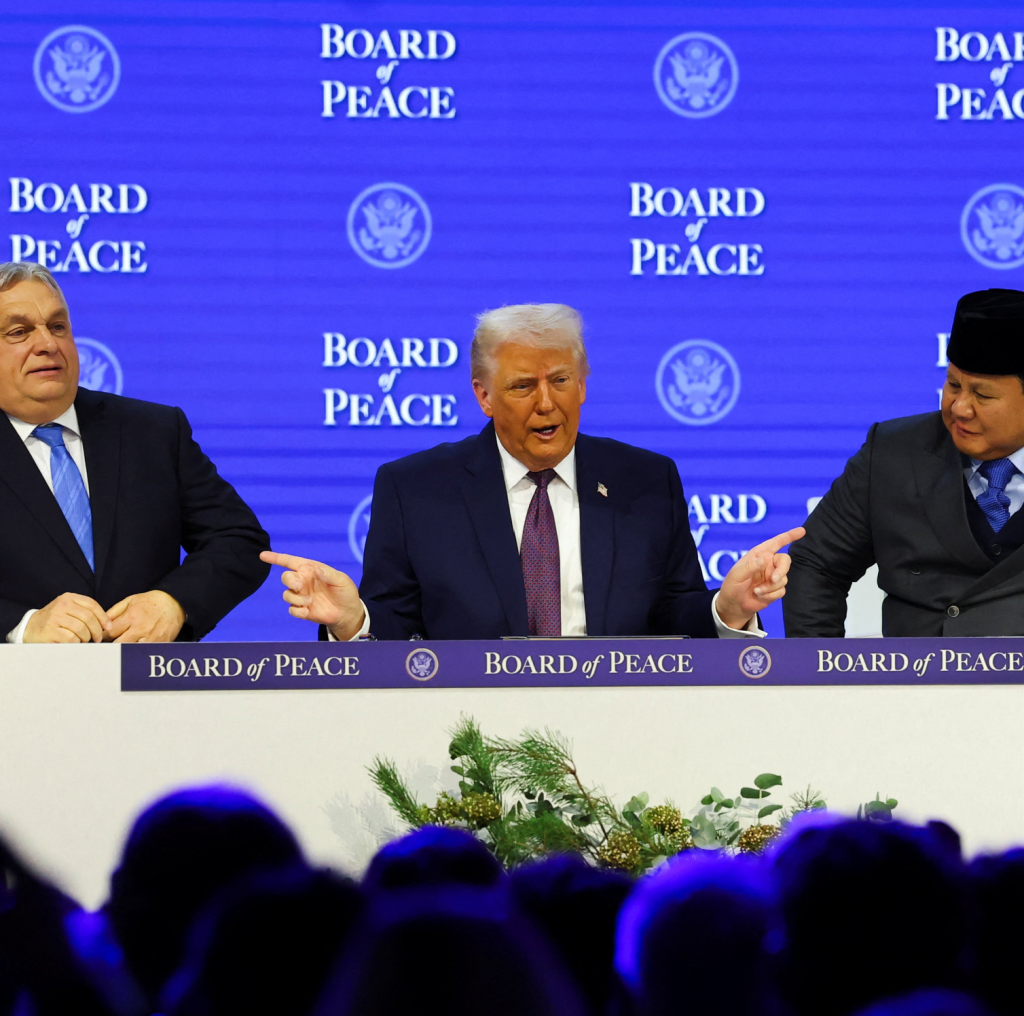
This was all business as usual, but a new challenge has recently emerged from the Trump administration. The US government is pursuing a policy of selective multilateralism, trying to reshape the global system around US and Trump’s personal interests. It’s recently announced its withdrawal from 66 international organisations and processes and offered to provide humanitarian funding only with many conditions attached. Now Trump has come up with something that could overshadow the Security Council: the Board of Peace, launched at the recent World Economic Forum in Davos, Switzerland.
This new body’s origins lie in Security Council Resolution 2803, adopted in November 2025 to create a two-year body for the external governance of Gaza. The unusually vague resolution, passed with China’s and Russia’s abstention, was widely seen as the only way of securing Trump’s buy-in, essential for any process to end the genocide. But the Board of Peace now seems to have mutated into a permanent institution that envisages a broader global role under Trump’s personal control.
Trump as chair has sweeping powers. He has the sole authority to appoint and dismiss members, veto decisions, issue resolutions and determine agendas. So far, the body’s membership is skewed towards authoritarian regimes, including Belarus, Egypt, Israel, Saudi Arabia and Vietnam, while more democratic states, including permanent Council members France and the UK, have broadly declined invitations to join. With human rights not mentioned in its draft charter, this clearly isn’t an institution that’s going to respect rights and open itself up to civil society.
Instead of legitimising the Board of Peace, efforts should be invested in Security Council reform. This must address two fundamental flaws: representation and veto power. The global south’s exclusion is indefensible. Systems gain legitimacy when they embrace the world’s diversity and actively involve less powerful states in decision-making, making reasoned decisions likelier and winning broader international support. But veto reform – whether through voluntary restraint, multiple-veto requirements or complete abolition – is just as crucial.
Accountability and transparency are also essential. There must be space for a broad range of civil society to engage with the Council, so it can exert pressure on states to prioritise the UN Charter over self-interest and hold them accountable when they don’t.
Some momentum exists. The September 2024 Pact for the Future committed world leaders to developing a consolidated Security Council reform model. Since 2008, the General Assembly has conducted formal intergovernmental negotiations on Council reform, covering membership expansion, regional representation, veto reform and working methods. These negotiations became more transparent in 2023, with sessions now recorded and posted online alongside member statements. This allows civil society to track proceedings, offer expertise and challenge states that are blocking progress.
However, these efforts continue to run up against entrenched interests, geopolitical rivalries and institutional inertia. Now on top of that has come the Trump administration’s selective and transactional approach to multilateralism. The UN faces a particularly demanding year in 2026, managing the renewal of peacekeeping operations while navigating an unprecedented liquidity crisis exacerbated by funding cuts. Adding to these pressures is the selection process for the next secretary-general, who takes office in January 2027. In such circumstances, it’s easy to defer action on difficult matters.
But the reform case is clear, as is the choice between action to make the Council more fit to serve its mission or continuing paralysis that renders it irrelevant and allows it to be supplanted by Trump’s Board of Peace. This new threat ought to concentrate minds.