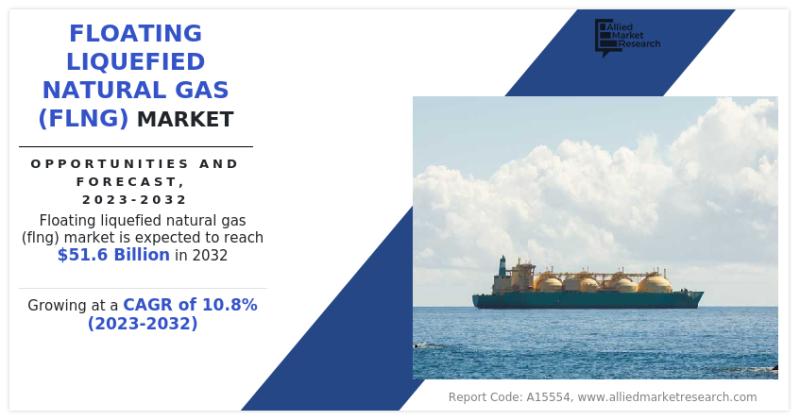
According to a new report published by Allied Market Research, the Floating Liquefied Natural Gas (FLNG) Market was valued at $19.2 billion in 2022 and is projected to reach $51.6 billion by 2032, registering a robust CAGR of 10.8% from 2023 to 2032. The market is gaining strong momentum due to rising global demand for liquefied natural gas, increased offshore gas exploration, and the need for cost-effective alternatives to onshore LNG infrastructure.
Download PDF Brochure: https://www.alliedmarketresearch.com/request-sample/A15554
Introduction to the Floating Liquefied Natural Gas (FLNG) Market
Floating liquefied natural gas refers to the process of extracting, liquefying, storing, and offloading natural gas directly from offshore gas fields using floating vessels. FLNG eliminates the need for expensive onshore liquefaction plants and long pipelines, making it a flexible and economical solution for monetizing offshore gas reserves, especially in remote or deepwater locations.
FLNG systems consist of several integrated components, including liquefaction units, storage tanks, offloading systems, and floating vessels. These vessels are either purpose-built or converted from conventional LNG carriers. Natural gas extracted from offshore wells is processed onboard, cooled to cryogenic temperatures to convert it into LNG, and stored safely in insulated tanks. The LNG is later transferred to LNG carriers through specialized offloading systems for transportation to global markets.
The Floating Liquefied Natural Gas (FLNG) Market is emerging as a critical solution for countries aiming to accelerate natural gas production while minimizing capital expenditure and development timelines.
Market Dynamics
Cost Efficiency and Deployment Flexibility Driving Growth
One of the major growth drivers of the Floating Liquefied Natural Gas (FLNG) Market is its cost-efficient and flexible deployment model. Traditional onshore LNG projects require extensive infrastructure development, including pipelines, liquefaction plants, and storage facilities. In contrast, FLNG projects significantly reduce capital costs by consolidating production, liquefaction, storage, and offloading on a single floating platform.
FLNG vessels can be redeployed to different gas fields over their operational life, enabling operators to maximize asset utilization. This mobility allows companies to monetize smaller or stranded gas reserves that were previously considered economically unviable. In addition, FLNG projects typically have shorter development timelines compared to onshore LNG plants, enabling faster access to global LNG markets.
Rising Global Demand for LNG
The increasing demand for cleaner energy sources is a key factor supporting the Floating Liquefied Natural Gas (FLNG) Market growth. LNG is widely regarded as a transition fuel due to its lower carbon emissions compared to coal and oil. Industrial, commercial, and power generation sectors are increasingly adopting LNG to meet energy needs while complying with emission reduction targets.
The ongoing energy security concerns, intensified by geopolitical tensions such as the Russia-Ukraine conflict, have pushed several countries to diversify their energy supply sources. This has resulted in higher investments in offshore gas exploration and FLNG projects, particularly in Asia-Pacific and emerging economies.
Challenges Related to Infrastructure and Financing
Despite its advantages, the Floating Liquefied Natural Gas (FLNG) Market faces several challenges. The development of FLNG projects is capital-intensive, requiring substantial investment in vessel construction, offshore pipelines, and support facilities. Securing financing for large-scale FLNG projects can be challenging, particularly in volatile economic environments.
In addition, the successful implementation of FLNG projects demands advanced engineering expertise and robust regulatory compliance. Environmental concerns, safety requirements, and complex offshore operations further add to project risks, potentially impacting market growth.
Buy This Report (266 Pages PDF with Insights, Charts, Tables, and Figures): https://www.alliedmarketresearch.com/floating-liquefied-natural-gas-market/purchase-options
Segmentation Analysis
The Floating Liquefied Natural Gas (FLNG) Market analysis is segmented based on technology, capacity, and region.
By Technology
Based on technology, the market is categorized into LNG FPSO, FSRU, and others. Among these, the FSRU (Floating Storage and Regasification Unit) segment dominated the market in 2022 and is expected to maintain its dominance during the forecast period.
FSRUs enable rapid and efficient delivery of regasified LNG and play a critical role in offshore LNG supply chains. Their lower capital costs, faster deployment, and environmentally friendly operations have significantly increased their adoption worldwide, contributing to the growth of the Floating Liquefied Natural Gas (FLNG) Market.
By Capacity
By capacity, the market is classified into small/mid-scale, large-scale, and others. The large-scale FLNG segment accounted for the highest revenue share in 2022 and is projected to grow at the fastest pace during the forecast period.
The rising demand for LNG from industrial and commercial consumers has led to bulk procurement, increased production capacity, and multiple planned expansions. These factors are driving investments in large-scale FLNG facilities, strengthening the overall Floating Liquefied Natural Gas (FLNG) Market outlook.
Regional Analysis
Region-wise, the Floating Liquefied Natural Gas (FLNG) Market is analyzed across North America, Europe, Asia-Pacific, and LAMEA.
Asia-Pacific dominated the global market in terms of revenue in 2022 and is expected to grow at the highest CAGR during the forecast period. Countries in the region are expanding offshore LNG production to reduce dependence on imported energy and enhance energy security. The impact of geopolitical conflicts has further accelerated investments in FLNG infrastructure across Asia-Pacific.
Collaborations between regional governments and international energy companies are bringing technological expertise and financial resources into the Floating Liquefied Natural Gas Industry. Joint ventures and strategic partnerships are increasingly being adopted to overcome technical and financial challenges associated with FLNG projects.
Competitive Landscape
The Floating Liquefied Natural Gas (FLNG) Market is moderately consolidated, with major players focusing on collaborations, expansions, and technological advancements. Key companies operating in the market include Eni S.p.A., Shell plc, Höegh LNG, Golar LNG Limited, EXMAR, Woodside Energy Group Ltd., Mitsui O.S.K. Lines, Excelerate Energy Inc., BASF SE, ABB Ltd., and PETRONAS.
These players are investing in advanced FLNG vessel designs, modular construction techniques, and digital monitoring solutions to enhance operational efficiency and reduce project costs.
Get a Customized Research Report: https://www.alliedmarketresearch.com/request-for-customization/A15554
Conclusion
In conclusion, the Floating Liquefied Natural Gas (FLNG) Market is set to experience strong growth through 2032, driven by increasing LNG demand, offshore gas development, and the need for cost-efficient gas monetization solutions. While infrastructure and financing challenges remain, technological advancements and strategic collaborations are expected to unlock significant growth opportunities, positioning FLNG as a cornerstone of the global LNG supply chain.
Trending Reports in Energy and Power Industry:
Floating Liquefied Natural Gas (FLNG) Market
https://www.alliedmarketresearch.com/floating-liquefied-natural-gas-market-A15554
Floating Production Storage and Offloading (FPSO) Market
https://www.alliedmarketresearch.com/floating-production-storage-and-offloading-market-A07604
LNG Carrier Market
https://www.alliedmarketresearch.com/lng-carrier-market-A09307
LNG Engine Market
https://www.alliedmarketresearch.com/lng-engine-market-A325619
Bio-LNG Market
https://www.alliedmarketresearch.com/bio-lng-market-A187448
LNG Bunkering Market
https://www.alliedmarketresearch.com/lng-bunkering-market
Planned LNG Market
https://www.alliedmarketresearch.com/planned-lng-market
Large Scale LNG Terminals Market
https://www.alliedmarketresearch.com/large-scale-lng-terminals-market
Bunker Fuel Market
https://www.alliedmarketresearch.com/bunker-fuel-market
Marine Bunker Oil Market
https://www.alliedmarketresearch.com/marine-bunker-oil-market
Singapore Bunker Fuel Market
https://www.alliedmarketresearch.com/singapore-bunker-fuel-market-A14491
UAE Liquified Petroleum Gas Market
https://www.alliedmarketresearch.com/uae-liquified-petroleum-gas-market-A323615
Compressed Natural Gas Market
https://www.alliedmarketresearch.com/compressed-natural-gas-market
Floating Storage Regasification Unit (FSRU) market
https://www.alliedmarketresearch.com/floating-storage-regasification-unit-market-A07866
David Correa
1209 Orange Street,
Corporation Trust Center,
Wilmington, New Castle,
Delaware 19801 USA.
Int’l: +1-503-894-6022
Toll Free: +1-800-792-5285
Fax: +1-800-792-5285
help@alliedmarketresearch.com
Web: www.alliedmarketresearch.com
Allied Market Research Blog:
https://blog.alliedmarketresearch.com
Allied Market Research (AMR) is a full-service market research and business-consulting wing of Allied Analytics LLP based in Portland, Oregon. Allied Market Research provides global enterprises as well as medium and small businesses with unmatched quality of “Market Research Reports” and “Business Intelligence Solutions.” AMR has a targeted view to provide business insights and consulting to assist its clients to make strategic business decisions and achieve sustainable growth in their respective market domain.
Pawan Kumar, the CEO of Allied Market Research, is leading the organization toward providing high-quality data and insights. We are in professional corporate relations with various companies and this helps us in digging out market data that helps us generate accurate research data tables and confirms utmost accuracy in our market forecasting. Each and every data presented in the reports published by us is extracted through primary interviews with top officials from leading companies of domain concerned. Our secondary data procurement methodology includes deep online and offline research and discussion with knowledgeable professionals and analysts in the industry.
This release was published on openPR.