In the wake of the US military intervention in Venezuela and the abduction of Nicolas Maduro, EU authorities along with most individual European nations scrambled to issue some sort of subdued diplomatic response, highlighting the primacy of international law while making sure not to upset Washington. Germany mused the legality of the operation was “complex” and Italy called it a “defensive intervention”, while the UN expressed its usual “deep concerns”, and the EU called for a peaceful and democratic transition.
More forceful words, however, were heard from Bratislava. “We are a small country. We cannot change anything. All we can do is watch in disbelief as American special forces kidnap the president of a sovereign Venezuela,” Fico said.
He continued: “I must categorically reject such a subversion of international laws”, also describing the US military intervention as “further evidence of the breakdown of the world order created after World War II”. Acknowledging that his stance is liable to complicate relations with Washington, he posed as a candid truth-speaker in opposition to an “incapable and hypocritical” EU, claiming his remaining silent on the US operation would have contradicted his (in truth, very mild) condemnation of Russia’s invasion of Ukraine.
Paradoxically, both Trump and Fico might have found themselves strengthened in the belief that the EU is not able to rise to the occasion and face the geopolitical challenges facing it.
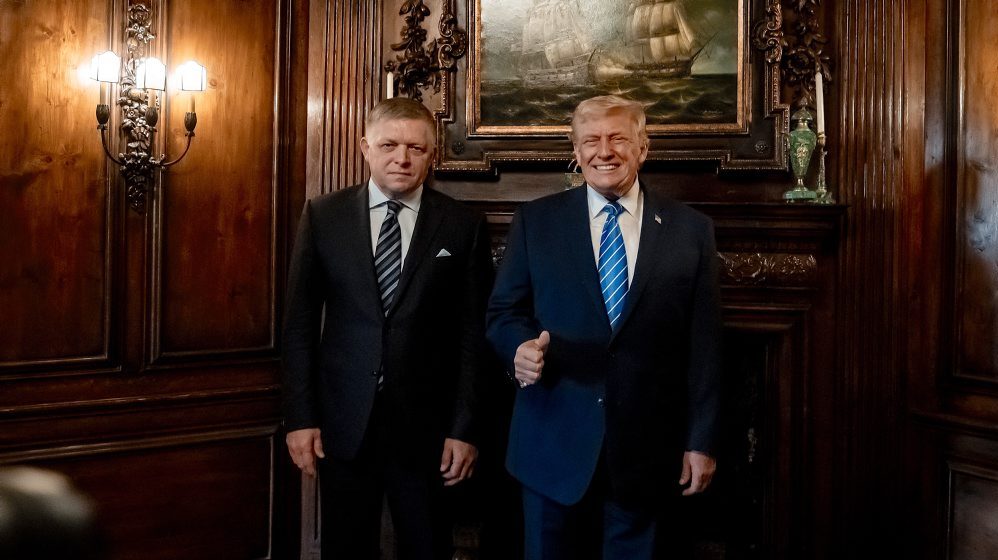
But the topic was promptly ignored during the January 17 meet. Fico’s silence in Mar-a-Lago was criticised from within the ranks of his own coalition, with the far-right Slovak National Party (SNS) urging him to make Slovakia’s position clear to their US counterparts and not tiptoe around the issue.
The opposition, too, jumped on the opportunity and accused Fico of double standards: “Prime Minister Fico likes to accuse Europe of hypocrisy. He claims the EU is unable to respond to what he calls Donald Trump’s illegal intervention in Venezuela and says it is too dependent on the United States,” the main opposition party Progressive Slovakia stated. “Now he has a unique opportunity to prove that he is different. Words are cheap.”
Slovak government officials like to argue that, as a small country historically attuned to the threats of global powers and to talks of “spheres of influence”, multilateralism and the respect for international law are their best chance of survival; all the while undermining, from the inside, one such format of multilateral union and cosying up, proudly and publicly, with global powers intent on undermining international norms of cooperation.
This article was updated at 09:40 on Wednesday, January 28 to include Politico’s report on Fico’s description of his meeting with Trump.